Thank you for visiting SNEWPapers!
Sign up free
Literary
February 4, 1933
Nogales International
Nogales, Santa Cruz County, Arizona
What is this article about?
Bruce Barton explores the development of the conception of God through biblical prophets: Moses (one God), Amos (just God), and Hosea (loving and forgiving God), as a foundation for Jesus' teachings in 'The Man Nobody Knows.'
Clipping
OCR Quality
98%
Excellent
Full Text
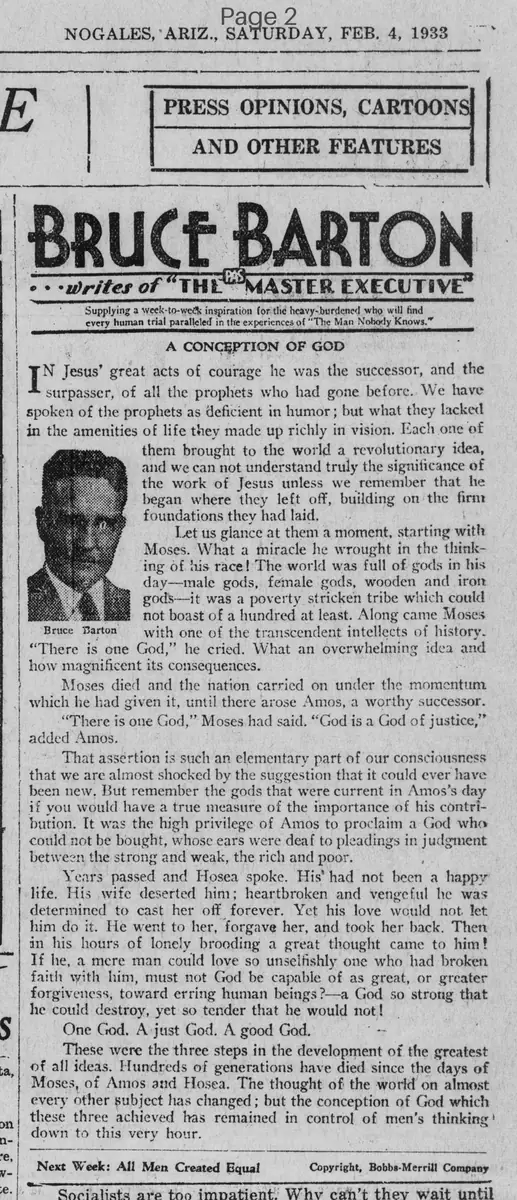
NOGALES, ARIZ., SATURDAY, FEB. 4, 1933
PRESS OPINIONS, CARTOONS AND OTHER FEATURES
BRUCE BARTON writes of "THE MASTER EXECUTIVE"
Supplying a week-to-week inspiration for the heavy-burdened who will find every human trial paralleled in the experiences of "The Man Nobody Knows.
A CONCEPTION OF GOD
IN Jesus' great acts of courage he was the successor, and the surpasser, of all the prophets who had gone before. We have spoken of the prophets as deficient in humor ; but what they lacked in the amenities of life they made up richly in vision. Each one of them brought to the world a revolutionary idea, and we can not understand truly the significance of the work of Jesus unless we remember that he began where they left off, building on the firm foundations they had laid.
Let us glance at them a moment, starting with Moses. What a miracle he wrought in the thinking of his race! The world was full of gods in his day-male gods, female gods, wooden and iron gods--it was a poverty stricken tribe which could not boast of a hundred at least. Along came Moses with one of the transcendent intellects of history.
"There is one God," he cried. What an overwhelming idea and how magnificent its consequences.
Moses died and the nation carried on under the momentum which he had given it, until there arose Amos, a worthy successor.
"There is one God," Moses had said. "God is a God of justice," added Amos.
That assertion is such an elementary part of our consciousness that we are almost shocked by the suggestion that it could ever have been new. But remember the gods that were current in Amos's day if you would have a true measure of the importance of his contribution. It was the high privilege of Amos to proclaim a God who could not be bought, whose ears were deaf to pleadings in judgment between the strong and weak, the rich and poor.
Years passed and Hosea spoke. His' had not been a happy life. His wife deserted him; heartbroken and vengeful he was determined to cast her off forever. Yet his love would not. let him do it. He went to her. forgave her. and took her back. Then in his hours of lonely brooding a great thought came to him!
If he, a mere man could love so unselfishly one who had broken faith with him, must not God be capable of as great, or greater forgiveness, toward erring human beings?--a God so strong that he could destroy, yet so tender that he would not!
One God. A just God. A good God.
These were the three steps in the development of the greatest of all ideas. Hundreds of generations have died since the days of Moses, of Amos and Hosea. The thought of the world on almost every other subject has changed; but the conception of God which these three achieved has remained in control of men's thinking down to this very hour.
Next Week: All Men Created Equal
Copyright, Bobbs-Merrill Company
PRESS OPINIONS, CARTOONS AND OTHER FEATURES
BRUCE BARTON writes of "THE MASTER EXECUTIVE"
Supplying a week-to-week inspiration for the heavy-burdened who will find every human trial paralleled in the experiences of "The Man Nobody Knows.
A CONCEPTION OF GOD
IN Jesus' great acts of courage he was the successor, and the surpasser, of all the prophets who had gone before. We have spoken of the prophets as deficient in humor ; but what they lacked in the amenities of life they made up richly in vision. Each one of them brought to the world a revolutionary idea, and we can not understand truly the significance of the work of Jesus unless we remember that he began where they left off, building on the firm foundations they had laid.
Let us glance at them a moment, starting with Moses. What a miracle he wrought in the thinking of his race! The world was full of gods in his day-male gods, female gods, wooden and iron gods--it was a poverty stricken tribe which could not boast of a hundred at least. Along came Moses with one of the transcendent intellects of history.
"There is one God," he cried. What an overwhelming idea and how magnificent its consequences.
Moses died and the nation carried on under the momentum which he had given it, until there arose Amos, a worthy successor.
"There is one God," Moses had said. "God is a God of justice," added Amos.
That assertion is such an elementary part of our consciousness that we are almost shocked by the suggestion that it could ever have been new. But remember the gods that were current in Amos's day if you would have a true measure of the importance of his contribution. It was the high privilege of Amos to proclaim a God who could not be bought, whose ears were deaf to pleadings in judgment between the strong and weak, the rich and poor.
Years passed and Hosea spoke. His' had not been a happy life. His wife deserted him; heartbroken and vengeful he was determined to cast her off forever. Yet his love would not. let him do it. He went to her. forgave her. and took her back. Then in his hours of lonely brooding a great thought came to him!
If he, a mere man could love so unselfishly one who had broken faith with him, must not God be capable of as great, or greater forgiveness, toward erring human beings?--a God so strong that he could destroy, yet so tender that he would not!
One God. A just God. A good God.
These were the three steps in the development of the greatest of all ideas. Hundreds of generations have died since the days of Moses, of Amos and Hosea. The thought of the world on almost every other subject has changed; but the conception of God which these three achieved has remained in control of men's thinking down to this very hour.
Next Week: All Men Created Equal
Copyright, Bobbs-Merrill Company
What sub-type of article is it?
Essay
What themes does it cover?
Religious
Moral Virtue
What keywords are associated?
Conception Of God
Prophets
Moses
Amos
Hosea
Forgiveness
Justice
Monotheism
What entities or persons were involved?
Bruce Barton
Literary Details
Title
A Conception Of God
Author
Bruce Barton
Subject
The Development Of The Conception Of God Through Prophets
Form / Style
Prose Reflection On Biblical Prophets
Key Lines
"There Is One God," He Cried.
"God Is A God Of Justice," Added Amos.
If He, A Mere Man Could Love So Unselfishly One Who Had Broken Faith With Him, Must Not God Be Capable Of As Great, Or Greater Forgiveness, Toward Erring Human Beings? A God So Strong That He Could Destroy, Yet So Tender That He Would Not!
One God. A Just God. A Good God.