Thank you for visiting SNEWPapers!
Sign up free
The Hillsdale Standard
Hillsdale, Hillsdale County, Michigan
What is this article about?
Hon. Edward Everett delivers a statesmanlike speech in the U.S. Senate on the 21st ult., ending debate on foreign affairs by Cass, Douglas, and others. He recounts historical events on British policy in Central America without bitterness, silencing opposition through superior information. His peroration advocates peaceful national growth via population increase over military conquest.
Clipping
OCR Quality
Full Text
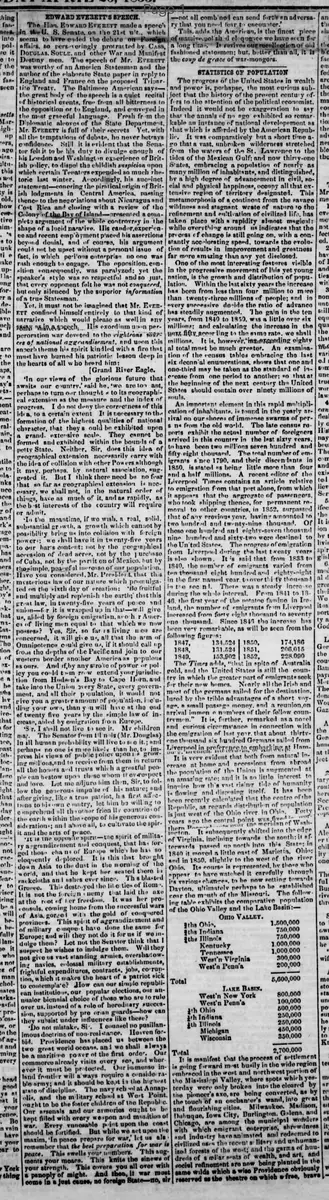
Yet, it must not be imagined that Mr. Everett confined himself entirely to that kind of narrative which would please as well in any gofny wine speech. His exordium upon peroration was devoted to the righteous sources of national aggrandisement, and upon this superb theme his spirit kindled with a fire that must have burned his patriotic lesson deep in the hearts of all who heard him:
[Grand River Eagle.
'In our views of the glorious future that awaits our country,' said he, 'we are too apt, perhaps to turn our thoughts to its geographical extension as the measure and the index of progress. I do not deny the correctness of this idea, to a certain extent It is necessary to the formation of the highest qualities of national character, that they should be exhibited upon a grand, extensive scale. They cannot be formed and exhibited within the bounds of a petty State. Neither, Sir, does this idea of geographical extension necessarily carry with the idea of collision with other Powers, although it may, perhaps, by natural association, suggested it. But I think there need be no fear that so far as geographical extension is necessary, we shall not, in the natural order of things, have as much of it, and as rapidly, as the best interests of the country will require or admit.
·In the meantime, if we wish a real, solid, substantial growth, a growth which cannot by possibility bring us into collision with foreign powers: we shall have it in twenty-five years to our heart's content: not by the geographical accession of dead acres, not by the purchase of Cuba, not by the partition of Mexico, but by the simple, peaceful increase of our population. Have you considered, Mr. President, that this mysterious law of our nature which promulgated on the sixth day of creation: 'Be fruitful and multiply and replenish the earth;' that this great law, in twenty-five years of peace and union—for it is wrapped up in that—will give us, aided by foreign emigration, as many American of living men equal to that which we now possess? Yes, Sir, so far as living men are concerned, it will give us, all that the arm of Omnipotence could give us, if it should call up from the depths of the Pacific and join to our western border another America as populous as ours. And if, by any stretch of power or policy you could tomorrow extend your jurisdiction from Hudson's Bay to Cape Horn, and take into the Union every State, every government, and all their population, it would not give you a greater amount of population, including your own, than you will have at the end of twenty five years by the simple law of increase, aided by emigration from Europe.
Sir, I shall not live to see it. My children may. The Senator from Illinois (Mr. Douglas) in all human probability will live to see it.; and perhaps no one is more likely than he, to impress his views of public policy upon his growing millions, and to receive from them in return all the honors and trusts which a grateful people can bestow upon those whom they respect and love. Let me adjure him then, Sir, to follow the generous impulse of his nature; and after giving, like a true patriot, his first affections to his own country, let him be willing to comprehend all the other friendly countries of the earth within the scope of his generous considerations; and above all, to cultivate the spirit and the arts of peace.
It is the opposite spirit—the spirit of military aggrandizement and conquest, that has forged those chains of Europe which he has so eloquently deplored. It is this that brought down Asia to the dust in the morning of the world, and that has kept her seated there in sackcloth and ashes ever since. This blasted Greece. This destroyed the liberties of Rome. It is not the foreign enemy that laid the axe at the root of her freedom. It was her proconsuls, coming home from the successful wars of Asia, gorged with the gold of conquered provinces. This spirit of aggrandizement and of military conquest have done the same for Europe; and will they not do it for us if we indulge them? Let not the Senator think that I suspect he wishes to indulge them. Will they not give us vast standing armies, overshadowing navies, colossal military establishments, frightful expenditures, contracts, jobs, corruption, which it makes the heart of a patriot sick to contemplate? How can our simple republican institutions, our popular elections, our annual or biennial choice of those who are to rule over us, instead of a rule of hereditary succession, supported by praetorian guards—how can they subsist under influences like these?
Do not mistake, Sir, I counsel no pusillanimous doctrine of non-resistance. Heaven forbid. Providence has placed us between the two great world oceans, and we shall always be a maritime power of the first order. Our commerce already visits every sea, and wherever it goes it must be protected. Our immense inland frontier will always require a considerable state of discipline. The navy school at Annapolis, the military school at West Point, ought to be the foster children of the Republic. Our arsenals and our armories ought to be kept filled with every weapon and munition of war. Every vulnerable point upon the coast should be fortified. But while we act upon the maxim, 'In peace prepare for war,' let us also remember that the best preparation for war is peace. This swells your numbers. This augments your means. This knits the sinews of your strength. This covers you all over with panoply of might. And then, if war must come in a just cause, no foreign State—no, sir not all combined can send forth an adversary that you need fear to encounter.'
This, adds the American, is the finest piece of massive, polished eloquence we have seen for a long time. It revives our recollection of old fashioned statesmen; but, better than all, it is the coup de grace of war-mongers.
What sub-type of article is it?
What themes does it cover?
What keywords are associated?
What entities or persons were involved?
Where did it happen?
Story Details
Key Persons
Location
U. S. Senate
Event Date
21st Ult.
Story Details
Edward Everett's Senate speech on foreign affairs recites historical events on British Central American policy, silencing war advocates like Douglas through lucid narrative and candor. His peroration promotes peaceful population growth over conquest, warning against military aggrandizement's dangers to republics.