Thank you for visiting SNEWPapers!
Sign up free
Editorial
November 29, 1820
The Hillsborough Recorder
Hillsboro, Orange County, North Carolina
What is this article about?
The editorial 'The Prompter' criticizes the phrase 'It will do for the present' as an excuse for avoiding necessary changes in farming practices, public infrastructure, governance, and moral conduct, urging proactive improvements to prevent future hardships.
Clipping
OCR Quality
98%
Excellent
Full Text
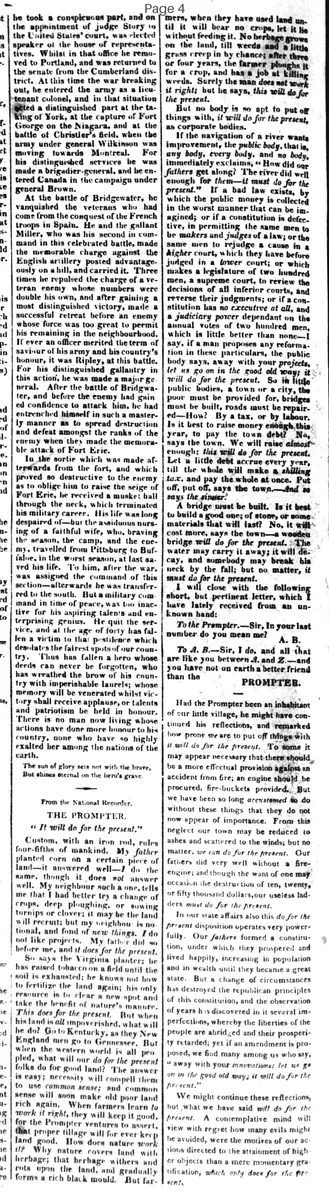
From the National Recorder.
THE PROMPTER.
"It will do for the present."
Custom, with an iron rod, rules four-fifths of mankind. My father planted corn on a certain piece of land—it answered well—I do the same, though it does not answer well. My neighbour such a one, tells me that I had better try a change of crops, deep ploughing, or sowing turnips or clover; it may be the land will recruit; but my neighbour is no—tional, and fond of new things. I do not like projects. My father did so before me, and it does for the present.
So says the Virginia planter: he has raised tobacco on a field until the soil is exhausted; he knows not how to fertilize the land again; his only resource is to clear a new spot and take the benefit of nature's manure. This does for the present. But when his land is all impoverished, what will he do? Go to Kentucky, as they New England men go to Tennessee. But when the western world is all peopled, what will our do for the present folks do for good land? The answer is easy; necessity will compel them to use common sense: and common sense will soon make old poor land rich again. When farmers learn to work it right, they will keep it good. For the Prompter ventures to assert, that proper tillage will for ever keep land good. How does nature work it? Why nature covers land with herbage; that herbage withers and rots upon the land, and gradually forms a rich black mould. But far mers, when they have used land until it will bear no crops, let it lie without feeding it. No herbage grows on the land, till weeds and a little grass creep in by chance; after three or four years, the farmer ploughs it for a crop, and has a job at killing weeds. Surely the man does not work it right; but he says, this will do for the present.
But no body is so apt to put off things with, it will do for the present, as corporate bodies. If the navigation of a river wants improvement, the public body, that is, any body, every body, and no body, immediately exclaims, "How did our fathers get along? The river did well enough for them—it must do for the present." If a bad law exists, by which the public money is collected in the worst manner that can be imagined; or if a constitution is defective, in permitting the same men to be makers and judges of a law; or the same men to rejudge a cause in a higher court, which they have before judged in a lower court; or which makes a legislature of two hundred men, a supreme court, to review the decisions of all inferior courts, and reverse their judgments; or if a constitution has no executive at all, and a judiciary power dependant on the annual votes of two hundred men, which is little better than none—say, if a man proposes any reformation in these particulars, the public body says, away with your projects, let us go on in the good old way; it will do for the present. So in little public bodies, a town or a city, the poor must be provided for, bridges must be built, roads must be repaired—How? By a tax, or by labour, Is it best to raise money enough this year, to pay the town debt? No, says the town. We will raise almost enough; this will do for the present. Let a little debt accrue every year, till the whole will make a shilling tax, and pay the whole at once. Put off, put off, says the town.—And so says the sinner.
A bridge must be built. Is it best to build a good one; of stone, or some materials that will last? No, it will cost more, says the town—a wooden bridge will do for the present. The water may carry it away; it will decay, and somebody may break his neck by the fall; but no matter, it must do for the present.
I will close with the following short, but pertinent letter, which I have lately received from, an unknown hand:
To the Prompter.—Sir, In your last number, do you mean me?
A. B.
To A. B.—Sir, I do, and all that are like you between A. and Z.—and you have not on earth a better friend than the
PROMPTER.
Had the Prompter been an inhabitant of our little village, he might have continued his reflections, and remarked how prone we are to put off things with it will do for the present. To some it may appear necessary that there should be a more effectual provision against an accident from fire; an engine should be procured, fire-buckets provided. But we have been so long accustomed to do without these things that they do not now appear of importance. From this neglect our town may be reduced to ashes and scattered to the winds; but no matter, we can do for the present. Our fathers did very well without a fire-engine; and though the want of one may occasion the destruction of ten, twenty, or fifty thousand dollars, our useless ladders must do for the present.
In our state affairs also this do for the present disposition operates very powerfully. Our fathers formed a constitution, under which they prospered and lived happily, increasing in population and in wealth until they became a great state. But a change of circumstances has destroyed the republican principles of this constitution, and the observation of years has discovered in it several imperfections, whereby the liberties of the people are abridged and their prosperity retarded; yet if an amendment is proposed, we find many among us who say, "away with your innovations: let us go on in the good old way; it will do for the present."
We might continue these reflections, but what we have said will do for the present. A contemplative mind will view with regret how many evils might be avoided, were the motives of our actions directed to the attainment of higher objects than a mere momentary gratification, which only does for the present.
THE PROMPTER.
"It will do for the present."
Custom, with an iron rod, rules four-fifths of mankind. My father planted corn on a certain piece of land—it answered well—I do the same, though it does not answer well. My neighbour such a one, tells me that I had better try a change of crops, deep ploughing, or sowing turnips or clover; it may be the land will recruit; but my neighbour is no—tional, and fond of new things. I do not like projects. My father did so before me, and it does for the present.
So says the Virginia planter: he has raised tobacco on a field until the soil is exhausted; he knows not how to fertilize the land again; his only resource is to clear a new spot and take the benefit of nature's manure. This does for the present. But when his land is all impoverished, what will he do? Go to Kentucky, as they New England men go to Tennessee. But when the western world is all peopled, what will our do for the present folks do for good land? The answer is easy; necessity will compel them to use common sense: and common sense will soon make old poor land rich again. When farmers learn to work it right, they will keep it good. For the Prompter ventures to assert, that proper tillage will for ever keep land good. How does nature work it? Why nature covers land with herbage; that herbage withers and rots upon the land, and gradually forms a rich black mould. But far mers, when they have used land until it will bear no crops, let it lie without feeding it. No herbage grows on the land, till weeds and a little grass creep in by chance; after three or four years, the farmer ploughs it for a crop, and has a job at killing weeds. Surely the man does not work it right; but he says, this will do for the present.
But no body is so apt to put off things with, it will do for the present, as corporate bodies. If the navigation of a river wants improvement, the public body, that is, any body, every body, and no body, immediately exclaims, "How did our fathers get along? The river did well enough for them—it must do for the present." If a bad law exists, by which the public money is collected in the worst manner that can be imagined; or if a constitution is defective, in permitting the same men to be makers and judges of a law; or the same men to rejudge a cause in a higher court, which they have before judged in a lower court; or which makes a legislature of two hundred men, a supreme court, to review the decisions of all inferior courts, and reverse their judgments; or if a constitution has no executive at all, and a judiciary power dependant on the annual votes of two hundred men, which is little better than none—say, if a man proposes any reformation in these particulars, the public body says, away with your projects, let us go on in the good old way; it will do for the present. So in little public bodies, a town or a city, the poor must be provided for, bridges must be built, roads must be repaired—How? By a tax, or by labour, Is it best to raise money enough this year, to pay the town debt? No, says the town. We will raise almost enough; this will do for the present. Let a little debt accrue every year, till the whole will make a shilling tax, and pay the whole at once. Put off, put off, says the town.—And so says the sinner.
A bridge must be built. Is it best to build a good one; of stone, or some materials that will last? No, it will cost more, says the town—a wooden bridge will do for the present. The water may carry it away; it will decay, and somebody may break his neck by the fall; but no matter, it must do for the present.
I will close with the following short, but pertinent letter, which I have lately received from, an unknown hand:
To the Prompter.—Sir, In your last number, do you mean me?
A. B.
To A. B.—Sir, I do, and all that are like you between A. and Z.—and you have not on earth a better friend than the
PROMPTER.
Had the Prompter been an inhabitant of our little village, he might have continued his reflections, and remarked how prone we are to put off things with it will do for the present. To some it may appear necessary that there should be a more effectual provision against an accident from fire; an engine should be procured, fire-buckets provided. But we have been so long accustomed to do without these things that they do not now appear of importance. From this neglect our town may be reduced to ashes and scattered to the winds; but no matter, we can do for the present. Our fathers did very well without a fire-engine; and though the want of one may occasion the destruction of ten, twenty, or fifty thousand dollars, our useless ladders must do for the present.
In our state affairs also this do for the present disposition operates very powerfully. Our fathers formed a constitution, under which they prospered and lived happily, increasing in population and in wealth until they became a great state. But a change of circumstances has destroyed the republican principles of this constitution, and the observation of years has discovered in it several imperfections, whereby the liberties of the people are abridged and their prosperity retarded; yet if an amendment is proposed, we find many among us who say, "away with your innovations: let us go on in the good old way; it will do for the present."
We might continue these reflections, but what we have said will do for the present. A contemplative mind will view with regret how many evils might be avoided, were the motives of our actions directed to the attainment of higher objects than a mere momentary gratification, which only does for the present.
What sub-type of article is it?
Agriculture
Constitutional
Social Reform
What keywords are associated?
Procrastination
Agricultural Reform
Constitutional Defects
Infrastructure Neglect
Social Complacency
Moral Exhortation
What entities or persons were involved?
Virginia Planter
Farmers
Public Bodies
Town
Legislature
Prompter
Editorial Details
Primary Topic
Critique Of Procrastination And Resistance To Reform Using 'It Will Do For The Present'
Stance / Tone
Critical Of Complacency, Advocating For Proactive Change And Improvement
Key Figures
Virginia Planter
Farmers
Public Bodies
Town
Legislature
Prompter
Key Arguments
Custom And Tradition Hinder Agricultural Innovation, Leading To Soil Exhaustion
Corporate Bodies Resist Improvements In Navigation, Laws, And Constitutions
Towns Delay Debt Payment And Build Inferior Infrastructure To Save Costs
Procrastination In Moral And Personal Matters Mirrors Societal Failings
Constitutional Defects Abridge Liberties But Amendments Are Rejected As Innovations
Proper Tillage And Common Sense Can Sustain Land Indefinitely