Thank you for visiting SNEWPapers!
Sign up free
Daily National Intelligencer
Washington, District Of Columbia
What is this article about?
Historical account of Peter the Great's ambitious canal projects in Russia to connect inland navigation from Persia to Petersburg via the Volga, Don, and other rivers, involving engineers like Col. Breckell and Capt. John Perry. Efforts halted by war but completed by successors, enabling vast trade routes spanning thousands of miles.
Clipping
OCR Quality
Full Text
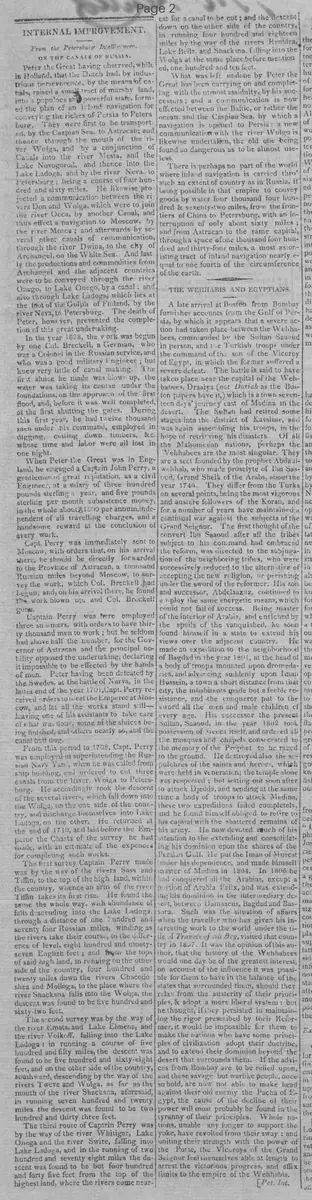
From the Petersburg Intelligencer.
ON THE CANALS OF RUSSIA.
Peter the Great having observed, while in Holland, that the Dutch had, by industrious perseverance, by the means of canals, raised a small tract of marshy land, into a populous and powerful state, formed the plan of an inland navigation for conveying the riches of Persia to Petersburg. They were first to be transported, by the Caspian Sea, to Astracan; and thence through the mouth of the river Wolga, and by a conjunction of canals into the river Mesta, and the Lake Novogorod, and thence into the Lake Ladoga, and by the river Neva, to Petersburg; being a course of four hundred and sixty miles. He likewise projected a communication between the rivers Don and Wolga, which were to join the river Occa, by another canal, and thus effect a navigation to Moscow, by the river Mosca; and afterwards by several other canals of communication, through the river Dwina, to the city of Archangel, on the White Sea. And lastly the productions and commodities from Archangel and the adjacent countries were to be conveyed through the river Onego, to Lake Onego, by a canal: and also through Lake Ladoga, which lies at the foot of the Gulph of Finland, by the river Neva, to Petersburg. The death of Peter, however, prevented the completion of this great undertaking.
In the year 1698, the work was begun by one Col. Breckell, a German, who was a Colonel in the Russian service, and who was a good military engineer; but knew very little of canal making. The first sluice he made was blown up, the water was taking its course under the foundations, on the approach of the first flood, and, before it was well completed, at the first shutting the gates. During this first year, he had twelve thousand men under his command, employed in digging, cutting down timbers, &c. whose time and labor were all lost in one night.
When Peter the Great was in England, he engaged a Captain John Perry, a gentleman of great reputation, as a civil engineer, at a salary of three hundred pounds sterling a year, and five pounds sterling per month subsistence money, in the whole about 1500 per annum, independent of all travelling charges, and a handsome reward at the conclusion of every work.
Capt. Perry was immediately sent to Moscow, with orders that, on his arrival there, he should be directly forwarded to the Province of Astracan, a thousand Russian miles beyond Moscow, to survey the work, which Col. Breckell, had begun; and, on his arrival there, he found work blown up, and Col. Breckell gone.
Captain Perry was here employed three summers, with orders to have thirty thousand men to work; but he seldom had above half the number, for the Governor of Astracan and the principal nobility opposed the undertaking, declaring it impossible to be effected by the hands of men. Peter having been defeated by the Swedes, at the battle of Narva, in the latter end of the year 1700, Capt. Perry received orders to meet the Emperor at Moscow, and let all the works stand still—leaving one of his assistants to take care of what was done, some of the sluices being finished, and others nearly so, and the canal half dug.
From this period to 1708, Capt. Perry was employed in superintending the Russian Navy Yard, when he was called from ship building, and ordered to cut three canals from the River Wolga to Petersburg. He accordingly took the descent of the several rivers, which fall down into the Wolga, on the one side of the country, and discharge themselves into Lake Ladoga, on the other. He returned at the end of 1710, and laid before the Emperor the Charts of the survey he had made, with an estimate of the expense for completing such works.
The first survey Captain Perry made was by the way of the rivers Sias and Tillin, to the top of the high land, within the country, whence an arm of the river Tillin takes its first rise. He found the same the whole way, with abundance of falls descending into the Lake Ladoga, through a distance of one hundred and seventy four Russian miles, winding as the rivers take their course, to the difference of level, eight hundred and ninety seven English feet; and from the tops of said high land, in running on the other side of the country, four hundred and twenty miles down the rivers Chakado shea and Molloga, to the place where the river Shacksna falls into the Wolga, the descent was found to be five hundred and sixty-two feet.
The second survey was by the way of the river Mesta, and Lake Mstinsk, and the river Msta, falling into the Lake Ladoga: in running a course of five hundred and fifty miles, the descent was found to be five hundred and sixty-eight feet, and on the other side of the country, southward, descending by the way of the rivers Tvertsa and Wolga, as far as the mouth of the river Shacksna, aforesaid, in running seven hundred and twenty miles the descent was found to be two hundred and thirty three feet.
The third route of Captain Perry was by the way of the river Vitegra, Lake Onega and the river Svir, falling into Lake Ladoga, and in the running of two hundred and seventy-eight miles the descent was found to be but four hundred and forty five feet from the top of the highest land, where the rivers come nearest for a canal to be cut: and the descent down on the other side of the country, in running four hundred and eighteen miles by the way of the rivers Rybinsk, Lake Bela, and Shacksna, falling into the Wolga at the same place before mentioned, one hundred and ten feet.
What was left undone by Peter the Great has been carrying on and completing with the utmost assiduity, by his successors; and a communication is now effected between the Baltic, or rather the ocean, and the Caspian Sea, by which a navigation is opened to Persia: a new communication with the river Volga is likewise undertaken, the old one being found so dangerous as to be almost useless.
There is perhaps no part of the world where inland navigation is carried thro' such an extent of country as in Russia, it being possible in that empire to convey goods by water four thousand four hundred and seventy-two miles, from the frontiers of China to Petersburg, with an interruption of only about sixty miles; and from Astracan to the same capital, through a space of one thousand four hundred and thirty-four miles, a most astonishing tract of inland navigation nearly equal to one fourth of the circumference of the earth.
What sub-type of article is it?
What keywords are associated?
What entities or persons were involved?
Where did it happen?
Foreign News Details
Primary Location
Russia
Event Date
1698 1710 (Peter The Great's Era); Completed By Successors
Key Persons
Outcome
projects partially completed under peter; fully realized by successors, opening navigation from caspian sea to baltic, enabling trade routes up to 4,472 miles from china to petersburg.
Event Details
Peter the Great planned extensive canal systems to link Persian riches via Caspian Sea, Volga, and other rivers to Petersburg, involving routes through Mesta, Ladoga, Neva, Don, Occa, Dwina, and Onego. Work began in 1698 under Col. Breckell, who failed; Capt. Perry surveyed and worked from 1700s, facing opposition and war interruptions. Three survey routes detailed with distances and descents. Successors completed the networks for vast inland navigation.