Thank you for visiting SNEWPapers!
Sign up free
Literary
January 25, 1883
Crawford Avalanche
Grayling, Crawford County, Michigan
What is this article about?
First-person narrative of McGrath's jealousy toward Jack Beecher over Miss Carrie Danvers during a Rhine holiday. To compete, McGrath swims to a picnic but forgets his clothes, leading to embarrassment, arrest in a borrowed coat, and discovering Carrie's preference for Beecher, souring his view of Germany.
Clipping
OCR Quality
98%
Excellent
Full Text
"And you mean to say you'll swim down the Rhine to the picnic?"
"Yes, Miss Carrie: every inch of the way. I'll start from the bath and send my clothes on by a cart, and meet you when you arrive in the carriage."
"Well, if you do, Mr. Beecher, you shall sit next me at the lunch as a reward. What do you think of that? But be careful and don't run any risks: the current, you know, is very strong in some places."
"What's this, Miss Carrie?" said I, joining in the conversation. "Is Beecher going to swim down to-morrow?"
"Yes, he says so; but I don't think he can manage it."
"Well, if he can, I can: and, to prove it, I'll swim with him." The fact was, I was very jealous of Beecher; and, being a good swimmer myself, I was determined not to be outdone. But, in order to explain the state of my feelings, I must go back a little.
I was staying as a guest with my uncle and aunt at C., on the Rhine. They had come for a month's holiday, and, having no children of their own, had asked me to accompany them—an invitation which I very readily accepted, more especially as they had another guest in the person of Miss Carrie Danvers, the daughter of one of their oldest friends. I had before met Miss Danvers at their house, and on that occasion she had made "her mark" on my heart; and now, in the month we were to spend in each other's society, I calculated on being able to return the compliment, and I hoped, ere I again saw England, to have obtained her consent to become, at no distant period, Mrs. McGrath—an arrangement which I felt sure would please my relations.
For the first fortnight of our stay at C. everything went on smoothly, and I congratulated myself on the progress I was making. But, unfortunately for me, while we were walking in the Kursaal Gardens one evening after dinner, we came across the Beecher family, neighbors of my uncle in England, and who, finding him at C., and being charmed with the place, determined to make a stay there also. I liked all the family except the eldest son, Jack, in the Guards. Under other circumstances, I doubtless should have liked him; but, just now, he was in the way, very much in the way. He, too, was an old acquaintance of Miss Carrie, and, at times, I felt inclined to believe something more than an acquaintance. As I have stated above, I was jealous of him—and that was the long and short of the matter.
Since he had arrived, I had not Miss Carrie to myself as formerly; Jack Beecher shared in our walks and conversations to an extent I did not approve of, but I am bound to admit his presence seemed to give the young lady considerable pleasure, and this made my pain all the more keen.
Some days previous to the evening on which I have introduced myself and friends to the reader, a picnic had been settled on at M., a charming spot on the Rhine, some four miles below C. The Beechers were all coming, and some other English folk, whose acquaintance we had made during our stay, together with two or three German officers stationed at C.
The excursion promised to be a very pleasant one, and fine weather was all that was required to make the trip delightful. It had been arranged we should drive down to M., starting at 11 o'clock, and we were now discussing the final arrangements, and settling who was to be responsible for the salt, who for the spoons, and who for the various other little necessaries and comforts, which are generally found to be missing when the picnic cloth is laid.
"Yes," continued I, turning to Jack Beecher, "I'll swim down with you to-morrow."
"Thanks," replied he. "That will be very jolly. It would be rather solitary work by one's self. We ought to start about 10.30, certainly not later; for, even with the stream in our favor, we shall not be able to go as fast as the carriages. Will that suit you?"
"Oh, yes, that will do very well indeed."
"All right; then I will make arrangements to-night for a man to take our clothes on in a cart, and I shall expect to see you at the bath at 10.30 sharp."
"Right you are, Beecher; I'll be there."
The conversation after this turned upon general topics, and in a short time our party broke up and we retired for the night to our respective hotels.
The next morning after breakfast I found Carrie in the drawing-room at the piano, and, as she was alone, I seized upon the opportunity of improving the occasion. I got her to sing, then I sang (I rather fancied my own voice in those days), and finally we tried some duets together. She was very nice and kind, and the minutes passed so rapidly that when she at length asked me whether it was not time for her to go and prepare for her drive, I was astonished to find it was just 10:30. I knew I should be late for my appointment with Beecher, and so ran as hard as I could all the way and arrived at the baths about ten minutes after time, and learnt that he had already started. I thought I could easily catch him before he reached M., so undressed quickly and plunged in at once. When I had proceeded a few yards I remembered about my clothes, and shouted back to the custodian of the baths telling him to let the man have them with those of Mr. Beecher. He made some reply which I did not catch, and away I went, doing my best to overtake my rival. It was a glorious swim and I thoroughly enjoyed it. The current was so strong that but little exertion was required. All you had to do was to keep your head above water and the river did the rest. After going some two miles I turned a corner, and could just make out Beecher a long way ahead of me. I put on a spurt, but I didn't gain on him as I expected. He was a better swimmer than I had given him credit for being, and arrived at the destination a good five minutes before me. When I did arrive I found him seated on the bank dressing.
"Why, McGrath, is that you?" he shouted. "I thought you were not coming: I waited a few minutes for you and then set off alone."
"I was rather late," I replied; "I didn't quite know how the time was going."
"Oh, well, it doesn't matter! You have arrived to the minute, for here are the carriages; so get out and dress at once."
I scrambled up the bank and dried myself.
"Where has the fellow put my clothes? I don't see them."
"I'm sure I can't say," he replied. "Who did you send them by?"
"By your man."
"No: I'm sure you didn't. He started with mine before I commenced my swim. I saw him safely on the road, for fear of any mistake."
"Then mine haven't come. Good gracious! what am I to do?"
"My dear fellow, I am awfully sorry, but I had no idea you would come when you didn't show up at the right time, or I would have made him wait."
"Confound it! this is a nuisance. I can't appear as I am: or, at best, clad only in a couple of wet towels, can I?"
"No: that you can't," said he, laughing, as I thought, in a very unfeeling way. "And, what is more, you can't stay where you are, for here are some of the ladies coming on the bank: into the water with you quick!"
There was nothing else for it, so in I went up to my neck.
"Now stay there quietly while I go and explain matters, and see what can be done for you," he shouted, as he disappeared over the bank.
My temper was none of the best, and my thoughts were none of the most pleasant as I stood soaking in the Rhine. He appeared to have been away an hour, when he at length returned, accompanied by a German officer.
"You can come out now," he shouted; "I have explained matters, and Lieut. Linden here is kind enough to say he will lend you his military overcoat; it is a good long one so you will be all right. Out you come."
Out I did come most promptly, with profuse thanks to Lieut. Linden for his most acceptable loan. He was a tall man and the garment reached nearly to my heels. I know I cut a sorry figure, and, though I received a considerable amount of sympathy from the party when I appeared among them, still it was mixed with smiles and but partially concealed laughter, which was most galling to my feelings. It was out of the question that I should remain longer in this single garment than was absolutely necessary, so I determined to at once return to C. and claim my clothes. Fortunately the man who had brought those of Danvers had not returned, and I was thus enabled to obtain a lift back, otherwise I should have had to walk as the carriages had returned at once, before my misfortune became known. The party all came down to the road to see me start, and now, as I look back upon the accident, I can forgive the laughter they then indulged in, for I certainly must have looked very curious—no hat, no boots or stockings, only a military overcoat, on a blazing hot day in July. Just as I was starting, Carrie said: "Mind you are back again in time for the dinner: you are entitled to a seat by me, remember."
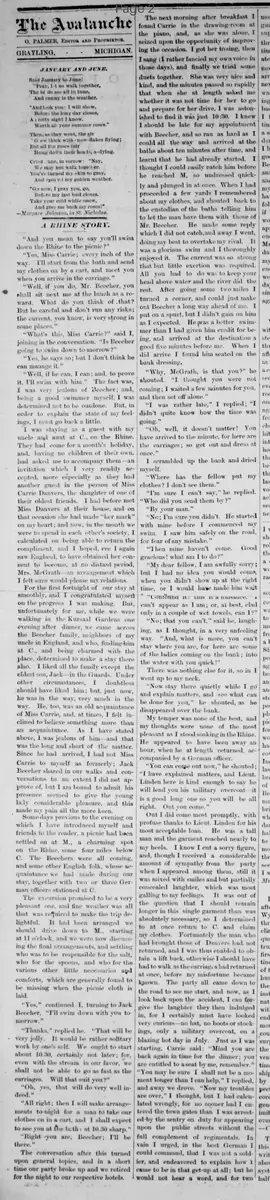
"You may be sure I shall not be a moment longer than I can help," I replied, and away we drove. "Now my troubles are over," I thought, but I had calculated wrongly, for no sooner had I entered the town gates than I was arrested—by the sentry on duty for appearing upon the public streets without the full complement of regimentals. In vain I urged, in the best German I could command, that I was not a soldier, and endeavored to explain how I came to be in that get-up at all; but he would not hear a word, and for two mortal hours I was locked up in the guard-house before I was taken to the superior officer. Here I again went through an explanation, and this time with more effect, as I was liberated, after receiving a warning to be more careful in future and make better arrangements about my clothes when next I swam down the Rhine. I didn't waste much time in getting my belongings and dressing, and was soon driving back to M. When I arrived there I found dinner had been over some time, and I had to content myself with a solitary meal, as every one had wandered off in various directions. Just as I had finished, and was regaining my good temper to some extent, Carrie and Beecher returned. They were very anxious to know the cause of my delay, and when I concluded the account of my sufferings Carrie said, "And now we have something to tell you," and then followed a piece of information which, if I had received it before my meal, would have effectually driven away my appetite, and as it was it banished at once and forever my idea of making her Mrs. McGrath. From that moment I date my dislike to Germany. To lose my clothes and be arrested was bad enough, but to lose my sweetheart was worse. I left for England the next day, and I have never seen the Rhine since, and I don't care if I never see it again.—London Graphic.
"Yes, Miss Carrie: every inch of the way. I'll start from the bath and send my clothes on by a cart, and meet you when you arrive in the carriage."
"Well, if you do, Mr. Beecher, you shall sit next me at the lunch as a reward. What do you think of that? But be careful and don't run any risks: the current, you know, is very strong in some places."
"What's this, Miss Carrie?" said I, joining in the conversation. "Is Beecher going to swim down to-morrow?"
"Yes, he says so; but I don't think he can manage it."
"Well, if he can, I can: and, to prove it, I'll swim with him." The fact was, I was very jealous of Beecher; and, being a good swimmer myself, I was determined not to be outdone. But, in order to explain the state of my feelings, I must go back a little.
I was staying as a guest with my uncle and aunt at C., on the Rhine. They had come for a month's holiday, and, having no children of their own, had asked me to accompany them—an invitation which I very readily accepted, more especially as they had another guest in the person of Miss Carrie Danvers, the daughter of one of their oldest friends. I had before met Miss Danvers at their house, and on that occasion she had made "her mark" on my heart; and now, in the month we were to spend in each other's society, I calculated on being able to return the compliment, and I hoped, ere I again saw England, to have obtained her consent to become, at no distant period, Mrs. McGrath—an arrangement which I felt sure would please my relations.
For the first fortnight of our stay at C. everything went on smoothly, and I congratulated myself on the progress I was making. But, unfortunately for me, while we were walking in the Kursaal Gardens one evening after dinner, we came across the Beecher family, neighbors of my uncle in England, and who, finding him at C., and being charmed with the place, determined to make a stay there also. I liked all the family except the eldest son, Jack, in the Guards. Under other circumstances, I doubtless should have liked him; but, just now, he was in the way, very much in the way. He, too, was an old acquaintance of Miss Carrie, and, at times, I felt inclined to believe something more than an acquaintance. As I have stated above, I was jealous of him—and that was the long and short of the matter.
Since he had arrived, I had not Miss Carrie to myself as formerly; Jack Beecher shared in our walks and conversations to an extent I did not approve of, but I am bound to admit his presence seemed to give the young lady considerable pleasure, and this made my pain all the more keen.
Some days previous to the evening on which I have introduced myself and friends to the reader, a picnic had been settled on at M., a charming spot on the Rhine, some four miles below C. The Beechers were all coming, and some other English folk, whose acquaintance we had made during our stay, together with two or three German officers stationed at C.
The excursion promised to be a very pleasant one, and fine weather was all that was required to make the trip delightful. It had been arranged we should drive down to M., starting at 11 o'clock, and we were now discussing the final arrangements, and settling who was to be responsible for the salt, who for the spoons, and who for the various other little necessaries and comforts, which are generally found to be missing when the picnic cloth is laid.
"Yes," continued I, turning to Jack Beecher, "I'll swim down with you to-morrow."
"Thanks," replied he. "That will be very jolly. It would be rather solitary work by one's self. We ought to start about 10.30, certainly not later; for, even with the stream in our favor, we shall not be able to go as fast as the carriages. Will that suit you?"
"Oh, yes, that will do very well indeed."
"All right; then I will make arrangements to-night for a man to take our clothes on in a cart, and I shall expect to see you at the bath at 10.30 sharp."
"Right you are, Beecher; I'll be there."
The conversation after this turned upon general topics, and in a short time our party broke up and we retired for the night to our respective hotels.
The next morning after breakfast I found Carrie in the drawing-room at the piano, and, as she was alone, I seized upon the opportunity of improving the occasion. I got her to sing, then I sang (I rather fancied my own voice in those days), and finally we tried some duets together. She was very nice and kind, and the minutes passed so rapidly that when she at length asked me whether it was not time for her to go and prepare for her drive, I was astonished to find it was just 10:30. I knew I should be late for my appointment with Beecher, and so ran as hard as I could all the way and arrived at the baths about ten minutes after time, and learnt that he had already started. I thought I could easily catch him before he reached M., so undressed quickly and plunged in at once. When I had proceeded a few yards I remembered about my clothes, and shouted back to the custodian of the baths telling him to let the man have them with those of Mr. Beecher. He made some reply which I did not catch, and away I went, doing my best to overtake my rival. It was a glorious swim and I thoroughly enjoyed it. The current was so strong that but little exertion was required. All you had to do was to keep your head above water and the river did the rest. After going some two miles I turned a corner, and could just make out Beecher a long way ahead of me. I put on a spurt, but I didn't gain on him as I expected. He was a better swimmer than I had given him credit for being, and arrived at the destination a good five minutes before me. When I did arrive I found him seated on the bank dressing.
"Why, McGrath, is that you?" he shouted. "I thought you were not coming: I waited a few minutes for you and then set off alone."
"I was rather late," I replied; "I didn't quite know how the time was going."
"Oh, well, it doesn't matter! You have arrived to the minute, for here are the carriages; so get out and dress at once."
I scrambled up the bank and dried myself.
"Where has the fellow put my clothes? I don't see them."
"I'm sure I can't say," he replied. "Who did you send them by?"
"By your man."
"No: I'm sure you didn't. He started with mine before I commenced my swim. I saw him safely on the road, for fear of any mistake."
"Then mine haven't come. Good gracious! what am I to do?"
"My dear fellow, I am awfully sorry, but I had no idea you would come when you didn't show up at the right time, or I would have made him wait."
"Confound it! this is a nuisance. I can't appear as I am: or, at best, clad only in a couple of wet towels, can I?"
"No: that you can't," said he, laughing, as I thought, in a very unfeeling way. "And, what is more, you can't stay where you are, for here are some of the ladies coming on the bank: into the water with you quick!"
There was nothing else for it, so in I went up to my neck.
"Now stay there quietly while I go and explain matters, and see what can be done for you," he shouted, as he disappeared over the bank.
My temper was none of the best, and my thoughts were none of the most pleasant as I stood soaking in the Rhine. He appeared to have been away an hour, when he at length returned, accompanied by a German officer.
"You can come out now," he shouted; "I have explained matters, and Lieut. Linden here is kind enough to say he will lend you his military overcoat; it is a good long one so you will be all right. Out you come."
Out I did come most promptly, with profuse thanks to Lieut. Linden for his most acceptable loan. He was a tall man and the garment reached nearly to my heels. I know I cut a sorry figure, and, though I received a considerable amount of sympathy from the party when I appeared among them, still it was mixed with smiles and but partially concealed laughter, which was most galling to my feelings. It was out of the question that I should remain longer in this single garment than was absolutely necessary, so I determined to at once return to C. and claim my clothes. Fortunately the man who had brought those of Danvers had not returned, and I was thus enabled to obtain a lift back, otherwise I should have had to walk as the carriages had returned at once, before my misfortune became known. The party all came down to the road to see me start, and now, as I look back upon the accident, I can forgive the laughter they then indulged in, for I certainly must have looked very curious—no hat, no boots or stockings, only a military overcoat, on a blazing hot day in July. Just as I was starting, Carrie said: "Mind you are back again in time for the dinner: you are entitled to a seat by me, remember."
"You may be sure I shall not be a moment longer than I can help," I replied, and away we drove. "Now my troubles are over," I thought, but I had calculated wrongly, for no sooner had I entered the town gates than I was arrested—by the sentry on duty for appearing upon the public streets without the full complement of regimentals. In vain I urged, in the best German I could command, that I was not a soldier, and endeavored to explain how I came to be in that get-up at all; but he would not hear a word, and for two mortal hours I was locked up in the guard-house before I was taken to the superior officer. Here I again went through an explanation, and this time with more effect, as I was liberated, after receiving a warning to be more careful in future and make better arrangements about my clothes when next I swam down the Rhine. I didn't waste much time in getting my belongings and dressing, and was soon driving back to M. When I arrived there I found dinner had been over some time, and I had to content myself with a solitary meal, as every one had wandered off in various directions. Just as I had finished, and was regaining my good temper to some extent, Carrie and Beecher returned. They were very anxious to know the cause of my delay, and when I concluded the account of my sufferings Carrie said, "And now we have something to tell you," and then followed a piece of information which, if I had received it before my meal, would have effectually driven away my appetite, and as it was it banished at once and forever my idea of making her Mrs. McGrath. From that moment I date my dislike to Germany. To lose my clothes and be arrested was bad enough, but to lose my sweetheart was worse. I left for England the next day, and I have never seen the Rhine since, and I don't care if I never see it again.—London Graphic.
What sub-type of article is it?
Prose Fiction
Satire
What themes does it cover?
Love Romance
Social Manners
What keywords are associated?
Rhine Picnic
Swimming Mishap
Jealousy Rivalry
Romantic Disappointment
German Arrest
English Tourists
What entities or persons were involved?
London Graphic
Literary Details
Author
London Graphic
Form / Style
Humorous First Person Short Story
Key Lines
"Well, If He Can, I Can: And, To Prove It, I'll Swim With Him."
"Confound It! This Is A Nuisance. I Can't Appear As I Am: Or, At Best, Clad Only In A Couple Of Wet Towels, Can I?"
"Mind You Are Back Again In Time For The Dinner: You Are Entitled To A Seat By Me, Remember."
From That Moment I Date My Dislike To Germany. To Lose My Clothes And Be Arrested Was Bad Enough, But To Lose My Sweetheart Was Worse.