Thank you for visiting SNEWPapers!
Sign up free
Danbury Times
Danbury, Fairfield County, Connecticut
What is this article about?
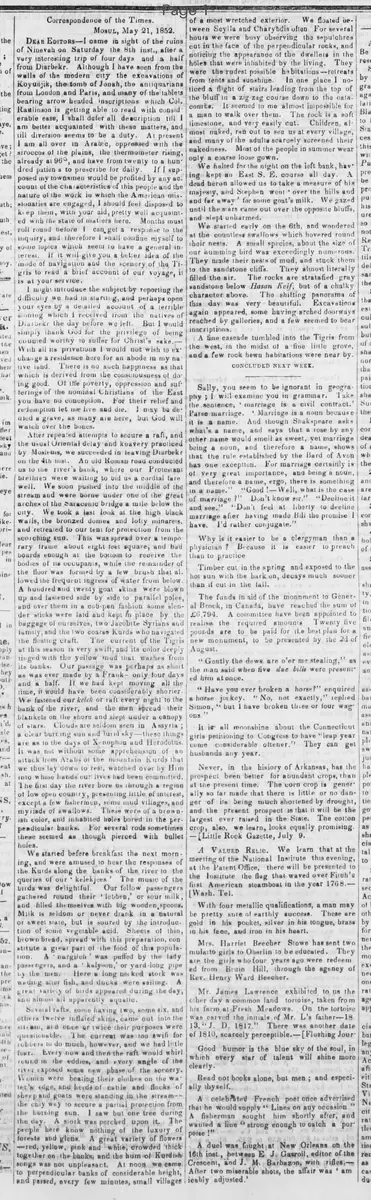
In a letter from Mosul dated May 21, 1852, an American missionary describes his four-and-a-half-day raft voyage down the Tigris River from Diarbekr to the ruins of Ninevah, noting scenery, wildlife, local inhabitants, and his commitment to aiding oppressed Christians despite hardships.
Merged-components note: Continuation of the correspondence story from Mosul across pages, with sequential reading order and direct text flow.
Clipping
OCR Quality
Full Text
MOSUL, May 21, 1852
Dear Editors--I came in sight of the ruins
of Ninevah on Saturday the 8th inst., after a
very interesting trip of four days and a half
from Diarbekr. Although I have seen from the
walls of the modern city the excavations of
Koyunjik, the tomb of Jonah, the antiquarians
from London and Paris, and many of the tablets
bearing arrow headed inscriptions which Col.
Rawlinson is getting able to read with considerable
ease, I shall defer all description till I
am better acquainted with these matters, and
till diversion seems to be a duty. At present
I am all over in Arabic, oppressed with the
siroccos of the plains, the thermometer rising,
already at 96, and have from twenty to a hundred patients to prescribe for daily. If I supposed
my townsmen would be profited by any account of the characteristics of this people and the
nature of the work to which the American missionaries are engaged, I should feel disposed to
keep them, with your aid, pretty well acquainted
with the state of matters here. Months must
roll round before I can get a response to the
inquiry, and therefore I shall confine myself to
some topics which seem to have a general interest. If it will give you a better idea of the
mode of navigation and the scenery of the Tigris to read a brief account of our voyage, it
is at your service.
I might introduce the subject by reporting the
difficulty we had in starting, and perhaps open
your eyes by a detailed account of a terrible
stoning which I received from the natives of
Diarbekr the day before we left. But I would
simply thank God for the privilege of being
counted worthy to suffer for Christ's sake.--
With all its privations I would not wish to exchange a residence here for an abode in my native land. There is no such happiness as that
which is derived from the consciousness of doing good. Of the poverty, oppression and sufferings of the nominal Christians of the East
you have no conception. For their relief and
redemption let me live and die. I may be denied a grave, as many are here, but God will
watch over the bones.
After repeated attempts to secure a raft, and
the usual Oriental delay and knavery practiced
by Moslems, we succeeded in leaving Diarbekr
on the 4th inst. An old Roman road conducted
us to the river's bank, where our Protestant
brethren were waiting to bid us a cordial farewell. We soon pushed into the middle of the
stream and were borne under one of the great
arches of the Saracenic bridge a mile below the
city. We took a last look at the high black
walls, the bronzed domes and lofty minarets,
and retreated to our tent for protection from the
scorching sun. This was spread over a temporary frame about eight feet square, and had
boards enough at the bottom to receive the
bodies of its occupants, while the remainder of
the floor was formed by a few brush that allowed the frequent ingress of water from below.
A hundred and twenty goat skins were blown
up and fastened side by side to parallel poles,
and over them in a cob-pen fashion some slender sticks were laid and kept in place by the
baggage of ourselves, two Jacobite Syrians and
family, and the two coarse Kurds who navigated
the floating craft. The current of the Tigris
at this season is very swift, and its color deeply
tinged with the yellow mud that washes from
its banks. Our passage was perhaps as short
as was ever made by a Frank-- only four days
and a half. If we had kept moving all the
time, it would have been considerably shorter.
We fastened our kelick or raft every night to the
bank of the river, and the men spread their
blankets on the shore and slept under a canopy
of stars. Clouds are seldom seen in Assyria;
a clear burning sun and fund sky--these things
are as in the days of Xenophon and Herodotus.
It was not without some apprehension of an
attack from Arabs or the mountain Kurds that
we thus lay down to rest, watched over by Him
into whose hands our lives had been committed.
The first day the river bore us through a region
of low open country, presenting little of interest,
except a few fishermen, some mud villages, and
myriads of swallows. These were of a brownish
color, and inhabited holes bored in the perpendicular banks. For several rods sometimes
these seemed as though pierced with bullet
holes.
We started before breakfast the next morning, and were amused to hear the responses of
the Kurds along the banks of the river to the
queries of our kelekjees' The music of the
birds was delightful. Our fellow passengers
gathered round their 'lebben,' or sour milk,
and filled themselves with big wooden spoons.
Milk is seldom or never drank in a natural
or sweet state, but is soured by the introduction of some vegetable acid. Sheets of thin
brown bread, spread with this preparation, constitute a great part of the food of this population. A 'nargileh' was puffed by the lady
passengers, and a 'kalyoon,' or yard-long pipe
by the men. Here a long necked stork was
wading after fish, and ducks were sailing. A
great variety of birds appeared during the day,
and almost all apparently aquatic.
Several rafts, some having two, some six, and
others twelve inflated skins, came out into the
stream, and once or twice their purposes were
questionable. The current was too swift for
robbers to do much, however, and we had little
fear. Every now and then the raft would whirl
round in the eddies, and every angle of the
river exposed some new phase of the scenery.
Women were beating their clothes on the water's edge, and herds of cattle and flocks of
sheep and goats were standing in the stream--
the only way to secure a partial protection from
the burning sun. I saw but one tree during
the day. A stork was perched upon it. The
people here know nothing of the luxury of
forests and glens." A great variety of flowers
-red, yellow, pink and white, crowded thick
together on the banks, and the hum of Kurdish
songs was not unpleasant. At noon we came
to perpendicular banks of considerable height,
and passed, every few minutes, small villages
of a most wretched exterior. We floated between Seylla and Charybdis often For several
hours we were busy observing the sepulchres
cut in the face of the perpendicular rocks, and
noticing the appearance of the dwellers in the
holes that were inhabited by the living. They
were the rudest possible habitations--retreats
from tents and sunshine. In one place I noticed a flight of stairs leading from the top of
the bluff in a zig-zag course down to the catacombs. It seemed to me almost impossible for
a man to walk over them. The rock is a soft
limestone, and very easily cut. Children, almost naked, ran out to see us at every village,
and many of the adults scarcely screened their
nakedness. Most of the people in summer wear
only a coarse loose gown.
We halted for the night on the left bank, having kept an East S. E. course all day. A
death heron allowed us to take a measure of his
majesty, and Stephen went 'over the hills and
far away' for some goat's milk. We gazed
until the stars came out over the opposite bluffs,
and slept unharmed.
We started early on the 6th, and wondered
at the countless swallows which hovered round
their nests. A small species, about the size of
our humming bird was exceedingly numerous.
They made their nests of mud, and stuck them
to the sandstone cliffs. They almost literally
filled the air. The rocks are stratified gray
sandstone below Hasan Keif, but of a chalky
character above. The shifting panorama of
this day was very beautiful. Excavations
again appeared, some having arched doorways
reached by galleries, and a few seemed to bear
inscriptions.
A fine cascade tumbled into the Tigris from
the west, in the midst of a fine little grove,
and a few rock hewn habitations were near by.
CONCLUDED NEXT WEEK.
What sub-type of article is it?
What themes does it cover?
What keywords are associated?
What entities or persons were involved?
Where did it happen?
Story Details
Key Persons
Location
Tigris River From Diarbekr To Ninevah, Assyria
Event Date
May 4 8, 1852
Story Details
An American missionary travels down the Tigris on a goat-skin raft, describing the swift current, local scenery including villages, birds, rock dwellings, and flowers, while expressing joy in his mission work despite dangers and hardships.