Thank you for visiting SNEWPapers!
Sign up free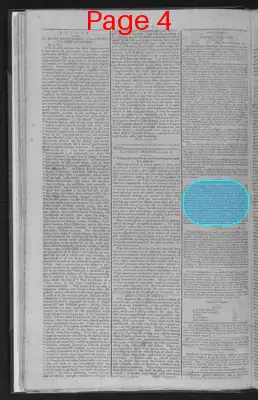
Domestic News
May 23, 1789
Gazette Of The United States
New York, New York County, New York
What is this article about?
A Boston newspaper correspondent praises the U.S. President's character upon his elevation to office, noting his refusal of pecuniary emoluments, mild language, implied support for constitutional improvements, republican address to Congress, and democratic simplicity, likening him to Fabius of Rome.
Clipping
OCR Quality
98%
Excellent
Full Text
ONE SPIRIT ANIMATES THE WHOLE
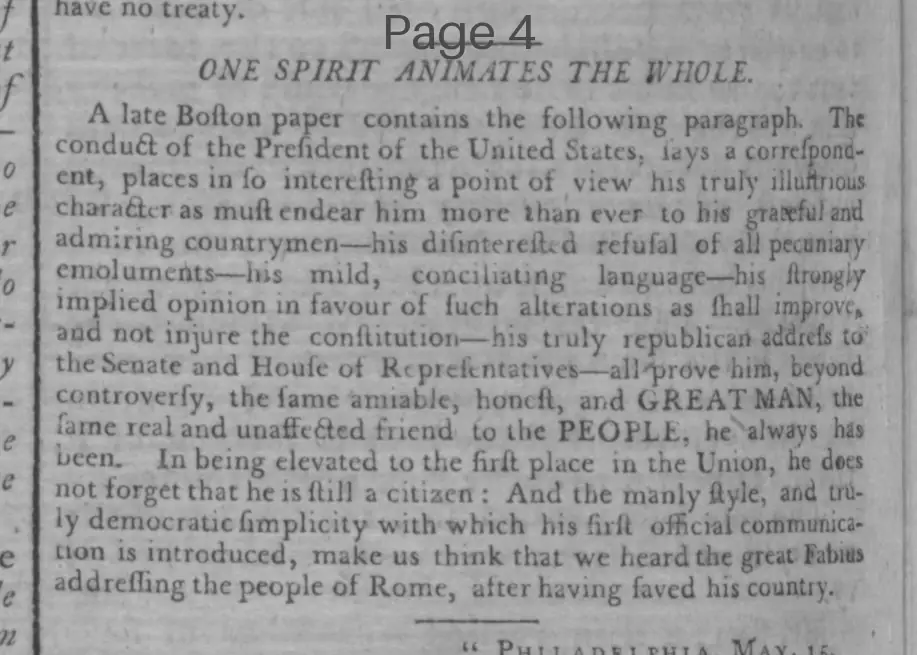
A late Boston paper contains the following paragraph. The conduct of the President of the United States, says a correspondent, places in so interesting a point of view his truly illustrious character as must endear him more than ever to his grateful and admiring countrymen—his disinterested refusal of all pecuniary emoluments—his mild, conciliating language—his strongly implied opinion in favour of such alterations as shall improve, and not injure the constitution—his truly republican address to the Senate and House of Representatives—all prove him, beyond controversy, the same amiable, honest, and GREAT MAN, the same real and unaffected friend to the PEOPLE, he always has been. In being elevated to the first place in the Union, he does not forget that he is still a citizen: And the manly style, and truly democratic simplicity with which his first official communication is introduced, make us think that we heard the great Fabius addressing the people of Rome, after having saved his country.
A late Boston paper contains the following paragraph. The conduct of the President of the United States, says a correspondent, places in so interesting a point of view his truly illustrious character as must endear him more than ever to his grateful and admiring countrymen—his disinterested refusal of all pecuniary emoluments—his mild, conciliating language—his strongly implied opinion in favour of such alterations as shall improve, and not injure the constitution—his truly republican address to the Senate and House of Representatives—all prove him, beyond controversy, the same amiable, honest, and GREAT MAN, the same real and unaffected friend to the PEOPLE, he always has been. In being elevated to the first place in the Union, he does not forget that he is still a citizen: And the manly style, and truly democratic simplicity with which his first official communication is introduced, make us think that we heard the great Fabius addressing the people of Rome, after having saved his country.
What sub-type of article is it?
Politics
What keywords are associated?
President Praise
Constitutional Improvements
Republican Address
Boston Paper
Fabius Comparison
What entities or persons were involved?
President Of The United States
Where did it happen?
Boston
Domestic News Details
Primary Location
Boston
Key Persons
President Of The United States
Event Details
A correspondent praises the President's conduct, including refusal of salary, conciliating language, opinion on constitutional alterations, republican address to Congress, and democratic simplicity in his first official communication, comparing him to Fabius.