Thank you for visiting SNEWPapers!
Sign up free
The Morning Star
Providence, Providence County, Rhode Island
What is this article about?
Report on the Austrian Day concert at Boston's World's Peace Jubilee on June 21, featuring performances by Madame Peschka-Leutner, Johann Strauss, the Grenadier Guards Band, and others, attended by 15-16 thousand people with great success.
Clipping
OCR Quality
Full Text
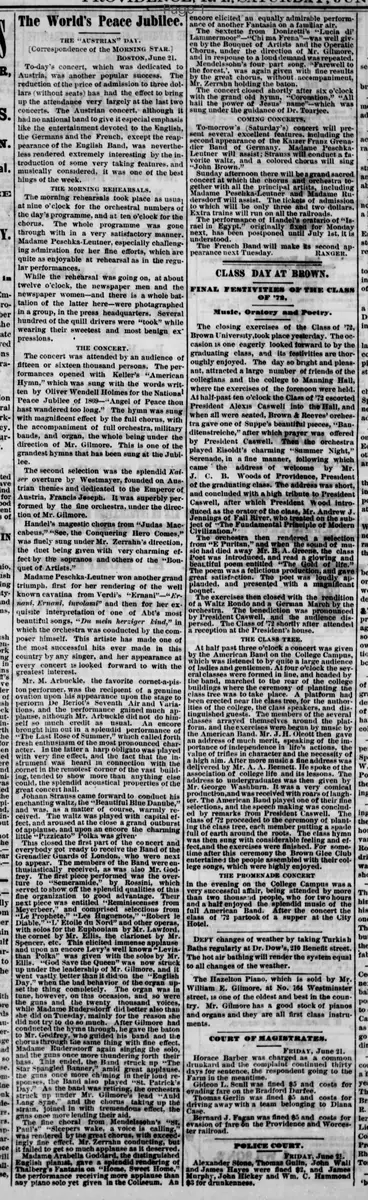
THE "AUSTRIAN" DAY.
[Correspondence of the MORNING STAR.]
Boston, June 21.
To-day's concert, which was dedicated to Austria, was another popular success. The reduction of the price of admission to three dollars (without seats) has had the effect to bring up the attendance very largely at the last two concerts. The Austrian concert—although it had no national band to give it especial emphasis like the entertainment devoted to the English, the Germans and the French, except the reappearance of the English Band, was nevertheless rendered extremely interesting by the introduction of some very taking features, and musically considered, it was one of the best things of the week.
THE MORNING REHEARSALS.
The morning rehearsals took place as usual at nine o'clock for the orchestral numbers of the day's programme, and at ten o'clock for the chorus. The whole programme was gone through with in a very satisfactory manner. Madame Peschka-Leutner, especially challenging admiration for her fine efforts, which are quite as enjoyable at rehearsal as in the regular performances.
While the rehearsal was going on, at about twelve o'clock, the newspaper men and the newspaper women—and there is a whole battalion of the latter here—were photographed in a group, in the press headquarters. Several hundred of the quill drivers were "took" while wearing their sweetest and most benign expressions.
THE CONCERT.
The concert was attended by an audience of fifteen or sixteen thousand persons. The performances opened with Keller's "American Hymn," which was sung with the words written by Oliver Wendell Holmes for the National Peace Jubilee of 1869—"Angel of Peace thou hast wandered too long." The hymn was sung with magnificent effect by the full chorus, with the accompaniment of full orchestra, military bands, and organ, the whole being under the direction of Mr. Gilmore. This is one of the grandest hymns that has been sung at the Jubilee.
The second selection was the splendid Kaiser overture by Westmayer, founded on Austrian themes and dedicated to the Emperor of Austria, Francis Joseph. It was superbly performed by the fine orchestra, under the direction of Mr. Gilmore.
Handel's majestic chorus from "Judas Maccabeus," "See, the Conquering Hero Comes," was finely sung under Mr. Zerrahn's direction, the duet being given with very charming effect by the sopranos and others of the "Bouquet of Artists."
Madame Peschka-Leutner won another grand triumph, first for her rendering of the well known cavatina from Verdi's "Ernani"—"Ernani, Ernani, involami" and then for her exquisite interpretation of one of Abt's most beautiful songs, "Du mein herziger kind," in which the orchestra was conducted by the composer himself. This artiste has made one of the most successful hits ever made in this country by any singer, and her appearance at every concert is looked forward to with the greatest interest.
Mr. M. Arbuckle, the favorite cornet-a-piston performer, was the recipient of a genuine ovation upon his appearance upon the stage to perform De Beriot's Seventh Air and Variations, and the performance gained much applause, although Mr. Arbuckle did not do himself so much credit as usual. An encore brought him out in a splendid performance of "The Last Rose of Summer," which called forth fresh enthusiasm of the most pronounced character. In the latter a harp obligato was played with very fine effect, and the fact that the instrument was heard in connection with the cornet in the remotest corner of the vast building, tended to show more than anything else could, the splendid acoustical properties of the great concert hall.
Johann Strauss came forward to conduct his enchanting waltz, the "Beautiful Blue Danube," and was, as a matter of course, warmly received. The waltz was played with capital effect, and aroused at the close a grand outburst of applause, and upon an encore the charming little "Pizzicato" Polka was given.
This closed the first part of the concert and everybody got ready to receive the Band of the Grenadier Guards of London, who were next to appear. The members of the Band were enthusiastically received, as was also Mr. Godfrey. The first piece performed was the overture to "Semiramis," by Rossini, which served to show off the splendid qualities of this fine organization to good advantage. Their next piece was entitled "Reminiscences from Meyerbeer," and comprised selections from "Le Prophete," "Les Huguenots," "Robert le Diable," "L' Etoile du Nord" and other operas, with solos for the Euphonium by Mr. Lawford, the cornet by Mr. Ellis, the clarionet by Mr. Spencer, etc. This elicited immense applause and upon an encore Levy's well known "Leviathan Polka" was given with the solos by Mr. Ellis. "God Save the Queen" was now struck up under the leadership of Mr. Gilmore, and it went vastly better than it did on the "English Day," when the bad behavior of the organ upset the thing completely. The organ was in tune, however, on this occasion, and so were the guns and the twenty thousand voices, while Madame Rudersdorff did better also than she did on Tuesday, mainly for the reason she did not try to do so much. After Gilmore had conducted the hymn through, he gave the baton to Mr. Godfrey, who guided his band and the chorus through the same thing with fine effect, Madame Rudersdorff again singing the solo, and the guns once more thundering forth their bass. This ended, the Band struck up "The Star Spangled Banner," the guns once more chiming in their loud responses, the Band also played "St. Patrick's Day." As the band was retiring, the orchestra struck up under Mr. Gilmore's lead "Auld Lang Syne," and the chorus taking up the strain, joined in with tremendous effect, the guns once more lending their aid.
The fine choral from Mendelssohn's "St. Paul's" "Sleepers wake, a voice is calling," was rendered by the great chorus, with exceedingly fine effect. Mr. Zerrahn conducting, but it failed to get so much applause as it deserved.
Madame Arabella Goddard, the distinguished English pianist, gave a splendid rendering of Thalberg's Fantasia on "Home, Sweet Home," the performance receiving more applause than any piano solo yet given in the Coliseum. An encore elicited an equally admirable performance of another Fantasia on a familiar air.
The Sextette from Donizetti's "Lucia di Lammermoor"—"Chi mi Frena"—was well given by the Bouquet of Artists and the Operatic Chorus, under the direction of Mr. Gilmore, and in response to a loud demand was repeated.
Mendelssohn's four part song, "Farewell to the forest," was again given with fine results by the great chorus, without accompaniment, Mr. Zerrahn holding the baton.
The concert closed shortly after six o'clock with the grand old hymn, "Coronation," "All hail the power of Jesus' name" which was sung under the guidance of Dr. Toarjee.
What sub-type of article is it?
What keywords are associated?
What entities or persons were involved?
Where did it happen?
Domestic News Details
Primary Location
Boston
Event Date
June 21
Key Persons
Outcome
the concert was a popular success with an audience of fifteen or sixteen thousand persons, featuring various musical performances and receiving enthusiastic applause.
Event Details
The Austrian Day concert at the World's Peace Jubilee included morning rehearsals, a large audience, and performances of hymns, overtures, choruses, solos, and band pieces by international artists and ensembles, ending with a grand hymn.