Thank you for visiting SNEWPapers!
Sign up free
Editorial
February 12, 1795
Gazette Of The United States And Daily Evening Advertiser
Philadelphia, Philadelphia County, Pennsylvania
What is this article about?
An excerpt from 'White on Government' analyzes the balance of powers in a three-branch system, arguing that equal branches would allow two to overpower one, unlike the British constitution's adjustable resistance mechanism, and contrasts it with a simpler two-branch balance.
Clipping
OCR Quality
98%
Excellent
Full Text
From White on Government.
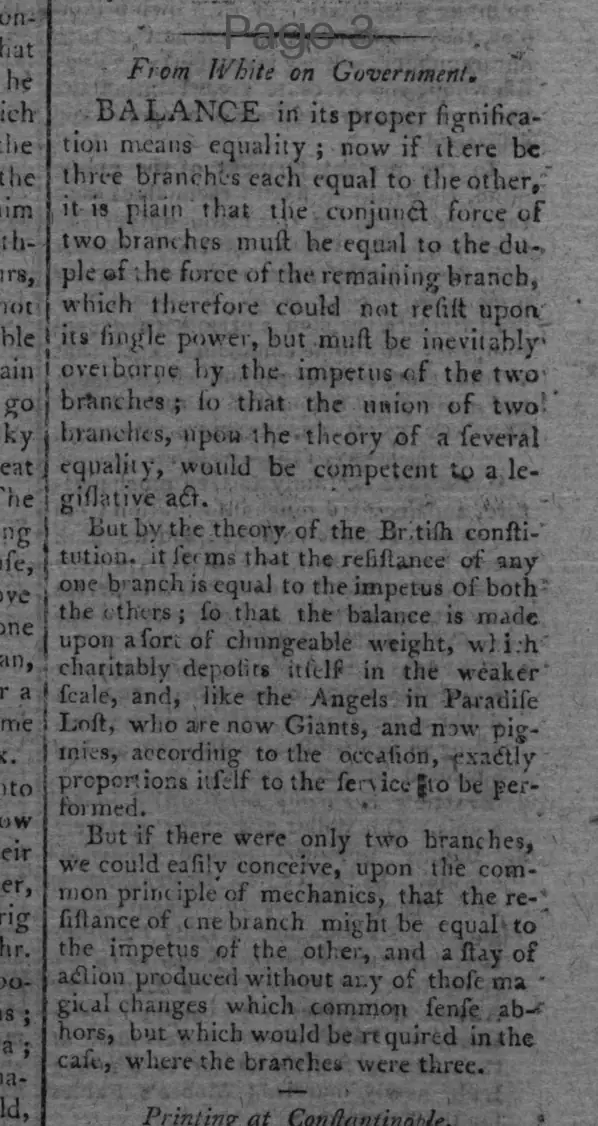
BALANCE in its proper signification means equality; now if there be three branches each equal to the other, it is plain that the conjunct force of two branches must be equal to the double of the force of the remaining branch, which therefore could not resist upon its single power, but must be inevitably overborne by the impetus of the two branches; so that the union of two branches, upon the theory of a several equality, would be competent to a legislative act.
But by the theory of the British constitution, it seems that the resistance of any one branch is equal to the impetus of both the others; so that the balance is made upon a sort of changeable weight, which charitably deposits itself in the weaker scale, and, like the Angels in Paradise Lost, who are now Giants, and now pigmies, according to the occasion, exactly proportions itself to the service to be performed.
But if there were only two branches, we could easily conceive, upon the common principle of mechanics, that the resistance of one branch might be equal to the impetus of the other, and a stay of action produced without any of those magical changes which common sense abhors, but which would be required in the case, where the branches were three.
BALANCE in its proper signification means equality; now if there be three branches each equal to the other, it is plain that the conjunct force of two branches must be equal to the double of the force of the remaining branch, which therefore could not resist upon its single power, but must be inevitably overborne by the impetus of the two branches; so that the union of two branches, upon the theory of a several equality, would be competent to a legislative act.
But by the theory of the British constitution, it seems that the resistance of any one branch is equal to the impetus of both the others; so that the balance is made upon a sort of changeable weight, which charitably deposits itself in the weaker scale, and, like the Angels in Paradise Lost, who are now Giants, and now pigmies, according to the occasion, exactly proportions itself to the service to be performed.
But if there were only two branches, we could easily conceive, upon the common principle of mechanics, that the resistance of one branch might be equal to the impetus of the other, and a stay of action produced without any of those magical changes which common sense abhors, but which would be required in the case, where the branches were three.
What sub-type of article is it?
Constitutional
What keywords are associated?
Balance Of Powers
Government Branches
British Constitution
Constitutional Theory
Mechanics Analogy
What entities or persons were involved?
White
British Constitution
Editorial Details
Primary Topic
Balance Of Powers In Three Branch Government
Stance / Tone
Analytical Critique Of Constitutional Balance
Key Figures
White
British Constitution
Key Arguments
With Three Equal Branches, Two Can Overbear The Third, Enabling Legislative Acts By Union.
British Constitution Features Resistance Of One Branch Equal To Both Others Via Adjustable Weight.
Two Branch System Allows Natural Balance Without Magical Changes, Per Mechanics Principles.