Thank you for visiting SNEWPapers!
Sign up free
Letter to Editor
August 16, 1771
The New Hampshire Gazette And Historical Chronicle
Portsmouth, Greenland, Rockingham County, New Hampshire
What is this article about?
Louis Dutenis writes to the New-Hampshire Gazette describing a remarkable chess-playing automaton invented by M. de Kempell in Hungary, detailing its construction, operation, and the author's personal observations of its skillful play.
Clipping
OCR Quality
95%
Excellent
Full Text
To the Publishers of the New-Hampshire Gazette.
I think the following description of an Automaton at Presburg in Hungary, published in the Court Miscellany, &c. for February last, worthy of a place in your paper, as it discovers the noble Effects of genius and industry, when united, and the wonderful operation of mechanic powers when under the management of a skilful hand.
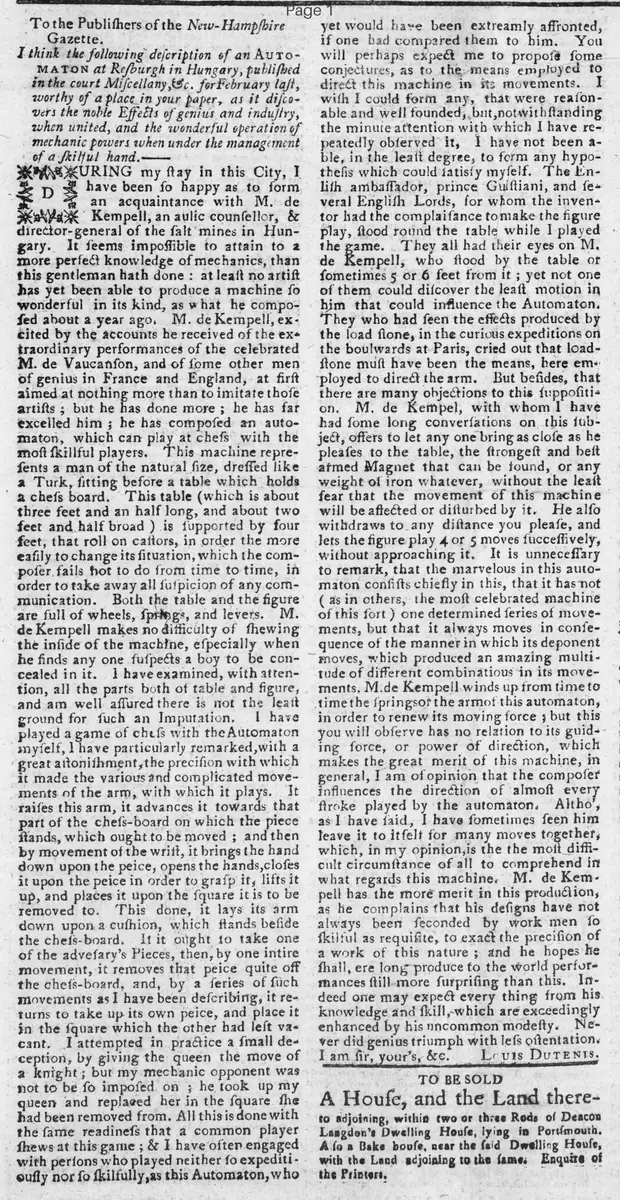
During my stay in this City, I have been so happy as to form an acquaintance with M. de Kempell, an aulic councellor, & director-general of the salt mines in Hungary. It seems impossible to attain to a more perfect knowledge of mechanics, than this gentleman hath done: at least no artist has yet been able to produce a machine so wonderful in its kind, as what he composed about a year ago. M. de Kempell, excited by the accounts he received of the extraordinary performances of the celebrated M. de Vaucanson, and of some other men of genius in France and England, at first aimed at nothing more than to imitate those artists; but he has done more; he has far excelled him; he has composed an automaton, which can play at chess with the most skilful players. This machine represents a man of the natural size, dressed like a Turk, sitting before a table which holds a chess board. This table (which is about three feet and an half long, and about two feet and half broad) is supported by four feet, that roll on casters, in order the more easily to change its situation, which the composer fails not to do from time to time, in order to take away all suspicion of any communication. Both the table and the figure are full of wheels, pins, and levers. M. de Kempell makes no difficulty of shewing the inside of the machine, especially when he finds any one suspects a boy to be concealed in it. I have examined, with attention, all the parts both of table and figure, and am well assured there is not the least ground for such an imputation. I have played a game of chess with the Automaton myself, I have particularly remarked, with a great astonishment, the precision with which it made the various and complicated movements of the arm, with which it plays. It raises this arm, it advances it towards that part of the chess-board on which the piece stands, which ought to be moved: and then by movement of the wrist, it brings the hand down upon the piece, opens the hand, closes it upon the piece in order to grasp it, lifts it up, and places it upon the square it is to be removed to. This done, it lays its arm down upon a cushion, which stands beside the chess-board. If it ought to take one of the adversary's pieces, then, by one entire movement, it removes that piece quite off the chess-board, and, by a series of such movements as I have been describing, it returns to take up its own piece, and place it in the square which the other had left vacant. I attempted in practice a small deception, by giving the queen the move of a knight; but my mechanic opponent was not to be so imposed on: he took up my queen and replaced her in the square she had been removed from. All this is done with the same readiness that a common player shews at this game; & I have often engaged with persons who played neither so expeditiously nor so skilfully, as this Automaton, who yet would have been extreamly affronted, if one had compared them to him. You will perhaps expect me to propose some conjectures, as to the means employed to direct this machine in its movements. I wish I could form any, that were reasonable and well founded, but, notwithstanding the minute attention with which I have repeatedly observed it, I have not been able, in the least degree, to form any hypothesis which could satisfy myself. The English ambassador, prince Giusiani, and several English Lords, for whom the inventor had the complaisance to make the figure play, stood round the table while I played the game. They all had their eyes on M. de Kempell, who stood by the table or sometimes 5 or 6 feet from it; yet not one of them could discover the least motion in him that could influence the Automaton. They who had seen the effects produced by the loadstone, in the curious expeditions on the boulevards at Paris, cried out that loadstone must have been the means, here employed to direct the arm. But besides, that there are many objections to this supposition, M. de Kempell, with whom I have had some long conversations on this subject, offers to let any one bring as close as he pleases to the table, the strongest and best armed Magnet that can be found, or any weight of iron whatever, without the least fear that the movement of this machine will be affected or disturbed by it. He also withdraws to any distance you please, and lets the figure play 4 or 5 moves successively, without approaching it. It is unnecessary to remark, that the marvelous in this automaton consists chiefly in this, that it has not (as in others, the most celebrated machine of this sort) one determined series of movements, but that it always moves in consequence of the manner in which its opponent moves, which produces an amazing multitude of different combinations in its movements. M. de Kempell winds up from time to time the springs of the arm of this automaton, in order to renew its moving force; but this you will observe has no relation to its guiding force, or power of direction, which makes the great merit of this machine, in general, I am of opinion that the composer influences the direction of almost every stroke played by the automaton. Altho', as I have said, I have sometimes seen him leave it to itself for many moves together, which, in my opinion, is the most difficult circumstance of all to comprehend in what regards this machine. M. de Kempell has the more merit in this production, as he complains that his designs have not always been seconded by work men so skilful as requisite, to exact the precision of a work of this nature: and he hopes he shall, ere long produce to the world performances still more surprizing than this. Indeed one may expect every thing from his knowledge and skill, which are exceedingly enhanced by his uncommon modesty. Never did genius triumph with less ostentation.
I am, sir, yours, &c.
Louis Dutenis.
I think the following description of an Automaton at Presburg in Hungary, published in the Court Miscellany, &c. for February last, worthy of a place in your paper, as it discovers the noble Effects of genius and industry, when united, and the wonderful operation of mechanic powers when under the management of a skilful hand.
During my stay in this City, I have been so happy as to form an acquaintance with M. de Kempell, an aulic councellor, & director-general of the salt mines in Hungary. It seems impossible to attain to a more perfect knowledge of mechanics, than this gentleman hath done: at least no artist has yet been able to produce a machine so wonderful in its kind, as what he composed about a year ago. M. de Kempell, excited by the accounts he received of the extraordinary performances of the celebrated M. de Vaucanson, and of some other men of genius in France and England, at first aimed at nothing more than to imitate those artists; but he has done more; he has far excelled him; he has composed an automaton, which can play at chess with the most skilful players. This machine represents a man of the natural size, dressed like a Turk, sitting before a table which holds a chess board. This table (which is about three feet and an half long, and about two feet and half broad) is supported by four feet, that roll on casters, in order the more easily to change its situation, which the composer fails not to do from time to time, in order to take away all suspicion of any communication. Both the table and the figure are full of wheels, pins, and levers. M. de Kempell makes no difficulty of shewing the inside of the machine, especially when he finds any one suspects a boy to be concealed in it. I have examined, with attention, all the parts both of table and figure, and am well assured there is not the least ground for such an imputation. I have played a game of chess with the Automaton myself, I have particularly remarked, with a great astonishment, the precision with which it made the various and complicated movements of the arm, with which it plays. It raises this arm, it advances it towards that part of the chess-board on which the piece stands, which ought to be moved: and then by movement of the wrist, it brings the hand down upon the piece, opens the hand, closes it upon the piece in order to grasp it, lifts it up, and places it upon the square it is to be removed to. This done, it lays its arm down upon a cushion, which stands beside the chess-board. If it ought to take one of the adversary's pieces, then, by one entire movement, it removes that piece quite off the chess-board, and, by a series of such movements as I have been describing, it returns to take up its own piece, and place it in the square which the other had left vacant. I attempted in practice a small deception, by giving the queen the move of a knight; but my mechanic opponent was not to be so imposed on: he took up my queen and replaced her in the square she had been removed from. All this is done with the same readiness that a common player shews at this game; & I have often engaged with persons who played neither so expeditiously nor so skilfully, as this Automaton, who yet would have been extreamly affronted, if one had compared them to him. You will perhaps expect me to propose some conjectures, as to the means employed to direct this machine in its movements. I wish I could form any, that were reasonable and well founded, but, notwithstanding the minute attention with which I have repeatedly observed it, I have not been able, in the least degree, to form any hypothesis which could satisfy myself. The English ambassador, prince Giusiani, and several English Lords, for whom the inventor had the complaisance to make the figure play, stood round the table while I played the game. They all had their eyes on M. de Kempell, who stood by the table or sometimes 5 or 6 feet from it; yet not one of them could discover the least motion in him that could influence the Automaton. They who had seen the effects produced by the loadstone, in the curious expeditions on the boulevards at Paris, cried out that loadstone must have been the means, here employed to direct the arm. But besides, that there are many objections to this supposition, M. de Kempell, with whom I have had some long conversations on this subject, offers to let any one bring as close as he pleases to the table, the strongest and best armed Magnet that can be found, or any weight of iron whatever, without the least fear that the movement of this machine will be affected or disturbed by it. He also withdraws to any distance you please, and lets the figure play 4 or 5 moves successively, without approaching it. It is unnecessary to remark, that the marvelous in this automaton consists chiefly in this, that it has not (as in others, the most celebrated machine of this sort) one determined series of movements, but that it always moves in consequence of the manner in which its opponent moves, which produces an amazing multitude of different combinations in its movements. M. de Kempell winds up from time to time the springs of the arm of this automaton, in order to renew its moving force; but this you will observe has no relation to its guiding force, or power of direction, which makes the great merit of this machine, in general, I am of opinion that the composer influences the direction of almost every stroke played by the automaton. Altho', as I have said, I have sometimes seen him leave it to itself for many moves together, which, in my opinion, is the most difficult circumstance of all to comprehend in what regards this machine. M. de Kempell has the more merit in this production, as he complains that his designs have not always been seconded by work men so skilful as requisite, to exact the precision of a work of this nature: and he hopes he shall, ere long produce to the world performances still more surprizing than this. Indeed one may expect every thing from his knowledge and skill, which are exceedingly enhanced by his uncommon modesty. Never did genius triumph with less ostentation.
I am, sir, yours, &c.
Louis Dutenis.
What sub-type of article is it?
Informative
Reflective
What themes does it cover?
Science Nature
What keywords are associated?
Automaton
Chess Player
M. De Kempell
Mechanics
Hungary
Scientific Invention
Vaucanson
What entities or persons were involved?
Louis Dutenis
To The Publishers Of The New Hampshire Gazette
Letter to Editor Details
Author
Louis Dutenis
Recipient
To The Publishers Of The New Hampshire Gazette
Main Argument
the letter shares a detailed description of m. de kempell's chess-playing automaton in hungary, praising its mechanical sophistication and the inventor's genius, based on the author's personal experience.
Notable Details
Inspired By Vaucanson's Works
Automaton Dressed As A Turk
Plays Chess With Precise Arm Movements
Resists Deception In Rules
No Hidden Operator Or Magnetic Influence Suspected
Inventor Allows Inspection And Remote Operation