Thank you for visiting SNEWPapers!
Sign up free
Story
April 13, 1875
Daily Kennebec Journal
Augusta, Kennebec County, Maine
What is this article about?
Descriptive account of the lumber industry on the Kennebec River, detailing log collection, booming, river driving by hardy rivermen, their crews, equipment, and nomadic lifestyle from Augusta to Bath.
Clipping
OCR Quality
95%
Excellent
Full Text
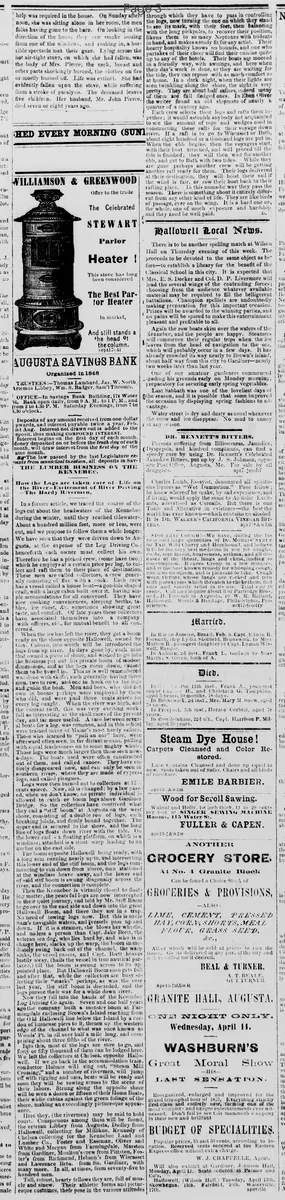
THE LUMBER BUSINESS ON THE KENNEBEC.
How the Logs are taken care of—Life on the River—Excitement of River Driving—The Hardy Rivermen.
In a former article, we traced the course of the logs cut about the headwaters of the Kennebec during the winter, until they reached tidewater. About one hundred million feet, more or less, were cut, and we propose to follow them a while longer.
We have seen that they were driven down to Augusta, at the expense of the Log Driving Co.: henceforth each owner must collect his own. Therefore he has a picked crew, (some have two,) which he employs at a certain price per log, to collect and raft them to their place of destination. These men are called collectors, a crew generally consisting of five with a cook. Each crew has a vessel called a house boat—a gondola-shaped craft, with a large cabin built over it, having ample accommodations for all concerned. They have nice cooking conveniences, sleeping berths, tables, ice chest, etc., sometimes showing great taste and comfort. Of late years these collectors have associated themselves into a company with officers, etc., for mutual benefit to all concerned.
When the ice has left the river, they get a boom ready on the shore opposite Hallowell, owned by Gov. Coburn, into which will be introduced the logs from up river. In days gone by, each man that owned a piece of shore, and wished to go into the business put out his private boom of moderate dimensions, and as the logs came down, caused them to be towed in. This, as is well remembered, was done with skill; each generally having three men, two to row, and one to hook on to the logs and guide the boat. Men and boys who did not own booms perhaps were employed by those who did, and were paid three cents apiece for every log caught. When the river was high, and the current swift, this was very exciting work; full as interesting as the skull races of the present day, and far more useful. A race between several boats for a log, was common, and in this school were trained many of Maine's most hardy sailors. Those who learned to "pull an oar" here, were afterward often seen, in far distant oceans, pulling with equal fearlessness on to some mighty whale. Those logs were much larger then than those seen nowadays. The boats used were often constructed out of them, and called canoes. They have entirely disappeared now, and can only be seen in southern rivers, where they are made of cypress logs, and called pirogues.
Logs were then turned out to collectors at 12 cents apiece. Now, all is changed; by a law passed, when we don't know, no private individual is allowed to catch or boom logs above Gardiner Bridge. So the collectors have contrived what they call a "stiff boom" at Augusta on the west shore, consisting of a double row of logs, each breaking joints, and firmly bound together. The upper end is secured to the shore, and the long line of logs floats down river with the tide. On the lower end is a floating platform, on which is a windlass; attached is a stout warp leading to an anchor on the east side.
The boom opposite Hallowell being ready, with a long arm running nearly up to, and intersecting this lower end of the stiff boom, and the logs commencing to run down from above, men stationed at the windlass heave away, and the lower end of said stiff boom is swung diagonally across the river, and the connection is complete.
Then the Kennebec is virtually closed to floating matter, the peaceful logs are now intercepted in their quiet journey, and told by Mr. Stiff Boom to go over to the east side and down into the great Hallowell Boom, and there they are in a trap.
No need of towing logs now. But this is Uncle Sam's navigable waters, and vessels pass up and down. If it is a steamer, she blows her whistle, and no less a person than Capt. Jake Brett, the veteran sea dog, who lies hard by, and who is in charge here, slacks up the warp, the boom immediately swings back out of the channel, the warp sinks, the vessel passes, and Capt. Brett heaves lustily away, hails the vessel in true nautical parlance, till the boom is swung across to its appointed place. But Hallowell Boom soon gets full and after that, while the collectors are busy re-lecting their "mark," perhaps, as was the case last year, the stiff boom is discarded, and the logs pursue their way for a while down river.
Now they fall into the hands of the Kennebec Log Driving Co again. Seven and one half years ago the company "built a monster boom at Farmingdale enclosing Brown's Island reaching from the old Hallowell line below the Island by cordon of immense piers to it, thence up the westerly edge of the channel to what was once known as Woods' Pt. in all over half a mile long, and comprising about three fifths of the river."
Into this, most of the logs are sure to go, and forty or fifty thousand of them can be lodged here.
We left the collectors at Chelsea, opposite Hallowell. If we go back in the accommodation train, conductor Holmes will sing out, "Steam Mill Crossing," and a number of rivermen, will jump off with rigging and oars, boats will be ready and soon they will be rowing across to the scene of their labors. Strung along the opposite shore will be seen a dozen or fifteen of their Home Boats, their white cabins against the green foliage of the shore, making an exceedingly picturesque appearance.
Here they, (the rivermen) may be said to hold court. Conspicuous among them will be found, the veteran Libbey from Augusta, Dudley from Hallowell, collecting for Milliken, Kennedy of Chelsea collecting for the Kennebec Land and Lumber Co., Foster and Eastman, Oliver and White and Morgan from Farmingdale, Marston from Gardiner. Moulton's crew from Pittston, Foster's from Richmond, Hebson's from Wiscasset and Lawrence Bros. from So. Gardiner, with many more. In all, at times, from seventy-five to one hundred men.
Tall, robust, hearty fellows they are, full of muscle and sinew. Their athletic forms and picturesque costumes, their pose in the various attitudes through which they have to pass in controlling the logs, now turning the one on which they stand to see its mark, with their feet, then balancing with the long pickpoles, to recover their position, likens them to so many Neptunes with tridents in hand, and makes a study fit for any artist. Their hearty hospitality knows no bounds, and one who partakes of their cheer will find their cuisine quite up to any of the hotels. Their boats are moored in a friendly way, with awnings, and here when their day's work is done, or they are waiting for the tide, they can repose with as much comfort as at home. In a dark night, when their lights are seen twinkling along the shore, the sight is very pretty. They are about half sailors, indeed many of them are full fledged ones. In Eben Oliver the writer found an old shipmate of nearly a quarter of a century ago.
Each crew selects their logs and rafts them together; it would astonish anybody not acquainted to see the amount of rope and wedges used in constructing these rafts for their voyage down river. If a raft is to go to Wiscasset or Bath, about eight hundred or a thousand logs are put in. When the ebb begins, then the voyagers start, with their boat attached, and will proceed till the tide is finished; they will then wait for another ebb, and get to Bath with two tides. While they are gone perhaps another crew will be getting another raft ready for them. Their logs delivered at their destination, they will hoist their sail if the wind is fair, or row their boat back to their rafting place. In this nomadic way they pass the season. There is something about it entirely different from any other kind of life. They are like birds of passage, ever on the wing. It is a hard one on the whole, one of much exposure and hardship and they need be well paid.
How the Logs are taken care of—Life on the River—Excitement of River Driving—The Hardy Rivermen.
In a former article, we traced the course of the logs cut about the headwaters of the Kennebec during the winter, until they reached tidewater. About one hundred million feet, more or less, were cut, and we propose to follow them a while longer.
We have seen that they were driven down to Augusta, at the expense of the Log Driving Co.: henceforth each owner must collect his own. Therefore he has a picked crew, (some have two,) which he employs at a certain price per log, to collect and raft them to their place of destination. These men are called collectors, a crew generally consisting of five with a cook. Each crew has a vessel called a house boat—a gondola-shaped craft, with a large cabin built over it, having ample accommodations for all concerned. They have nice cooking conveniences, sleeping berths, tables, ice chest, etc., sometimes showing great taste and comfort. Of late years these collectors have associated themselves into a company with officers, etc., for mutual benefit to all concerned.
When the ice has left the river, they get a boom ready on the shore opposite Hallowell, owned by Gov. Coburn, into which will be introduced the logs from up river. In days gone by, each man that owned a piece of shore, and wished to go into the business put out his private boom of moderate dimensions, and as the logs came down, caused them to be towed in. This, as is well remembered, was done with skill; each generally having three men, two to row, and one to hook on to the logs and guide the boat. Men and boys who did not own booms perhaps were employed by those who did, and were paid three cents apiece for every log caught. When the river was high, and the current swift, this was very exciting work; full as interesting as the skull races of the present day, and far more useful. A race between several boats for a log, was common, and in this school were trained many of Maine's most hardy sailors. Those who learned to "pull an oar" here, were afterward often seen, in far distant oceans, pulling with equal fearlessness on to some mighty whale. Those logs were much larger then than those seen nowadays. The boats used were often constructed out of them, and called canoes. They have entirely disappeared now, and can only be seen in southern rivers, where they are made of cypress logs, and called pirogues.
Logs were then turned out to collectors at 12 cents apiece. Now, all is changed; by a law passed, when we don't know, no private individual is allowed to catch or boom logs above Gardiner Bridge. So the collectors have contrived what they call a "stiff boom" at Augusta on the west shore, consisting of a double row of logs, each breaking joints, and firmly bound together. The upper end is secured to the shore, and the long line of logs floats down river with the tide. On the lower end is a floating platform, on which is a windlass; attached is a stout warp leading to an anchor on the east side.
The boom opposite Hallowell being ready, with a long arm running nearly up to, and intersecting this lower end of the stiff boom, and the logs commencing to run down from above, men stationed at the windlass heave away, and the lower end of said stiff boom is swung diagonally across the river, and the connection is complete.
Then the Kennebec is virtually closed to floating matter, the peaceful logs are now intercepted in their quiet journey, and told by Mr. Stiff Boom to go over to the east side and down into the great Hallowell Boom, and there they are in a trap.
No need of towing logs now. But this is Uncle Sam's navigable waters, and vessels pass up and down. If it is a steamer, she blows her whistle, and no less a person than Capt. Jake Brett, the veteran sea dog, who lies hard by, and who is in charge here, slacks up the warp, the boom immediately swings back out of the channel, the warp sinks, the vessel passes, and Capt. Brett heaves lustily away, hails the vessel in true nautical parlance, till the boom is swung across to its appointed place. But Hallowell Boom soon gets full and after that, while the collectors are busy re-lecting their "mark," perhaps, as was the case last year, the stiff boom is discarded, and the logs pursue their way for a while down river.
Now they fall into the hands of the Kennebec Log Driving Co again. Seven and one half years ago the company "built a monster boom at Farmingdale enclosing Brown's Island reaching from the old Hallowell line below the Island by cordon of immense piers to it, thence up the westerly edge of the channel to what was once known as Woods' Pt. in all over half a mile long, and comprising about three fifths of the river."
Into this, most of the logs are sure to go, and forty or fifty thousand of them can be lodged here.
We left the collectors at Chelsea, opposite Hallowell. If we go back in the accommodation train, conductor Holmes will sing out, "Steam Mill Crossing," and a number of rivermen, will jump off with rigging and oars, boats will be ready and soon they will be rowing across to the scene of their labors. Strung along the opposite shore will be seen a dozen or fifteen of their Home Boats, their white cabins against the green foliage of the shore, making an exceedingly picturesque appearance.
Here they, (the rivermen) may be said to hold court. Conspicuous among them will be found, the veteran Libbey from Augusta, Dudley from Hallowell, collecting for Milliken, Kennedy of Chelsea collecting for the Kennebec Land and Lumber Co., Foster and Eastman, Oliver and White and Morgan from Farmingdale, Marston from Gardiner. Moulton's crew from Pittston, Foster's from Richmond, Hebson's from Wiscasset and Lawrence Bros. from So. Gardiner, with many more. In all, at times, from seventy-five to one hundred men.
Tall, robust, hearty fellows they are, full of muscle and sinew. Their athletic forms and picturesque costumes, their pose in the various attitudes through which they have to pass in controlling the logs, now turning the one on which they stand to see its mark, with their feet, then balancing with the long pickpoles, to recover their position, likens them to so many Neptunes with tridents in hand, and makes a study fit for any artist. Their hearty hospitality knows no bounds, and one who partakes of their cheer will find their cuisine quite up to any of the hotels. Their boats are moored in a friendly way, with awnings, and here when their day's work is done, or they are waiting for the tide, they can repose with as much comfort as at home. In a dark night, when their lights are seen twinkling along the shore, the sight is very pretty. They are about half sailors, indeed many of them are full fledged ones. In Eben Oliver the writer found an old shipmate of nearly a quarter of a century ago.
Each crew selects their logs and rafts them together; it would astonish anybody not acquainted to see the amount of rope and wedges used in constructing these rafts for their voyage down river. If a raft is to go to Wiscasset or Bath, about eight hundred or a thousand logs are put in. When the ebb begins, then the voyagers start, with their boat attached, and will proceed till the tide is finished; they will then wait for another ebb, and get to Bath with two tides. While they are gone perhaps another crew will be getting another raft ready for them. Their logs delivered at their destination, they will hoist their sail if the wind is fair, or row their boat back to their rafting place. In this nomadic way they pass the season. There is something about it entirely different from any other kind of life. They are like birds of passage, ever on the wing. It is a hard one on the whole, one of much exposure and hardship and they need be well paid.
What sub-type of article is it?
Historical Event
Adventure
Journey
What themes does it cover?
Nature
Survival
Bravery Heroism
What keywords are associated?
Lumber Business
Kennebec River
Log Driving
Rivermen
Booms
Collectors
House Boats
Rafts
What entities or persons were involved?
Capt. Jake Brett
Gov. Coburn
Libbey
Dudley
Kennedy
Eben Oliver
Rivermen
Collectors
Where did it happen?
Kennebec River, Augusta, Hallowell, Farmingdale, Maine
Story Details
Key Persons
Capt. Jake Brett
Gov. Coburn
Libbey
Dudley
Kennedy
Eben Oliver
Rivermen
Collectors
Location
Kennebec River, Augusta, Hallowell, Farmingdale, Maine
Story Details
Logs cut in winter headwaters are driven to Augusta, then collected by crews using house boats and booms like the stiff boom and Hallowell Boom; rivermen raft logs for transport to mills, facing excitement and hardship in their nomadic river life.