Thank you for visiting SNEWPapers!
Sign up free
Gazette Of The United States, & Philadelphia Daily Advertiser
Philadelphia, Philadelphia County, Pennsylvania
What is this article about?
In the U.S. House of Representatives on January 16, Mr. Henderson continues his speech proposing indirect taxes on luxuries like theatrical exhibitions, domestic porter, clocks, watches, teas, beer, ale, and porter to raise revenue without direct taxes. He critiques revenue estimates, highlights discrepancies with Treasury reports, and opposes direct taxation as an 'entering wedge' burdening farmers, vowing to vote against the resolution.
Clipping
OCR Quality
Full Text
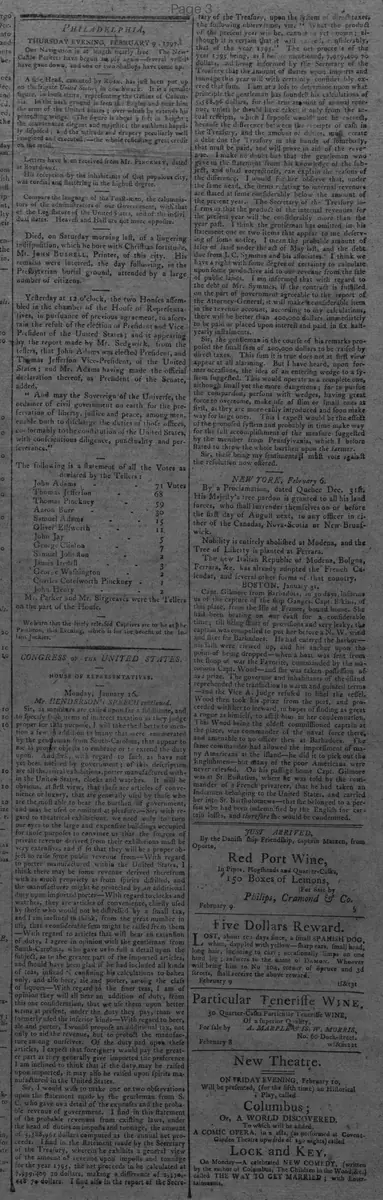
HOUSE OF REPRESENTATIVES.
Monday, January 16.
Mr. HENDERSON's SPEECH continued.
Sir, as members are called upon for a substitute, and to specify such items of indirect taxation as they judge proper for that purpose, I will take the liberty to mention a few in addition to many that were enumerated by the gentleman from South-Carolina, that appear to me as proper objects to embrace or to extend the duty upon, And sir, with regard to such as have not yet been noticed by government; of this description are all theatrical exhibitions, porter manufactured within the United States, clocks and watches. It will be obvious, at first view, that these are articles of convenience or luxury, that are generally used by those who are the most able to bear the burthen of government, and may be used or omitted at pleasure.—Sir, with regard to theatrical exhibitions, we need only to turn our eyes to the large and expensive buildings occupied for those purposes to convince us that the sources of private revenue derived from their exhibitions must be very extensive, and if so that they will be a proper object to raise some public revenue from—With regard to porter manufactured within the United States, I think there may be some revenue derived therefrom with as much propriety as from spirits distilled, and the manufacturer might be protected by an additional duty upon imported porter—With regard to clocks and watches, they are articles of convenience, chiefly used by those who would not be distressed by a small tax, and I am inclined to think, from the great number in use, that a considerable sum might be raised from them—With regard to articles that will bear an extension of duty, I agree in opinion with the gentleman from South-Carolina, who gave us so full a detail upon the subject, as to the greater part of the imported articles, and should have been glad if he had included all kinds of teas, instead confining his calculations to bohea only, and also beer, ale and porter, among the class of liquors—With regard to the finer teas, I am of opinion they will all bear an addition of duty, from this one consideration, that we use them upon better terms at present, under the duty they pay, than we formerly used the inferior kinds—With regard to beer, ale and porter, I would propose an additional tax, not only to aid the revenue, but to protect the manufacture among ourselves. Of the duty paid upon these articles, I expect that foreigners would pay the greater part as they generally give imported the preference I am inclined to think that if the duty may be raised upon imported, it may also be raised upon spirits manufactured in the United States.
Sir, I would wish to make one or two observations upon the statement made by the gentleman from S. C. who gave us a detail of the expenses and the probable revenue of government. I find in this statement of the probable revenues from existing laws, under the head of duties on imports and tonnage, the amount of 5,588,961 dollars computed as the annual net proceeds. I find in the statement made by the Secretary of the Treasury, wherein he exhibits a general view of the amount of revenue upon imports and tonnage for the year 1795, the net proceeds to be calculated at 7,959,409 70 dollars, making a difference of 2,370,448 70 dollars. I find also in the report of the Secretary of the Treasury upon the system of direct taxes the following observation, viz. " what the product of the present year will be, cannot as yet be known; although it is certain that it will exceed, considerably, that of the year 1795." The net proceeds of the year 1795 being, as I before mentioned, 7,959,409 70 dollars, and being informed by the Secretary of the Treasury that the amount of duties upon imports and tonnage this year will with certainty considerably exceed that sum. I am at a loss to determine upon what principle the gentleman has founded his calculations of 5,588,961 dollars, for the true amount of annual revenue, unless he should have taken it only from the actual receipts, which I suppose would not be correct, because the difference between the receipts of cash in the Treasury, and the amount of duties, must create a debt due the Treasury in the hands of somebody, that must be paid, and will prove in aid of the revenue. I make no doubt but that the gentleman who gave us the statement from his knowledge of the subject, and usual correctness, can explain the reasons of the difference. I would further observe that, under the same head, the items relating to internal revenues are stated at sums considerably below the amount of the present year, The Secretary of the Treasury informs us that the product of the internal revenues for the present year will be considerably more than the year past. I think the gentleman has omitted in his statement one or two items that appear to me deserving of some notice. I mean the probable amount of sales of land under the act of May last, and the debt due from J. C. Symmes and his associates. I think we have a right with some degree of certainty to calculate upon some productive aid to our revenue from the sale of public lands. I am informed that with regard to the debt of Mr. Symmes, if the contract is fulfilled on the part of government agreeable to the report of the Attorney General, it will make a considerable item in the revenue account, according to my calculations, there will be better than 400,000 dollars immediately to be paid or placed upon interest and paid in six half-yearly instalments.
Sir, the gentleman in the course of his remarks proposed the small sum of 200,000 dollars to be raised by direct taxes. This sum it is true does not at first view appear at all alarming. But I have heard, upon former occasions, the idea of an entering wedge to a system suggested. This would operate as a complete one, although small yet the more dangerous; for to pursue the comparison, persons with wedges, having great force to overcome, make use of slim or small ones at first, as they are more easily introduced and soon make way for large ones. This I expect would be the effect of the proposed system and probably in time make way for the full accomplishment of the measure suggested by the member from Pennsylvania, which I before stated to throw the whole burthen upon the farmer.
Sir, these being my sentiments I must vote against the resolution now offered.
What sub-type of article is it?
What keywords are associated?
What entities or persons were involved?
Where did it happen?
Domestic News Details
Primary Location
United States
Event Date
Monday, January 16
Key Persons
Outcome
mr. henderson announces he will vote against the resolution proposing direct taxes.
Event Details
Mr. Henderson continues his speech in the House of Representatives, suggesting indirect taxes on theatrical exhibitions, domestic porter, clocks, watches, teas, beer, ale, and porter to raise revenue. He critiques a colleague's revenue estimates as understated compared to Treasury reports for 1795 and current year projections, notes omissions like land sales and Symmes' debt, and opposes direct taxes of $200,000 as an initial step toward burdening farmers.