Thank you for visiting SNEWPapers!
Sign up free
Daily Kennebec Journal
Augusta, Kennebec County, Maine
What is this article about?
Proceedings of the 48th Congress in Washington on July 5-6, including Senate debates on interstate commerce regulation bill, appropriation conferences, and House discussions on Pacific railroads investigation, elections, and Nicaraguan canal appropriation.
Merged-components note: Sequential reading order and same topic: reporting on 48th Congress proceedings in Senate and House; relabeled from story to domestic_news as it is legislative news reporting.
Clipping
OCR Quality
Full Text
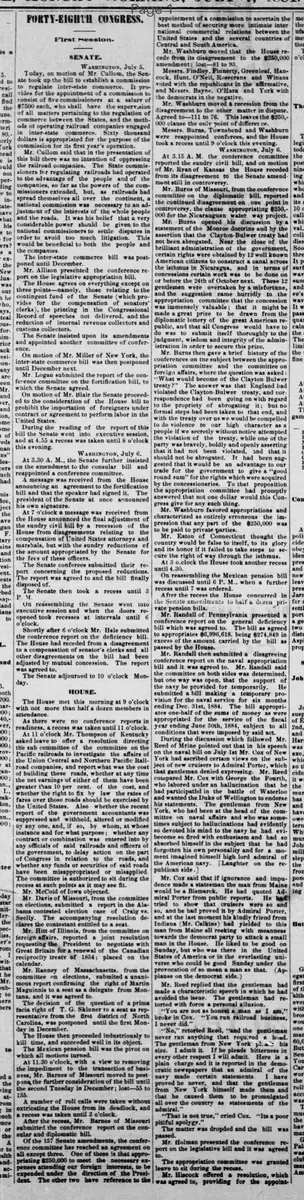
Adjourned session of Washington, July 5.
Today, on motion of Mr. Cullom, the Senate took up the bill to establish a commission to regulate inter-state commerce. It provides for the appointment of a commission to consist of five commissioners at a salary of $7500 each, who shall have the supervision of all matters pertaining to the regulation of commerce between the States, and the methods of operating railroad companies engaged in inter-state commerce. Sixty thousand dollars is appropriated for the purpose of the commission for its first year's operation.
Mr. Cullom said that in the presentation of this bill there was no intention of oppressing the railroad companies. The State commissioners for regulating railroads had operated to the advantage of the people and of the companies, so far as the powers of the commissioners extended, but as railroads had spread themselves all over the continent, a national commission was necessary to an adjustment of the interests of the whole people and the roads. It was his belief that a very considerable power should be given to the national commissioners to settle disputes in order to avoid too much litigation. This would be beneficial to both the people and the companies.
The inter-state commerce bill was postponed until December.
Mr. Allison presented the conference report on the legislative appropriation bill. The House agrees on everything except on three points-namely, those relating to the contingent fund of the Senate (which provides for the compensation of senators' clerks), the printing in the Congressional Record of speeches not delivered, and the reduction of internal revenue collectors and customs collectors.
The Senate insisted upon its amendments and appointed another committee of conference.
On motion of Mr. Miller of New York, the inter-state commerce bill was then postponed until December next.
Mr. Logan submitted the report of the conference committee on the fortification bill, to which the Senate agreed.
On motion of Mr. Blair the Senate proceeded to the consideration of the House bill to prohibit the importation of foreigners under contract or agreement to perform labor in the United States.
During the reading of the report of this bill the Senate went into executive session, and at 4:55 a recess was taken until 8 o'clock this evening.
WASHINGTON, July 6.
At 3:30 A.M., the Senate further insisted on the amendment to the consular bill and reappointed a conference committee.
A message was received from the House announcing an agreement to the fortification bill and that the speaker had signed it. The president of the Senate at once announced his own signature.
At 7 o'clock a message was received from the House announced the final adjustment of the sundry civil bill by a recession of the House from disagreements relating to the compensation of United States attorneys and marshals, but with the sundry reductions of the amount appropriated by the Senate for the fees of these officers.
The Senate conferees submitted their report concerning the proposed reductions. The report was agreed to and the bill finally disposed of.
The Senate then took a recess until 3 P.M.
On reassembling the Senate went into executive session and when the doors re-opened took recesses at intervals until 6 o'clock.
Shortly after 6 o'clock Mr. Hale submitted the conference report on the deficiency bill. The House had receded from a disagreement to a compensation of senator's clerks and all other disagreements on the bill had been adjusted by mutual concession. The report was agreed to.
The Senate adjourned to 10 o'clock Monday.
HOUSE.
The House met this morning at 9 o'clock with not more than half a dozen members in attendance.
As there were no conference reports in readiness, a recess was taken until 11 o'clock.
At 11 o'clock Mr. Thompson of Kentucky asked leave to offer a resolution directing the sub committee of the committee on the Pacific railroads to investigate the affairs of the Union Central and Northern Pacific Railroad companies, and report what was the cost of building these roads, whether at any time the net earnings of either of them have been greater than 10 per cent. of the cost, and whether the right to fix by law the rates of fares over those roads should be exercised by the United States. Also whether the recent report of the government accountants was suppressed and withheld, altered or modified by any one, and, if so, by whom, at whose instance and for what purpose; whether any contract or combination was entered into by any officials of said railroads and officers of the government, to delay action on the part of Congress in relation to the roads, and whether any funds or securities of said road have been misappropriated or misapplied.
The committee is authorized to sit during the recess at such points as it may see fit.
Mr. McCoid of Iowa objected.
Mr. Davis of Missouri, from the committee on elections, submitted a report in the Alabama contested election case of Craig vs. Seelly. The accompanying resolution declares the contestant entitled to a seat.
Mr. Hitt of Illinois, from the committee on foreign affairs, reported a joint resolution requesting the President to negotiate with Great Britain for a renewal of the Canadian reciprocity treaty of 1854: placed on the calendar.
Mr. Ranney of Massachusetts, from the committee on elections, submitted a unanimous report confirming the right of Martin Maguinnis to a seat as a delegate from Montana, and it was agreed to.
The decision of the question of a prima facie right of T. G. Skinner to a seat as representative from the first district of North Carolina, was postponed until the first Monday in December.
The House then proceeded industriously to kill time, and succeeded well in its object.
The Mexican pension bill was the pivot on which all motions turned.
At 11:30 o'clock, with a view to removing the impediment to the transaction of business, Mr. Barnes of Missouri moved to postpone the further consideration of the bill until the second Tuesday in December: lost-55 to 135.
A number of roll calls were taken without extricating the House from its deadlock, and a recess was taken until 3 o'clock.
After the recess, Mr. Barnes of Missouri submitted the conference report on the consular and diplomatic bill.
Of the 157 Senate amendments, the conference committee has reached an agreement on all except three. One of these is that appropriating $250,000 to meet the necessary expenses attending our foreign interests, to be expended under the direction of the President. The other two have reference to the appointment of a commission to ascertain the best method of securing more intimate international commercial relations between the United States and the several countries of Central and South America.
Mr. Washburn moved that the House recede from its disagreement to the $250,000 amendment: lost-81 to 93.
Messrs. Findley, Finnerty, Greenleaf, Hancock, Hunt, O'Neil, Rosecrans and Winans voted with the republicans in the affirmative, and Messrs. Bayne, O'Hara and York with the democrats in the negative.
Mr. Washburn moved a recession from the disagreement to the other matter in dispute. Agreed to-111 to 76. This leaves the $250,000 clause the only point of difference.
Messrs. Burns, Townshend and Washburn were reappointed conferees, and the House took a recess until 9 o'clock this evening.
WASHINGTON, July 6.
At 3:15 A.M. the conference committee reported the sundry civil bill, and on motion of Mr. Ryan of Kansas the House receded from its disagreement to the Senate amendment still in controversy.
Mr. Burns of Missouri, from the conference committee on the diplomatic bill, reported the continued disagreement on one point in controversy, the clause appropriating 250,000 for the Nicaraguan water way project.
Mr. Burns opened his discussion by a statement of the Monroe doctrine and by the assertion that the Clayton-Bulwer treaty had not been abrogated. Near the close of the brilliant administration of the government, certain rights were obtained by 12 well known American citizens to construct a canal across the isthmus in Nicaragua, and in terms of concessions certain work was to be done on or before the 24th of October next. These 12 gentlemen were overtaken by a misfortune, and the suggestion came hurriedly to the appropriation committee that the concession was immensely valuable: that it might be made a great prize to be drawn from the diplomatic lottery of the great American republic, and that all Congress would have to do was to submit itself thoroughly to the judgment, wisdom and integrity of the administration in order to secure this prize.
Mr. Burns then gave a brief history of the conferences on the subject between the appropriation committee and the committee on foreign affairs, where the question was asked: "What would become of the Clayton Bulwer treaty?" The answer was that England had violated the Clayton-Bulwer treaty, and correspondence had been going on with regard to the propriety of abrogating it; but no formal steps had been taken to that end, and with the treaty over us we would be compelled to do violence to our high character as a people if we secretly without notice attempted the violation of the treaty, while one of the party was bravely, boldly and openly asserting that it had not been violated, and that it should not be abrogated. It had been suggested that it would be an advantage to our trade for the government to give a "good round sum" for the rights which were acquired by the concessionaries. To that proposition the appropriation committee had promptly answered that not one dollar would this Congress give for any such thing.
Mr. Washburn favored appropriations and characterized as entirely erroneous the impression that any part of the $250,000 was to be paid to private parties.
Mr. Eaton of Connecticut thought the country would be false to itself, to its glory and its honor if it failed to take steps to secure the right of way through the isthmus.
At 3 o'clock the House took another recess until 4:30.
On reassembling the Mexican pension bill was discussed until 6 P.M., when a further recess until 7 was ordered.
After the recess the House concurred in the Senate amendments to half a dozen private pension bills.
Mr. Randall of Pennsylvania presented a conference report on the general deficiency bill which was agreed to. The bill as agreed to appropriates $6,996,618, being $274,849 in excess of the amount carried by the bill as passed by the House.
Mr. Randall then submitted a disagreeing conference report on the naval appropriation bill and it was agreed to. Mr. Randall said the committee on both sides was determined, but one way was open, that the support of the navy be provided for temporarily. He submitted a bill making a temporary provision for the naval service for six months ending Dec. 31st, 1884. The bill appropriates one-half of the sums of money as were appropriated for the service of the fiscal year ending June 30th, 1884, subject to all conditions that were imposed by said act.
During the discussion which followed Mr. Reed of Maine pointed out that in his speech on the naval bill on July 1st Mr. Cox of New York had ascribed certain views on the subject of new cruisers to Admiral Porter, which that gentleman denied expressing. Mr. Reed compared Mr. Cox with George the Fourth, who labored under an hallucination that he had participated in the battle of Waterloo and wanted the Duke of Wellington to endorse his statements. The gentleman from New York, who had been at the head of the committee on naval affairs and who was sometimes subject to hallucinations had evidently so devoted his mind to the navy he had evidently become so fired with enthusiasm and had so absorbed himself in the subject that he had forgotten his own personality and for a moment imagined himself high lord admiral of the American navy. [Laughter on the republican side.]
Mr. Cox said that if ignorance and impudence made a statesman the man from Maine would be a Bismarck. He had quoted Admiral Porter from public reports. He had tried to show that cruisers were so and so, and he had proved it by Admiral Porter, and at the last moment his kindly friend from Indiana (Mr. Calkins) had yielded to this man from Maine all reeking with meanness towards the democrat party to attack a small man in the House. He liked to be good on Sunday, but who was there in the United States of America or in the everlasting universe who could be good Sunday under the provocation of so mean a man as that. (Applause on the democrat side.)
Mr. Reed replied that the gentleman had made a characteristic speech in which he had avoided the issue. The gentleman had retorted with force a personal allusion.
"You are not as honest a man as I am," broke in Cox.
"You run railroad business, I never did."
"No," retorted Reed, "and the gentleman never ran anything that required head.
The gentleman from New York puts his size. I admit it. If he pleads bitterness in every other respect I will admit. Here is a plain charge and it is reported in the democratic newspapers that an admiral of the navy made certain statements. I have proved he never, and that the gentleman from New York himself made them and that he caused them to be promulgated all over the country as statements of the admiral."
"That is not true," cried Cox.
"It's a poor pitiful apology."
The matter was dropped and the bill passed.
Mr. Holman presented the conference report on the legislative bill and it was agreed to.
The appropriation committee was granted leave to sit during the recess.
Mr. Hiscock offered resolution, which was agreed to, providing for the appointment of seven representatives to sit during the recess and make inquiry relative to manufacture of guns of high powers and other metal plates and other material for construction of war vessels.
The House at 12:05 took a recess until 10 o'clock Monday.
What sub-type of article is it?
What keywords are associated?
What entities or persons were involved?
Where did it happen?
Domestic News Details
Primary Location
Washington
Event Date
July 5 6
Key Persons
Outcome
interstate commerce bill postponed to december; various appropriation bills agreed upon with adjustments; fortification bill signed; sundry civil bill disposed; deficiency bill agreed; house resolutions on pacific railroads investigation, elections, and nicaraguan canal debated; naval bill passed temporarily; legislative bill agreed.
Event Details
The Senate discussed and postponed the interstate commerce regulation bill, handled conference reports on appropriations including legislative, consular, fortification, sundry civil, and deficiency bills, and considered a bill prohibiting importation of contract laborers. The House dealt with low attendance, proposed investigations into Pacific railroads, contested elections in Alabama and Montana, a resolution for Canadian reciprocity treaty renewal, postponed decisions on North Carolina seat, debated Mexican pension bill, and conferred on diplomatic and consular bills, including controversy over $250,000 for Nicaraguan canal, with heated exchanges between Mr. Reed and Mr. Cox on naval matters.