Thank you for visiting SNEWPapers!
Sign up free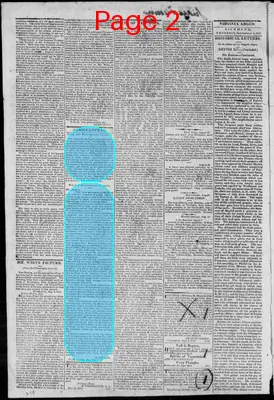
Virginia Argus
Richmond, Virginia
What is this article about?
In August 1811, a Frederick County, Virginia farmer shares experiments proving that scalding wheat seeds prevents Hessian Fly infestation, unlike untreated seeds, urging adoption to protect crops as seeding season starts.
Merged-components note: Merged the agricultural introduction with the accompanying letter on Hessian Fly experiments.
Clipping
OCR Quality
Full Text
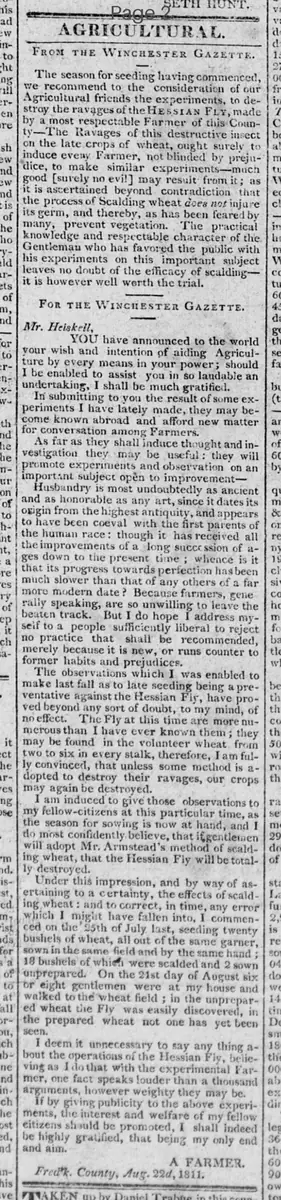
From the Winchester Gazette.
The season for seeding having commenced, we recommend to the consideration of our Agricultural friends the experiments, to destroy the ravages of the Hessian Fly, made by a most respectable Farmer of this County--The Ravages of this destructive insect on the late crops of wheat, ought surely to induce every Farmer, not blinded by prejudice, to make similar experiments--much good [surely no evil] may result from it; as it is ascertained beyond contradiction that the process of Scalding wheat does not injure its germ, and thereby, as has been feared by many, prevent vegetation. The practical knowledge and respectable character of the Gentleman who has favored the public with his experiments on this important subject leaves no doubt of the efficacy of scalding--it is however well worth the trial.
For the Winchester Gazette.
Mr. Heiskell,
YOU have announced to the world your wish and intention of aiding Agriculture by every means in your power; should I be enabled to assist you in so laudable an undertaking, I shall be much gratified.
In submitting to you the result of some experiments I have lately made, they may become known abroad and afford new matter for conversation among Farmers.
As far as they shall induce thought and investigation they may be useful: they will promote experiments and observation on an important subject open to improvement--Husbandry is most undoubtedly as ancient and as honorable as any art, since it dates its origin from the highest antiquity, and appears to have been coeval with the first parents of the human race: though it has received all the improvements of a long succession of ages down to the present time; whence is it that its progress towards perfection has been much slower than that of any others of a far more modern date? Because farmers, generally speaking, are so unwilling to leave the beaten track. But I do hope I address myself to a people sufficiently liberal to reject no practice that shall be recommended, merely because it is new, or runs counter to former habits and prejudices.
The observations which I was enabled to make last fall as to late seeding being a preventative against the Hessian Fly, have proved beyond any sort of doubt, to my mind, of no effect. The Fly at this time are more numerous than I have ever known them; they may be found in the volunteer wheat from two to six in every stalk, therefore, I am fully convinced, that unless some method is adopted to destroy their ravages, our crops may again be destroyed.
I am induced to give those observations to my fellow-citizens at this particular time, as the season for sowing is now at hand, and I do most confidently believe, that if gentlemen will adopt Mr. Armistead's method of scalding wheat, that the Hessian Fly will be totally destroyed.
Under this impression, and by way of ascertaining to a certainty, the effects of scalding wheat: and to correct, in time, any error which I might have fallen into, I commenced on the 25th of July last, seeding twenty bushels of wheat, all out of the same garner, sown in the same field and by the same hand; 18 bushels of which were scalded and 2 sown unprepared. On the 21st day of August six or eight gentlemen were at my house and walked to the wheat field; in the unprepared wheat the Fly was easily discovered, in the prepared wheat not one has yet been seen.
I deem it unnecessary to say any thing about the operations of the Hessian Fly, believing as I do that with the experimental Farmer, one fact speaks louder than a thousand arguments, however weighty they may be.
If by giving publicity to the above experiments, the interest and welfare of my fellow citizens should be promoted, I shall indeed be highly gratified, that being my only end and aim.
A FARMER.
Frederick County, Aug. 22d, 1811.
What sub-type of article is it?
What keywords are associated?
What entities or persons were involved?
Where did it happen?
Domestic News Details
Primary Location
Frederick County
Event Date
Aug. 22d, 1811
Key Persons
Outcome
scalded wheat showed no hessian fly infestation; unprepared wheat had visible flies. no damage to wheat germination from scalding.
Event Details
A farmer in Frederick County conducted an experiment seeding 20 bushels of wheat on July 25, 1811: 18 bushels scalded and 2 unprepared. On August 21, observers found flies in unprepared wheat but none in scalded. The method, based on Mr. Armistead's approach, is recommended to prevent crop destruction by the Hessian Fly as seeding season begins.