Thank you for visiting SNEWPapers!
Sign up free
The New Hampshire Gazette
Portsmouth, Rockingham County, New Hampshire
What is this article about?
A traveler's detailed description of Malta, highlighting its strategic ports, impregnable fortifications, the city of Valetta, the Grand Master's palace and authority, the Knights of St. John's history, and religious tolerance. Covers geography, architecture, governance, and historical background from Saracen times to Charles V's grant.
Clipping
OCR Quality
Full Text
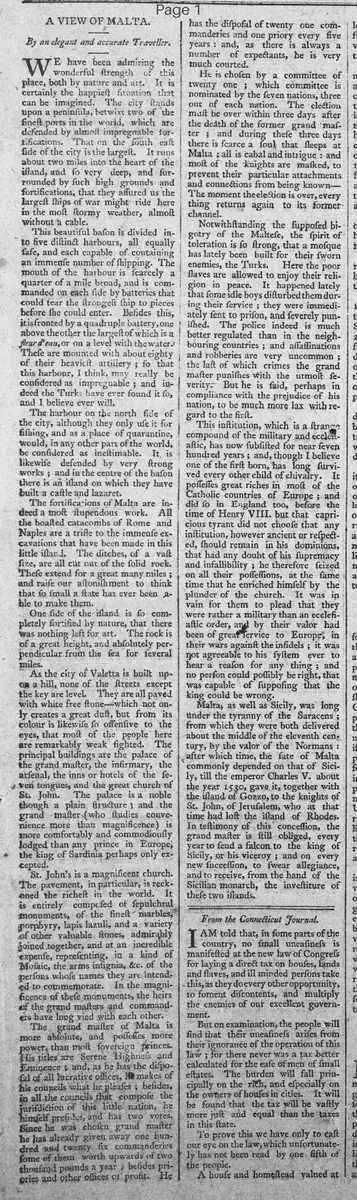
By an elegant and accurate Traveller
WE have been admiring the place, both by nature and art. It is certainly the happiest situation that can be imagined. The city stands upon a peninsula, betwixt two of the finest ports in the world, which are defended by almost impregnable fortifications. That on the south east side of the city is the largest. It runs about two miles into the heart of the island, and so very deep, and surrounded by such high grounds and fortifications, that they assured us the largest ships of war might ride here in the most stormy weather, almost without a cable.
This beautiful basin is divided into five distinct harbours, all equally safe, and each capable of containing an immense number of shipping. The mouth of the harbour is scarcely a quarter of a mile broad, and is commanded on each side by batteries that could tear the strongest ship to pieces before she could enter. Besides this, it is fronted by a quadruple battery, one above the other the largest of which is a fleurd'eau, or on a level with the water.
These are mounted with about eighty of their heaviest artillery ; so that this harbour, I think, may really be considered as impregnable ; and indeed the Turks have ever found it so, and I believe ever will.
The harbour on the north side of the city, although they only use it for fishing, and as a place of quarantine, would, in any other part of the world, be considered as inestimable. It, is likewise defended by very strong works ; and in the centre of the basin there is an island on which they have built a castle and lazaret.
The fortifications of Malta are indeed a most stupendous work. All the boasted catacombs of Rome and Naples are a trifle to the immense excavations that have been made in this little island. The ditches, of a vast size, are all cut out of the solid rock.
These extend for a great many miles ; and raise our astonishment to think that so small a state has ever been able to make them.
One side of the island is so completely fortified by nature, that there was nothing left for art. The rock is of a great height, and absolutely perpendicular from the sea for several miles.
As the city of Valetta is built upon a hill, none of the streets except the quay are level. They are all paved with white free stone—which not only creates a great dust, but from its colour is likewise so offensive to the eyes, that most of the people here are remarkably weak sighted.— The principal buildings are the palace of the grand master, the infirmary, the arsenal, the inns or hotels of the seven tongues, and the great church of St. John. The palace is a noble though a plain structure ; and the grand master (who studies convenience more than magnificence) is more comfortably and commodiously lodged than any prince in Europe the king of Sardinia perhaps only excepted.
St. John's is a magnificent church. The pavement, in particular, is reckoned the richest in the world. It is entirely composed of sepulchral monuments, of the finest marbles, porphyry, lapis lazuli, and a variety of other valuable stones, admirably joined together, and at an incredible expense, representing, in a kind of Mosaic, the arms insignia, &c. of the persons whose names they are intended to commemorate. In the magnificence of these monuments, the heirs of the grand masters and commanders have long vied with each other.
The grand master of Malta is more absolute, and possesses more power, than most sovereign princes. His titles are Serene Highness and Eminence ; and, as he has the disposal of all lucrative offices, he makes of his councils what he pleases ; besides, in all the councils that compose the jurisdiction of this little nation, he himself presides, and has two votes.
Since he was chosen grand master he has already given away one hundred and twenty-six commanderies some of them worth upwards of two thousand pounds a year besides priories and other offices of profit. He has the disposal of twenty one commanderies and one priory every five years: and, as there is always a number of expectants, he is very much courted.
He is chosen by a committee of twenty one ; which committee is nominated by the seven nations, three out of each nation. The election must be over within three days after the death of the former grand master ; and during these three days there is scarcely a soul that sleeps at Malta ; all is cabal and intrigue : and most of the knights are masked, to prevent their particular attachments and connections from being known—
The moment the election is over, every thing returns again to its former channel.
Notwithstanding the supposed bigotry of the Maltese, the spirit of toleration is so strong, that a mosque has lately been built for their sworn enemies, the Turks. Here the poor slaves are allowed to enjoy their religion in peace. It happened lately that some idle boys disturbed them during their service ; they were immediately sent to prison, and severely punished. The police indeed is much better regulated than in the neighbouring countries ; and assassinations and robberies are very uncommon ; the last of which crimes the grand master punishes with the utmost severity. But he is said, perhaps in compliance with the prejudice of his nation, to be much more lax with regard to the first.
This institution, which is a strange compound of the military and ecclesiastic, has now subsisted for near seven hundred years; and, though I believe one of the first born, has long survived every other child of chivalry. It possesses great riches in most of the Catholic countries of Europe ; and did so in England too, before the time of Henry VIII. but that capricious tyrant did not choose that any institution, however ancient or respected, should remain in his dominions, that had any doubt of his supremacy and infallibility ; he therefore seized on all their possessions, at the same time that he enriched himself by the plunder of the church. It was in vain for them to plead that they were rather a military than an ecclesiastic order, and by their valor had been of great service to Europe, in their wars against the infidels ; it was not agreeable to his system ever to hear a reason for any thing; and no person could possibly be right, that was capable of supposing that the king could be wrong.
Malta, as well as Sicily, was long under the tyranny of the Saracens ; from which they were both delivered about the middle of the eleventh century, by the valor of the Normans : after which time, the fate of Malta commonly depended on that of Sicily, till the emperor Charles V. about the year 1530, gave it, together with the island of Gozzo, to the knights of St. John, of Jerusalem, who at that time had lost the island of Rhodes.
In testimony of this concession, the grand master is still obliged, every year to send a falcon to the king of Sicily, or his viceroy ; and on every new succession, to wear allegiance, and to receive, from the hand of the Sicilian monarch, the investiture of these two islands.
What sub-type of article is it?
What keywords are associated?
What entities or persons were involved?
Where did it happen?
Foreign News Details
Primary Location
Malta
Key Persons
Event Details
Traveler describes Malta's strategic peninsula location with two major ports defended by impregnable fortifications, including a large southeastern harbor divided into five safe basins capable of holding immense shipping, protected by batteries and artillery. The northern harbor is used for fishing and quarantine with a central castle and lazaret. Fortifications involve vast rock excavations extending miles. Valetta's hilly streets are paved with white freestone causing dust and eye issues. Key buildings include the Grand Master's plain but comfortable palace, infirmary, arsenal, inns of the seven tongues, and magnificent St. John's Church with rich mosaic pavement of sepulchral monuments. The Grand Master holds absolute power, presides over councils with two votes, disposes of lucrative offices like commanderies and priories, and is elected by a committee of twenty-one within three days amid intrigue. Recent mosque built for Turkish slaves shows toleration; police regulates better than neighbors, punishing robberies severely but lax on assassinations. The Knights of St. John, a military-ecclesiastic order, has existed nearly 700 years, possessing riches in Catholic Europe until Henry VIII seized English assets. Malta was under Saracens until Normans liberated it mid-11th century; fate tied to Sicily until Charles V granted it and Gozo to the Knights in 1530 after losing Rhodes; annual falcon sent to Sicilian king as tribute.