Thank you for visiting SNEWPapers!
Sign up free
Daily National Intelligencer
Washington, District Of Columbia
What is this article about?
Documents from US Secretary of State John Quincy Adams to Chairman William Lowndes detail the US view that Spain's unratified Florida Treaty of February 22, 1819, remains binding on Spain's honor, justifying US seizure of Florida and indemnity for delays. Concerns over South American recognition and European reactions are addressed.
Clipping
OCR Quality
Full Text
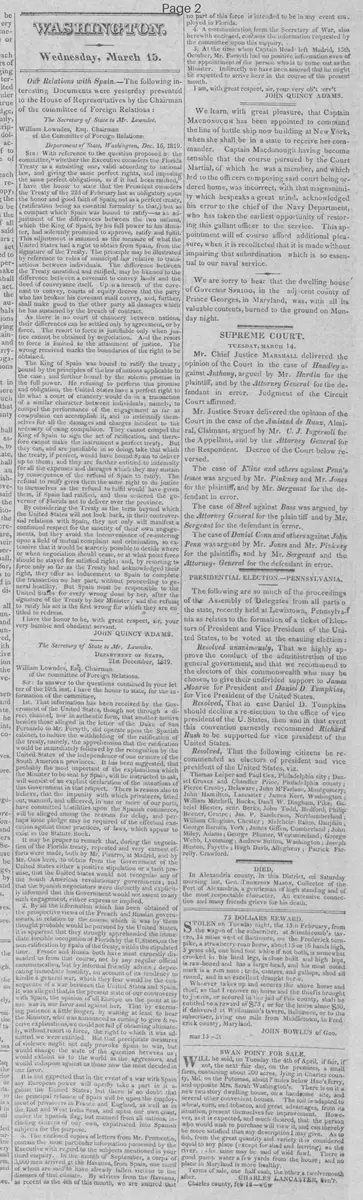
Wednesday, March 15.
Our Relations with Spain.—The following interesting Documents were yesterday presented to the House of Representatives by the Chairman of the committee of Foreign Relations:
The Secretary of State to Mr. Lowndes.
William Lowndes, Esq. Chairman of the Committee of Foreign Relations:
Department of State, Washington, Dec. 16, 1819.
Sir: With reference to the question proposed by the committee, "whether the Executive considers the Florida Treaty as a subsisting one, valid according to national law, and giving the same perfect rights, and imposing the same perfect obligations, as if it had been ratified," I have the honor to state that the President considers the Treaty of the 22d of February last as obligatory upon the honor and good faith of Spain, not as a perfect treaty, (ratification being an essential formality to that,) but as a compact which Spain was bound to ratify—as an adjustment of the differences between the two nations, which the King of Spain, by his full power to his Minister, had solemnly promised to approve, ratify and fulfil. This adjustment is assumed as the measure of what the United States had a right to obtain from Spain, from the signature of the Treaty. The principle may be illustrated by reference to rules of municipal law relative to transactions between individuals. The difference between the Treaty unratified and ratified, may be likened to the difference between a covenant to convey lands and the deed of conveyance itself. Upon a breach of the covenant to convey, courts of equity decree that the party who has broken his covenant shall convey, and, further, shall make good to the other party all damages which he has sustained by the breach of contract. As there is no court of chancery between nations, their differences can be settled only by agreement, or by force. The resort to force is justifiable only when justice cannot be obtained by negociation. And the resort to force is limited to the attainment of justice. The wrong received marks the boundaries of the right to be obtained. The King of Spain was bound to ratify the treaty; bound by the principles of the law of nations applicable to the case; and further bound by the solemn promise in the full power. He refusing to perform this promise and obligation, the United States have a perfect right to do what a court of chancery would do in a transaction of a similar character between individuals; namely, to compel the performance of the engagement as far as compulsion can accomplish it, and to indemnify themselves for all the damages and charges incident to the necessity of using compulsion. They cannot compel the King of Spain to sign the act of ratification, and therefore cannot make the instrument a perfect treaty. But they can, and are justifiable in so doing, take that which the treaty, if perfect, would have bound Spain to deliver up to them; and they are further entitled to indemnity for all the expenses and damages which they may sustain by consequence of the refusal of Spain to ratify. The refusal to ratify gives them the same right to do justice to themselves as the refusal to fulfil would have given them, if Spain had ratified, and then ordered the governor of Florida not to deliver over the province. By considering the Treaty as the term beyond which the United States will not look back, in their controversial relations with Spain, they not only will manifest a continued respect for the sanctity of their own engagements, but they avoid the inconvenience of re-entering upon a field of mutual complaint and crimination, so extensive that it would be scarcely possible to decide where or when negociation should cease, or at what point force should be stayed for satisfied right; and, by resorting to force only so far as the Treaty had acknowledged their right, they offer an inducement to Spain to complete the transaction on her part, without proceeding to general hostility. But Spain must be responsible to the United States for every wrong done by her, after the signature of the Treaty by her Minister; and the refusal to ratify his act is the first wrong for which they are entitled to redress.
I have the honor to be, with great respect, sir, your very humble and obedient servant.
JOHN QUINCY ADAMS.
The Secretary of State to Mr. Lowndes.
Department of State,
21st December, 1819.
William Lowndes, Esq. Chairman of the committee of Foreign Relations.
Sir: In answer to the questions contained in your letter of the 10th inst. I have the honor to state, for the information of the committee,
1st. That information has been received by the Government of the United States, though not through a direct channel, nor in authentic form, that another motive besides those alleged in the letter of the Duke of San Fernando to Mr. Forsyth, did operate upon the Spanish cabinet, to induce the withholding of the ratification of the treaty, namely, the apprehension that the ratification would be immediately followed by the recognition by the United States of the independence of one or more of the South American provinces. It has been suggested, that probably the most important of the explanations which the Minister to be sent by Spain, will be instructed to ask, will consist of an explicit declaration of the intentions of this Government in that respect. There is reason also to believe, that the impunity with which privateers, fitted out, manned, and officered, in one or more of our ports, have committed hostilities upon the Spanish commerce, will be alleged among the reasons for delay, and perhaps some pledge may be required of the effectual execution against these practices, of laws, which appear to exist in the Statute Book.
It may be proper to remark that, during the negociation of the Florida treaty, repeated and very earnest efforts were made, both by Mr. Pizarro, at Madrid, and by Mr. Onis here, to obtain from the Government of the United States either a positive stipulation or a tacit promise, that the United States would not recognise any of the South American revolutionary governments; and that the Spanish negociators were distinctly and explicitly informed that this Government would not assent to any such engagement, either express or implied.
2. By all the information which has been obtained of the prospective views of the French and Russian governments, in relation to the course which it was by them thought probable would be pursued by the United States, it is apparent that they strongly apprehended the immediate forcible occupation of Florida by the U. States, on the non-ratification by Spain of the treaty, within the stipulated time. France and Russia both have most earnestly dissuaded us from that course, not by any regular official communication, but by informal friendly advice; deprecating immediate hostility, on account of its tendency to kindle a general war, which they fear would be the consequence of a war between the United States and Spain. It was alleged that, in the present state of our controversy with Spain, the opinion of all Europe on the point at issue was in our favor and against her, That by exercising patience a little longer, by waiting at least to hear the Minister, who was announced as coming to give & receive explanations, we could not fail of obtaining ultimately, without resort to force, the right to which it was admitted we were entitled. But that precipitate measures of violence might not only provoke Spain to war, but would change the state of the question between us; would exhibit us to the world as the aggressors, and would indispose against us those now the most decided in our favor.
It is not expected that in the event of a war with Spain any European power will openly take a part in it against the United States; but there is no doubt that the principal relance of Spain will be upon the employment of privateers in France and England, as well as in the East and West India Seas, and upon our own coast, under the Spanish flag, but manned from all nations, including citizens of our own, expatriated into Spanish subjects for the purpose.
3. The enclosed copies of letters from Mr. Fromentin, contain the most particular information possessed by the Executive with regard to the subjects mentioned in your third enquiry. In the month of September, a corps of 3000 men arrived at the Havanna, from Spain, one third of whom are said to have already fallen victims to the diseases of that climate. By advices from the Havanna, as recent as the 4th of this month, we are assured that no part of this force is intended to be in any event employed in Florida.
4. A communication from the Secretary of War, also herewith enclosed, contains the information requested by the committee upon this enquiry.
5. At the time when Captain Read left Madrid, 13th October, Mr. Forsyth had no positive information even of the appointment of the person who is to come out as the Minister. Indirectly we have been assured that he might be expected to arrive here in the course of the present month.
I am, with great respect, sir, your very ob't serv't
JOHN QUINCY ADAMS.
What sub-type of article is it?
What keywords are associated?
What entities or persons were involved?
Where did it happen?
Foreign News Details
Primary Location
Spain
Event Date
December 16 And 21, 1819
Key Persons
Outcome
us asserts right to florida and indemnity due to spain's refusal to ratify the treaty; concerns over south american recognition and potential privateering in event of war; spanish troops in havana not for florida.
Event Details
Secretary of State Adams informs the Foreign Relations Committee that the unratified Florida Treaty binds Spain honorably, allowing US to compel delivery of Florida and seek damages. Additional motives for delay include fears of US recognition of South American independence and privateer issues. European powers advise against force to avoid general war. Spanish reinforcements in Havana reported, but not for Florida; expected Spanish minister to arrive soon.