Thank you for visiting SNEWPapers!
Sign up free
Editorial
August 24, 1957
The Key West Citizen
Key West, Monroe County, Florida
What is this article about?
This editorial questions the value of US foreign aid, arguing it fails to secure loyal allies despite heavy taxpayer costs, citing unrest in Japan and Formosa, unreliability of India and Egypt, and comparing it to endless handouts to beggars.
Clipping
OCR Quality
98%
Excellent
Full Text
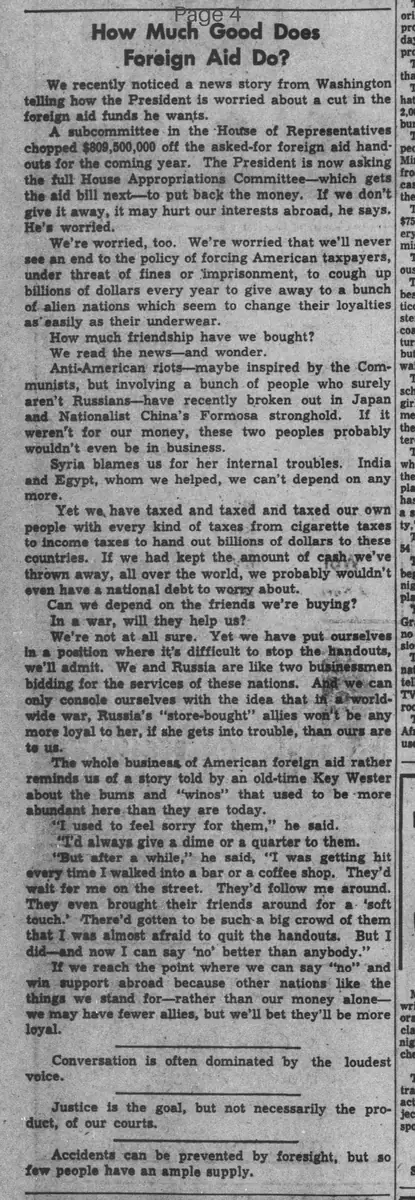
How Much Good Does Foreign Aid Do?
We recently noticed a news story from Washington telling how the President is worried about a cut in the foreign aid funds he wants.
A subcommittee in the House of Representatives chopped $809,500,000 off the asked-for foreign aid handouts for the coming year. The President is now asking the full House Appropriations Committee—which gets the aid bill next—to put back the money. If we don't give it away, it may hurt our interests abroad, he says.
He's worried.
We're worried, too. We're worried that we'll never see an end to the policy of forcing American taxpayers, under threat of fines or imprisonment, to cough up billions of dollars every year to give away to a bunch of alien nations which seem to change their loyalties as easily as their underwear.
How much friendship have we bought?
We read the news and wonder.
Anti-American riots—maybe inspired by the Communists, but involving a bunch of people who surely aren't Russians—have recently broken out in Japan and Nationalist China's Formosa stronghold. If it weren't for our money, these two peoples probably wouldn't even be in business.
Syria blames us for her internal troubles. India and Egypt, whom we helped, we can't depend on any more.
Yet we have taxed and taxed and taxed our own people with every kind of taxes from cigarette taxes to income taxes to hand out billions of dollars to these countries. If we had kept the amount of cash we've thrown away, all over the world, we probably wouldn't even have a national debt to worry about.
Can we depend on the friends we're buying?
In a war, will they help us?
We're not at all sure. Yet we have put ourselves in a position where it's difficult to stop the handouts, we'll admit. We and Russia are like two businessmen bidding for the services of these nations. And we can only console ourselves with the idea that in a worldwide war, Russia's "store-bought" allies won't be any more loyal to her, if she gets into trouble, than ours are to us.
The whole business of American foreign aid rather reminds us of a story told by an old-time Key Wester about the bums and "winos" that used to be more abundant here than they are today.
"I used to feel sorry for them," he said.
"I'd always give a dime or a quarter to them.
"But after a while," he said, "I was getting hit every time I walked into a bar or a coffee shop. They'd wait for me on the street. They'd follow me around.
They even brought their friends around for a soft touch. There'd gotten to be such a big crowd of them that I was almost afraid to quit the handouts. But I did and now I can say 'no' better than anybody."
If we reach the point where we can say "no" and win support abroad because other nations like the things we stand for—rather than our money alone—we may have fewer allies, but we'll bet they'll be more loyal.
Conversation is often dominated by the loudest voice.
Justice is the goal, but not necessarily the product, of our courts.
Accidents can be prevented by foresight, but so few people have an ample supply.
We recently noticed a news story from Washington telling how the President is worried about a cut in the foreign aid funds he wants.
A subcommittee in the House of Representatives chopped $809,500,000 off the asked-for foreign aid handouts for the coming year. The President is now asking the full House Appropriations Committee—which gets the aid bill next—to put back the money. If we don't give it away, it may hurt our interests abroad, he says.
He's worried.
We're worried, too. We're worried that we'll never see an end to the policy of forcing American taxpayers, under threat of fines or imprisonment, to cough up billions of dollars every year to give away to a bunch of alien nations which seem to change their loyalties as easily as their underwear.
How much friendship have we bought?
We read the news and wonder.
Anti-American riots—maybe inspired by the Communists, but involving a bunch of people who surely aren't Russians—have recently broken out in Japan and Nationalist China's Formosa stronghold. If it weren't for our money, these two peoples probably wouldn't even be in business.
Syria blames us for her internal troubles. India and Egypt, whom we helped, we can't depend on any more.
Yet we have taxed and taxed and taxed our own people with every kind of taxes from cigarette taxes to income taxes to hand out billions of dollars to these countries. If we had kept the amount of cash we've thrown away, all over the world, we probably wouldn't even have a national debt to worry about.
Can we depend on the friends we're buying?
In a war, will they help us?
We're not at all sure. Yet we have put ourselves in a position where it's difficult to stop the handouts, we'll admit. We and Russia are like two businessmen bidding for the services of these nations. And we can only console ourselves with the idea that in a worldwide war, Russia's "store-bought" allies won't be any more loyal to her, if she gets into trouble, than ours are to us.
The whole business of American foreign aid rather reminds us of a story told by an old-time Key Wester about the bums and "winos" that used to be more abundant here than they are today.
"I used to feel sorry for them," he said.
"I'd always give a dime or a quarter to them.
"But after a while," he said, "I was getting hit every time I walked into a bar or a coffee shop. They'd wait for me on the street. They'd follow me around.
They even brought their friends around for a soft touch. There'd gotten to be such a big crowd of them that I was almost afraid to quit the handouts. But I did and now I can say 'no' better than anybody."
If we reach the point where we can say "no" and win support abroad because other nations like the things we stand for—rather than our money alone—we may have fewer allies, but we'll bet they'll be more loyal.
Conversation is often dominated by the loudest voice.
Justice is the goal, but not necessarily the product, of our courts.
Accidents can be prevented by foresight, but so few people have an ample supply.
What sub-type of article is it?
Foreign Affairs
Economic Policy
What keywords are associated?
Foreign Aid
Us Taxpayers
International Loyalty
Anti American Riots
National Debt
Aid Dependency
What entities or persons were involved?
President
House Of Representatives
Japan
Nationalist China
Formosa
Syria
India
Egypt
Russia
Communists
Editorial Details
Primary Topic
Critique Of Us Foreign Aid Effectiveness
Stance / Tone
Critical And Skeptical Of Foreign Aid
Key Figures
President
House Of Representatives
Japan
Nationalist China
Formosa
Syria
India
Egypt
Russia
Communists
Key Arguments
Foreign Aid Cuts Worry The President But Burden Us Taxpayers
Aided Nations Show Anti American Riots And Shifting Loyalties
Billions Spent On Aid Could Eliminate National Debt If Kept At Home
Uncertain If Bought Friends Will Help In War
Us And Russia Compete Like Businessmen Bidding For Nations' Services
Analogy To Giving Money To Bums Who Become Dependent And Demanding
Better To Gain Support For Us Values Than Money Alone For More Loyal Allies