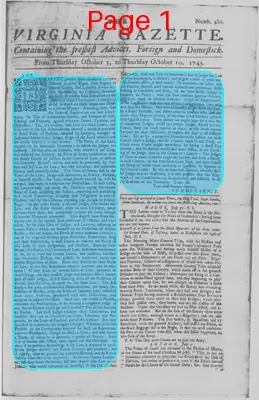
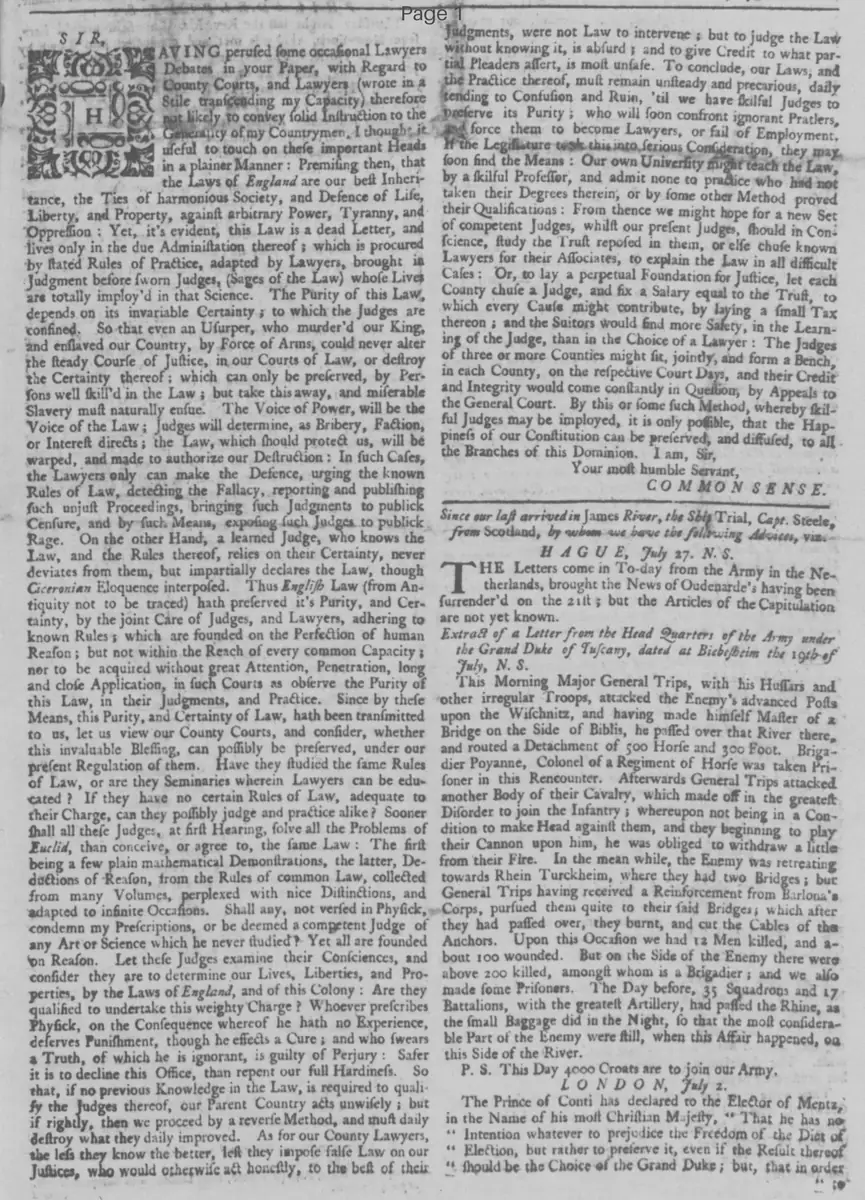
HAVING perused some occasional Lawyers Debates in your Paper, with Regard to County Courts, and Lawyers (wrote in a Stile transcending my Capacity) therefore not likely to convey solid Instruction to the Gentry of my Countrymen I thought useful to touch on these important Heads in a plainer Manner: Premising then, that the Laws of England are our best Inheritance, the Ties of harmonious Society, and Defence of Life, Liberty, and Property, against arbitrary Power, Tyranny, and Oppression: Yet, it's evident, this Law is a dead Letter, and lives only in the due Administration thereof; which is procured by stated Rules of Practice, adapted by Lawyers, brought in Judgment before worn Judges, (Sages of the Law) whose Lives are totally imploy'd in that Science. The Purity of this Law depends on its invariable Certainty; to which the Judges are confined. So that even an Usurper, who murder'd our King, and enslaved our Country, by Force of Arms, could never alter the steady Course of Justice, in our Courts of Law, or destroy the Certainty thereof; which can only be preserved, by Persons well skilled in the Law; but take this away, and miserable Slavery must naturally ensue. The Voice of Power, will be the Voice of the Law; Judges will determine, as Bribery, Faction, or Interest directs; the Law, which should protect us, will be warped, and made to authorize our Destruction: In such Cases, the Lawyers only can make the Defence, urging the known Rules of Law, detecting the Fallacy, reporting and publishing such unjust Proceedings, bringing such Judgments to publick Censure, and by such Means, exposing such Judges to publick Rage. On the other Hand, a learned Judge, who knows the Law, and the Rules thereof, relies on their Certainty, never deviates from them, but impartially declares the Law, though Ciceronian Eloquence interposed. Thus English Law (from Antiquity not to be traced) hath preserved its Purity, and Certainty, by the joint Care of Judges, and Lawyers, adhering to known Rules; which are founded on the Perfection of human Reason; but not within the Reach of every common Capacity: nor to be acquired without great Attention, Penetration, long and close Application, in such Courts as observe the Purity of this Law, in their Judgments, and Practice. Since by these Means, this Purity, and Certainty of Law, hath been transmitted to us, let us view our County Courts, and consider, whether this invaluable Blessing, can possibly be preserved, under our present Regulation of them. Have they studied the same Rules of Law, or are they Seminaries wherein Lawyers can be educated? If they have no certain Rules of Law, adequate to their Charge, can they possibly judge and practice alike? Sooner shall all these Judges, at first Hearing, solve all the Problems of Euclid, than conceive, or agree to, the same Law: The first being a few plain mathematical Demonstrations, the latter, Deductions of Reason, from the Rules of common Law, collected from many Volumes, perplexed with nice Distinctions, and adapted to infinite Occasions. Shall any, not versed in Physick, condemn my Prescriptions, or be deemed a competent Judge of any Art or Science which he never studied? Yet all are founded on Reason. Let these Judges examine their Consciences, and consider they are to determine our Lives, Liberties, and Properties, by the Laws of England, and of this Colony: Are they qualified to undertake this weighty Charge? Whoever prescribes Physick, on the Consequence whereof he hath no Experience, deserves Punishment, though he effects a Cure; and who swears a Truth, of which he is ignorant, is guilty of Perjury: Safer it is to decline this Office, than repent our foolish Hardiness. So that, if no previous Knowledge in the Law, is required to qualify the Judges thereof, our Parent Country acts unwisely; but if rightly, then we proceed by a reverse Method, and must daily destroy what they daily improved. As for our County Lawyers, the less they know the better, less they impose false Law on our Justices, who would otherwise act honestly, to the best of their Judgments, were not Law to intervene; but to judge the Law without knowing it, is absurd; and to give Credit to what partial Pleaders assert, is most unsafe. To conclude, our Laws, and the Practice thereof, must remain unsteady and precarious, daily tending to Confusion and Ruin, 'til we have skilful Judges to preserve its Purity; who will soon confront ignorant Pratlers, and force them to become Lawyers, or fail of Employment. If the Legislature takes this into Serious Consideration, they may soon find the Means: Our own University might teach the Law, by a skilful Professor, and admit none to practice who had not taken their Degrees therein, or by some other Method proved their Qualifications: From thence we might hope for a new Set of competent Judges, whilst our present Judges, should in Conscience, study the Trust reposed in them, or else chuse known Lawyers for their Associates, to explain the Law in all difficult Cases: Or, to lay a perpetual Foundation for Justice, let each County chuse a Judge, and fix a Salary equal to the Trust, to which every Cause might contribute, by laying a small Tax thereon; and the Suitors would find more Safety, in the Learning of the Judge, than in the Choice of a Lawyer: The Judges of three or more Counties might sit, jointly, and form a Bench, in each County, on the respective Court Days, and their Credit and Integrity would come constantly in Question, by Appeals to the General Court. By this or some such Method, whereby skilful Judges may be employed, it is only possible, that the Happiness of our Constitution can be preserved, and diffused, to all the Branches of this Dominion. I am, Sir, Your most humble Servant, COMMONSENSE.