Thank you for visiting SNEWPapers!
Sign up free
Letter to Editor
October 8, 1817
Alexandria Gazette & Daily Advertiser
Alexandria, Virginia
What is this article about?
A letter defending the Catholic Church against accusations of intolerance by arguing that such acts are human failings, not inherent to its principles, and asserting its infallibility as the only true church through logical and scriptural reasoning, contrasting it with Protestant divisions. Responds to Mr. Query's arguments.
Clipping
OCR Quality
98%
Excellent
Full Text
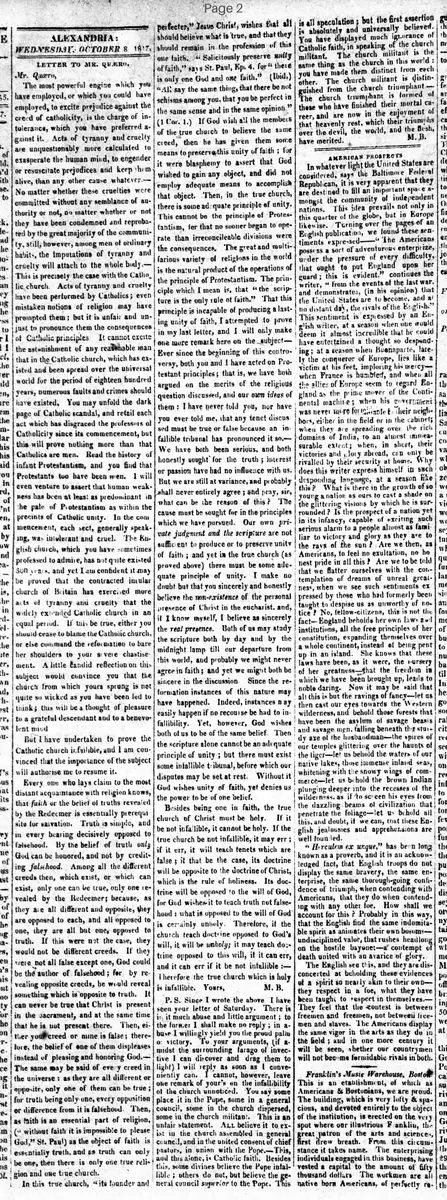
LETTER TO MR. QUERY.
The most powerful engine which you have employed, or which you could have employed, to excite prejudice against the creed of catholicity, is the charge of intolerance, which you have preferred against it. Acts of tyranny and cruelty are unquestionably more calculated to exasperate the human mind, to engender or resuscitate prejudices and keep them alive, than any other cause whatever.-- No matter whether these cruelties were committed without any semblance of authority or not, no matter whether or not they have been condemned and reprobated by the great majority of the community, still, however, among men of ordinary habits, the imputations of tyranny and cruelty will attach to the whole body.- This is precisely the case with the Catholic church. Acts of tyranny and cruelty have been performed by Catholics; even mistaken notions of religion may have prompted them; but it is unfair and unjust to pronounce them the consequences of Catholic principles. It cannot excite the astonishment of any reasonable man that in the Catholic church, which has existed and been spread over the universal world for the period of eighteen hundred years, numerous faults and crimes should have existed. You may unfold the dark page of Catholic scandal, and retail each act which has disgraced the professors of Catholicity since its commencement, but this will prove nothing more than that Catholics are men. Read the history of infant Protestantism, and you find that Protestants too have been men. I will even venture to assert that human weakness has been at least as predominant in the pale of Protestantism as within the precincts of Catholic unity. In the commencement, each sect, generally speaking, was intolerant and cruel. The English church, which you have sometimes professed to admire, has not quite existed 300 years, and yet I am confident it may be proved that the contracted insular church of Britain has exercised more acts of tyranny and cruelty than the widely extended Catholic church in an equal period. If this be true, either you should cease to blame the Catholic church, or else command the reformation to bare her shoulders to your severe chastisement. A little candid reflection on this subject would convince you that the church from which yours sprung is not quite so wicked as you have been led to think; this will be a thought of pleasure to a grateful descendant and to a benevolent mind.
But I have undertaken to prove the Catholic church infallible, and I am convinced that the importance of the subject will authorise me to resume it. Every one who lays claim to the most distant acquaintance with religion knows, that faith or the belief of truths revealed by the Redeemer is essentially prerequisite for salvation. Truth is simple, and in every bearing decisively opposed to falsehood. By the belief of truth only God can be honored, and not by crediting falsehood. Among all the different creeds then, which exist, or which can exist, only one can be true, only one revealed by the Redeemer; because, as they are all different and opposite, they are opposed to each other, and all opposed to one, they are all but one, opposed to truth. If this were not the case, they would not be different creeds. If they were not all false except one, God could be the author of falsehood; for by revealing opposite creeds, he would reveal something which is opposite to truth. It can never be true that Christ is present in the sacrament, and at the same time that he is not present there. Then, either you creed or mine is false; therefore, the belief of one of them displeases instead of pleasing and honoring God.- The same may be said of every creed in the universe: as they are all different or opposite, only one of them can be true; for truth being only one, every opposition or difference from it is falsehood. Then, as faith is an essential part of religion, ("without faith it is impossible to please God," St. Paul) as the object of faith is essentially truth, and as truth can only be one, then there is only one true religion and one true church.
In this true church, "its founder and perfecter," Jesus Christ, wishes that all should believe what is true, and that they should remain in the profession of this one faith. "Solicitously preserve unity of faith," says St. Paul, Ep. 4. or "there is only one God and one faith." (Ibid.) "All say the same thing, that there be not schisms among you, that you be perfect in the same sense and in the same opinion." (1 Cor. 1.) If God wish all the members of the true church to believe the same creed, then he has given them some means to preserve this unity of faith; for it were blasphemy to assert that God wished to gain any object, and did not employ adequate means to accomplish that object. Then, in the true church, there is some adequate principle of unity. This cannot be the principle of Protestantism, for that no sooner began to operate than irreconcileable divisions were the consequences. The great and multifarious variety of religions in the world is the natural product of the operations of the principle of Protestantism. The principle which I mean is, that "the scripture is the only rule of faith." That this principle is incapable of producing a lasting unity of faith, I attempted to prove in my last letter, and I will only make one more remark here on the subject- Ever since the beginning of this controversy, both you and I have acted on Protestant principles; that is, we have both argued on the merits of the religious question discussed, and our own ideas of them; I have never told you, nor have you ever told me, that any tenet discussed must be true or false because an infallible tribunal has pronounced it so.- We have both been serious, and both honestly sought for the truth; interest or passion have had no influence with us. But we are still at variance, and probably shall never entirely agree; and pray, sir, what can be the reason of this? The cause must be sought for in the principles which we have pursued. Our own private judgment and the scripture are not sufficient to produce or to preserve unity of faith; and yet in the true church (as proved above) there must be some adequate principle of unity. I make no doubt but that you sincerely and honestly believe the non-existence of the personal presence of Christ in the eucharist, and, if I know myself, I believe as sincerely the real presence. Both of us may study the scripture both by day and by the midnight lamp till our departure from this world, and probably we might never agree in faith; and yet we might both be sincere in the discussion. Since the reformation instances of this nature may have happened. Indeed, instances may easily happen if no recourse be had to infallibility. Yet, however, God wishes both of us to be of the same belief. Then the scripture alone cannot be an adequate principle of unity; but there must exist some infallible tribunal, before which our disputes may be set at rest. Without it God wishes unity of faith, yet denies us the power to be of one belief.
Besides being one in faith, the true church of Christ must be holy. If it be not infallible, it cannot be holy. If the true church be not infallible, it may err; if it err, it will teach tenets which are false; if that be the case, its doctrine will be opposite to the doctrine of Christ, which is the rule of holiness. Its doctrine will be opposed to the will of God. for God wishes it to teach truth not falsehood: what is opposed to the will of God is certainly unholy. Therefore, if the church teach doctrine opposed to God's will, it will be unholy; it may teach doctrine opposed to this will, if it can err, and it can err if it be not infallible: therefore the true church which is holy is infallible. Yours,
M. B.
P. S. Since I wrote the above I have seen your letter of Saturday. There is in it much abuse and little argument; to the former I shall make no reply; in abuse I willingly yield you the proud palm of victory. To your arguments, (if a-midst the surrounding farago of invective I can discover and drag them to light) I will reply as soon as I conveniently can. I cannot, however, leave one remark of yours on the infallibility of the church unnoticed. You say some place it in the Pope, some in a general council, some in the church dispersed, some in the church militant. This is an unfair statement. All believe it to exist in the church assembled in general council, and in the united consent of chief pastors, in union with the Pope. This, and thus alone, is Catholic faith. Besides this, some divines believe the Pope infallible; others do not, but believe the general council superior to the Pope. This is all speculation; but the first assertion is absolutely and universally believed. Catholic faith, in speaking of the church militant, means the same thing as the church in this world: you have displayed much ignorance of Catholic faith, you have made them distinct from each other. The church militant is distinguished from the church triumphant-- The church triumphant is formed of those who have finished their mortal career, and are now in the enjoyment of that heavenly rest, which their triumphs over the devil, the world, and the flesh, have merited.
M. B.
The most powerful engine which you have employed, or which you could have employed, to excite prejudice against the creed of catholicity, is the charge of intolerance, which you have preferred against it. Acts of tyranny and cruelty are unquestionably more calculated to exasperate the human mind, to engender or resuscitate prejudices and keep them alive, than any other cause whatever.-- No matter whether these cruelties were committed without any semblance of authority or not, no matter whether or not they have been condemned and reprobated by the great majority of the community, still, however, among men of ordinary habits, the imputations of tyranny and cruelty will attach to the whole body.- This is precisely the case with the Catholic church. Acts of tyranny and cruelty have been performed by Catholics; even mistaken notions of religion may have prompted them; but it is unfair and unjust to pronounce them the consequences of Catholic principles. It cannot excite the astonishment of any reasonable man that in the Catholic church, which has existed and been spread over the universal world for the period of eighteen hundred years, numerous faults and crimes should have existed. You may unfold the dark page of Catholic scandal, and retail each act which has disgraced the professors of Catholicity since its commencement, but this will prove nothing more than that Catholics are men. Read the history of infant Protestantism, and you find that Protestants too have been men. I will even venture to assert that human weakness has been at least as predominant in the pale of Protestantism as within the precincts of Catholic unity. In the commencement, each sect, generally speaking, was intolerant and cruel. The English church, which you have sometimes professed to admire, has not quite existed 300 years, and yet I am confident it may be proved that the contracted insular church of Britain has exercised more acts of tyranny and cruelty than the widely extended Catholic church in an equal period. If this be true, either you should cease to blame the Catholic church, or else command the reformation to bare her shoulders to your severe chastisement. A little candid reflection on this subject would convince you that the church from which yours sprung is not quite so wicked as you have been led to think; this will be a thought of pleasure to a grateful descendant and to a benevolent mind.
But I have undertaken to prove the Catholic church infallible, and I am convinced that the importance of the subject will authorise me to resume it. Every one who lays claim to the most distant acquaintance with religion knows, that faith or the belief of truths revealed by the Redeemer is essentially prerequisite for salvation. Truth is simple, and in every bearing decisively opposed to falsehood. By the belief of truth only God can be honored, and not by crediting falsehood. Among all the different creeds then, which exist, or which can exist, only one can be true, only one revealed by the Redeemer; because, as they are all different and opposite, they are opposed to each other, and all opposed to one, they are all but one, opposed to truth. If this were not the case, they would not be different creeds. If they were not all false except one, God could be the author of falsehood; for by revealing opposite creeds, he would reveal something which is opposite to truth. It can never be true that Christ is present in the sacrament, and at the same time that he is not present there. Then, either you creed or mine is false; therefore, the belief of one of them displeases instead of pleasing and honoring God.- The same may be said of every creed in the universe: as they are all different or opposite, only one of them can be true; for truth being only one, every opposition or difference from it is falsehood. Then, as faith is an essential part of religion, ("without faith it is impossible to please God," St. Paul) as the object of faith is essentially truth, and as truth can only be one, then there is only one true religion and one true church.
In this true church, "its founder and perfecter," Jesus Christ, wishes that all should believe what is true, and that they should remain in the profession of this one faith. "Solicitously preserve unity of faith," says St. Paul, Ep. 4. or "there is only one God and one faith." (Ibid.) "All say the same thing, that there be not schisms among you, that you be perfect in the same sense and in the same opinion." (1 Cor. 1.) If God wish all the members of the true church to believe the same creed, then he has given them some means to preserve this unity of faith; for it were blasphemy to assert that God wished to gain any object, and did not employ adequate means to accomplish that object. Then, in the true church, there is some adequate principle of unity. This cannot be the principle of Protestantism, for that no sooner began to operate than irreconcileable divisions were the consequences. The great and multifarious variety of religions in the world is the natural product of the operations of the principle of Protestantism. The principle which I mean is, that "the scripture is the only rule of faith." That this principle is incapable of producing a lasting unity of faith, I attempted to prove in my last letter, and I will only make one more remark here on the subject- Ever since the beginning of this controversy, both you and I have acted on Protestant principles; that is, we have both argued on the merits of the religious question discussed, and our own ideas of them; I have never told you, nor have you ever told me, that any tenet discussed must be true or false because an infallible tribunal has pronounced it so.- We have both been serious, and both honestly sought for the truth; interest or passion have had no influence with us. But we are still at variance, and probably shall never entirely agree; and pray, sir, what can be the reason of this? The cause must be sought for in the principles which we have pursued. Our own private judgment and the scripture are not sufficient to produce or to preserve unity of faith; and yet in the true church (as proved above) there must be some adequate principle of unity. I make no doubt but that you sincerely and honestly believe the non-existence of the personal presence of Christ in the eucharist, and, if I know myself, I believe as sincerely the real presence. Both of us may study the scripture both by day and by the midnight lamp till our departure from this world, and probably we might never agree in faith; and yet we might both be sincere in the discussion. Since the reformation instances of this nature may have happened. Indeed, instances may easily happen if no recourse be had to infallibility. Yet, however, God wishes both of us to be of the same belief. Then the scripture alone cannot be an adequate principle of unity; but there must exist some infallible tribunal, before which our disputes may be set at rest. Without it God wishes unity of faith, yet denies us the power to be of one belief.
Besides being one in faith, the true church of Christ must be holy. If it be not infallible, it cannot be holy. If the true church be not infallible, it may err; if it err, it will teach tenets which are false; if that be the case, its doctrine will be opposite to the doctrine of Christ, which is the rule of holiness. Its doctrine will be opposed to the will of God. for God wishes it to teach truth not falsehood: what is opposed to the will of God is certainly unholy. Therefore, if the church teach doctrine opposed to God's will, it will be unholy; it may teach doctrine opposed to this will, if it can err, and it can err if it be not infallible: therefore the true church which is holy is infallible. Yours,
M. B.
P. S. Since I wrote the above I have seen your letter of Saturday. There is in it much abuse and little argument; to the former I shall make no reply; in abuse I willingly yield you the proud palm of victory. To your arguments, (if a-midst the surrounding farago of invective I can discover and drag them to light) I will reply as soon as I conveniently can. I cannot, however, leave one remark of yours on the infallibility of the church unnoticed. You say some place it in the Pope, some in a general council, some in the church dispersed, some in the church militant. This is an unfair statement. All believe it to exist in the church assembled in general council, and in the united consent of chief pastors, in union with the Pope. This, and thus alone, is Catholic faith. Besides this, some divines believe the Pope infallible; others do not, but believe the general council superior to the Pope. This is all speculation; but the first assertion is absolutely and universally believed. Catholic faith, in speaking of the church militant, means the same thing as the church in this world: you have displayed much ignorance of Catholic faith, you have made them distinct from each other. The church militant is distinguished from the church triumphant-- The church triumphant is formed of those who have finished their mortal career, and are now in the enjoyment of that heavenly rest, which their triumphs over the devil, the world, and the flesh, have merited.
M. B.
What sub-type of article is it?
Persuasive
Religious
Philosophical
What themes does it cover?
Religion
What keywords are associated?
Catholic Church
Infallibility
Intolerance
Protestantism
Unity Of Faith
True Religion
Eucharist
Scripture Alone
What entities or persons were involved?
M. B.
Mr. Query.
Letter to Editor Details
Author
M. B.
Recipient
Mr. Query.
Main Argument
the catholic church is the only true and infallible church, defended against intolerance charges as human failings common to all religions, requiring an infallible authority for unity of faith unlike protestantism's divisions.
Notable Details
Compares Catholic And Protestant History Of Intolerance
Cites St. Paul On Unity Of Faith
Argues Logically For One True Creed
References Real Presence In Eucharist
Clarifies Catholic Views On Infallibility In P.S.