Thank you for visiting SNEWPapers!
Sign up free
Story
March 10, 1906
Bisbee Daily Review
Bisbee, Cochise County, Arizona
What is this article about?
At Central School, Superintendent Philbrook strictly enforces rules against students writing on walls or passing notes during breaks, using corporal punishment like ruler whippings to eliminate the practice, especially among defiant boys.
Clipping
OCR Quality
95%
Excellent
Full Text
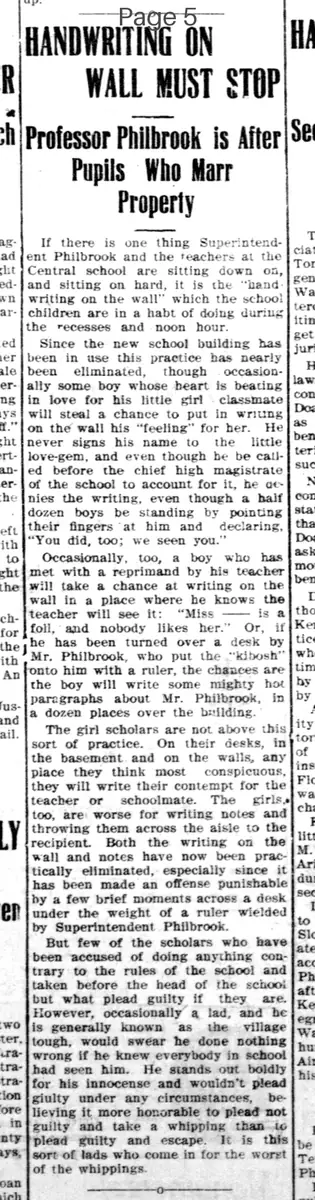
HANDWRITING ON WALL MUST STOP
Professor Philbrook is After Pupils Who Marr Property.
If there is one thing Superintendent Philbrook and the teachers at the Central school are sitting down on, and sitting on hard, it is the "hand writing on the wall" which the school children are in a habit of doing during the recesses and noon hour.
Since the new school building has been in use this practice has nearly been eliminated, though occasionally some boy whose heart is beating in love for his little girl classmate will steal a chance to put in writing on the wall his "feeling" for her. He never signs his name to the little love-gem, and even though he be called before the chief high magistrate of the school to account for it, he denies the writing, even though a half dozen boys be standing by pointing their fingers at him and declaring, "You did, too; we seen you."
Occasionally, too, a boy who has met with a reprimand by his teacher will take a chance at writing on the wall in a place where he knows the teacher will see it: "Miss - is a fool, and nobody likes her." Or, if he has been turned over a desk by Mr. Philbrook, who put the "kibosh" onto him with a ruler, the chances are the boy will write some mighty hot paragraphs about Mr. Philbrook in a dozen places over the building.
The girl scholars are not above this sort of practice. On their desks, in the basement and on the walls, any place they think most conspicuous, they will write their contempt for the teacher or schoolmate. The girls, too, are worse for writing notes and throwing them across the aisle to the recipient. Both the writing on the wall and notes have now been practically eliminated, especially since it has been made an offense punishable by a few brief moments across a desk under the weight of a ruler wielded by Superintendent Philbrook.
But few of the scholars who have been accused of doing anything contrary to the rules of the school and taken before the head of the school but what plead guilty if they are. However, occasionally a lad, and he is generally known as the village tough, would swear he done nothing wrong if he knew everybody in school had seen him. He stands out boldly for his innocence and wouldn't plead guilty under any circumstances, believing it more honorable to plead not guilty and take a whipping than to plead guilty and escape. It is this sort of lads who come in for the worst of the whippings.
Professor Philbrook is After Pupils Who Marr Property.
If there is one thing Superintendent Philbrook and the teachers at the Central school are sitting down on, and sitting on hard, it is the "hand writing on the wall" which the school children are in a habit of doing during the recesses and noon hour.
Since the new school building has been in use this practice has nearly been eliminated, though occasionally some boy whose heart is beating in love for his little girl classmate will steal a chance to put in writing on the wall his "feeling" for her. He never signs his name to the little love-gem, and even though he be called before the chief high magistrate of the school to account for it, he denies the writing, even though a half dozen boys be standing by pointing their fingers at him and declaring, "You did, too; we seen you."
Occasionally, too, a boy who has met with a reprimand by his teacher will take a chance at writing on the wall in a place where he knows the teacher will see it: "Miss - is a fool, and nobody likes her." Or, if he has been turned over a desk by Mr. Philbrook, who put the "kibosh" onto him with a ruler, the chances are the boy will write some mighty hot paragraphs about Mr. Philbrook in a dozen places over the building.
The girl scholars are not above this sort of practice. On their desks, in the basement and on the walls, any place they think most conspicuous, they will write their contempt for the teacher or schoolmate. The girls, too, are worse for writing notes and throwing them across the aisle to the recipient. Both the writing on the wall and notes have now been practically eliminated, especially since it has been made an offense punishable by a few brief moments across a desk under the weight of a ruler wielded by Superintendent Philbrook.
But few of the scholars who have been accused of doing anything contrary to the rules of the school and taken before the head of the school but what plead guilty if they are. However, occasionally a lad, and he is generally known as the village tough, would swear he done nothing wrong if he knew everybody in school had seen him. He stands out boldly for his innocence and wouldn't plead guilty under any circumstances, believing it more honorable to plead not guilty and take a whipping than to plead guilty and escape. It is this sort of lads who come in for the worst of the whippings.
What sub-type of article is it?
Curiosity
What themes does it cover?
Crime Punishment
Social Manners
What keywords are associated?
School Discipline
Writing On Walls
Passing Notes
Corporal Punishment
Superintendent Philbrook
Student Misbehavior
What entities or persons were involved?
Superintendent Philbrook
Professor Philbrook
Where did it happen?
Central School
Story Details
Key Persons
Superintendent Philbrook
Professor Philbrook
Location
Central School
Story Details
Superintendent Philbrook and teachers crack down on students' habit of writing on walls and passing notes, using ruler punishments to enforce rules, with most students admitting guilt but defiant boys receiving harsher treatment.