Thank you for visiting SNEWPapers!
Sign up free
Norfolk Gazette And Publick Ledger
Norfolk, Virginia
What is this article about?
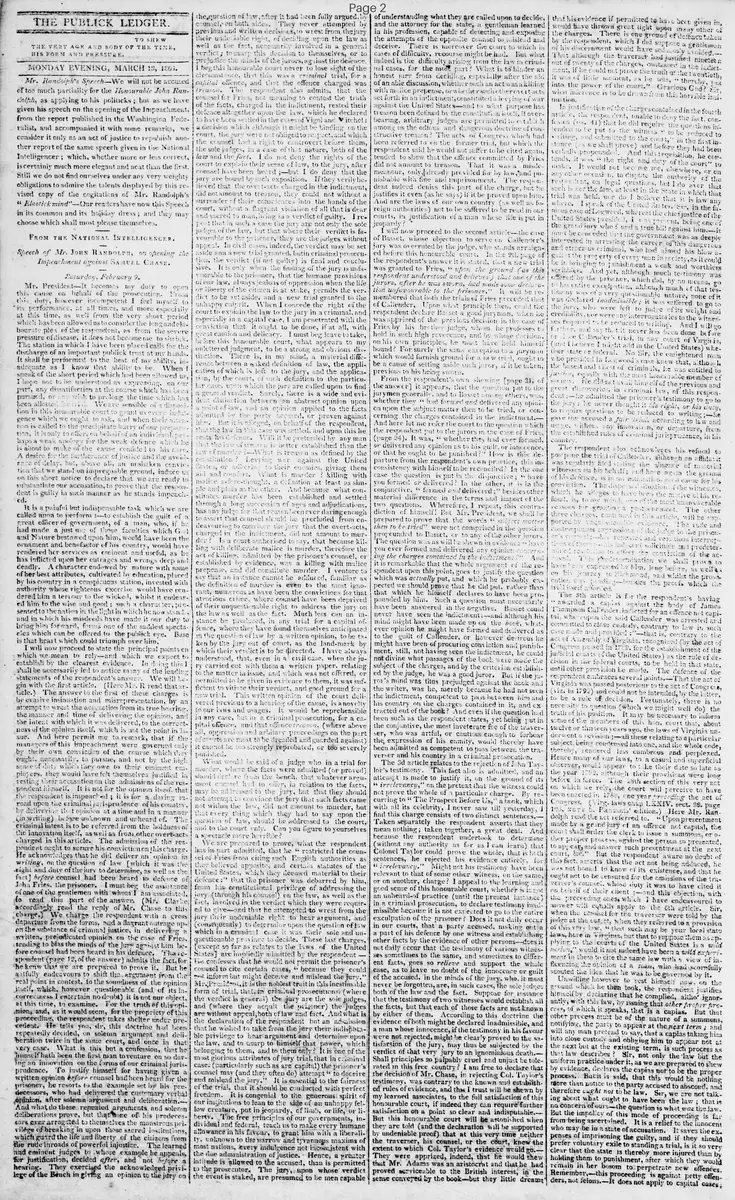
The Publick Ledger republishes John Randolph's speech from the National Intelligencer opening the impeachment trial of Supreme Court Justice Samuel Chase in the Senate on February 9, 1805. Randolph accuses Chase of judicial misconduct in the trials of John Fries for treason and James Callender for libel, including delivering prejudged written opinions, restricting counsel, improper jury selection, rejecting evidence, and partisan behavior.
Merged-components note: Continuation of the same article across pages 2 and 3, as the text flows directly from one to the next.
Clippings
1 of 2
OCR Quality
Full Text
TO SHEW
THE VERY AGE AND BODY OF THE TIME,
HIS FORM AND PRESSURE.
MONDAY EVENING, MARCH 18, 1805.
Mr. Randolph's Speech—We will not be accused of too much partiality for the Honourable John Randolph, as applying to his politicks; but as we have given his speech on the opening of the Impeachment, from the report published in the Washington Federalist, and accompanied it with some remarks, we consider it only as an act of justice to republish another report of the same speech given in the National Intelligencer; which, whether more or less correct, is certainly much more elegant and neat than the first. Still we do not find ourselves under any very weighty obligations to admire the talents displayed by this revised copy of the cogitations of Mr. Randolph's "Elastic mind"—Our readers have now this Speech in its common and its holiday dress; and they may choose which shall most please themselves.
From the National Intelligencer.
Speech of Mr. John Randolph, on opening the Impeachment against SAMUEL CHASE.
Saturday, February 9.
Mr. President—It becomes my duty to open this cause on behalf of the prosecution. From this duty, however incompetent I feel myself to its performance, at all times, and more especially at this time, as well from the very short period which has been allowed us to consider the long and elaborate plea of the respondent, as from the severe pressure of disease, it does not become me to shrink. The station in which I have been placed calls for the discharge of an important publick trust at my hands. It shall be performed to the best of my ability, inadequate as I know that ability to be. When I speak of the short period which had been allowed us, I hope not to be understood as expressing, on our part, any dissatisfaction at the course which has been pursued, or any wish to prolong the time which has been allotted for trial. We are sensible of a disposition in this honourable court to grant us every indulgence which we ought to ask, and when their attention is called to the precipitate hurry of our preparation, it is only to offer, on behalf of an individual, perhaps a weak apology for the weak defence which he is about to make of the cause confided to his care. A desire for the furtherance of justice and the avoidance of delay, but, above all, an unshaken conviction that we stand on impregnable ground, induce us on this short notice to declare that we are ready to substantiate our accusation, to prove that the respondent is guilty in such manner as he stands impeached.
It is a painful but indispensable task which we are called upon to perform:—to establish the guilt of a great officer of government, of a man, who, if he had made a just use of those faculties which God and Nature bestowed upon him, would have been the ornament and benefactor of his country, would have rendered her services as eminent and useful, as he has inflicted upon her outrages and wrongs deep and deadly. A character endowed by nature with some of her best attributes, cultivated by education, placed by his country in a conspicuous station, invested with authority whose righteous exercise would have rendered him a terror to the wicked, whilst it endeared him to the wise and good: such a character, presented to the nation in the light in which he now stands, and in which his misdeeds have made it our duty to bring him forward, forms one of the saddest spectacles which can be offered to the publick eye. Base is that heart which could triumph over him.
I will now proceed to state the principal points on which we mean to rely—and which we expect to establish by the clearest evidence. In doing this I shall be necessarily led to notice many of the leading statements of the respondent's answer. We will begin with the first article. (Here Mr. R. read that article.) The answer to the first of these charges is by evasive insinuation and misrepresentation, by an attempt to wrest the accusation from its true bearing, the manner and time of delivering the opinion, and the intent with which it was delivered, to the correctness of the opinion itself, which is not the point in issue. And here permit me to remark, that if the managers of this impeachment were governed only by their own conviction of the course which they ought, necessarily, to pursue, and not by the high sense of duty which they owe to their eminent employers, they would have felt themselves justified in resting their accusation on the admissions of the respondent himself. It is not for the opinion itself, that the respondent is impeached; it is for a daring inroad upon the criminal jurisprudence of his country, by delivering that opinion at a time and in a manner (in writing) before unknown and unheard of. The criminal intent is to be inferred from the boldness of the innovation itself, as well as from other overt-acts charged in this article. The admission of the respondent ought to secure his conviction on this charge. He acknowledges that he did deliver an opinion in writing, on the question of law [which it was the right and duty of the jury to determine, as well as the fact] before counsel had been heard in defence of John Fries, the prisoner. I must beg the assistance of one of the gentlemen with whom I am associated, to read this part of the answer. (Mr. Clarke accordingly read the reply of Mr. Chase to this charge.) We charge the respondent with a gross departure from the forms, and a flagrant outrage upon the substance of criminal justice, in delivering a written, prejudicated opinion on the case of Fries, tending to bias the minds of the jury against him before counsel had been heard in his defence. The respondent (page 12, of the answer) admits the fact, for he knew that we are prepared to prove it. But he artfully endeavours to shift the argument from the real point in contest, to the soundness of the opinion itself, which, however questionable (and of its incorrectness I entertain no doubt) it is not our object, at this time, to examine. For the truth of this opinion, and, as it would seem, for the propriety of this proceeding, the respondent takes shelter under precedent. He tells you, sir, this doctrine had been repeatedly decided, on solemn argument and deliberation twice in the same court, and once in that very case. What is this but a confession, that he himself hath been the first man to venture on so daring an innovation on the forms of our criminal jurisprudence. To justify himself for having given a written opinion before counsel had been heard for the prisoner, he resorts to the example set by his predecessors, who had delivered the customary verbal opinion, after solemn argument and deliberation.—And what do these repeated arguments and solemn deliberations prove, but that none of his predecessors ever arrogated to themselves the monstrous privilege of breaking in upon those sacred institutions, which guard the life and liberty of the citizens from the rude inroads of powerful injustice. The learned and eminent judges to whose example he appeals, for justification, decided after, and not before a hearing. They exercised the acknowledged privilege of the Bench in giving an opinion to the jury on the question of law, after it had been fully argued, by counsel, on both sides. They never attempted by previous and written decisions, to wrest from the jury their undeniable right, of deciding upon the law as well as the fact, necessarily involved in a general verdict; to usurp this decision to themselves, or to prejudice the minds of the jurors, against the defence.
I beg this honourable court never to lose sight of the circumstance, that this was a criminal trial, for a capital offence, and that the offence charged was treason. The respondent also admits, that the counsel for Fries, not meaning to contest the truth of the facts, charged in the indictment, rested their defence altogether upon the law, which he declared to have been settled in the cases of Vigol and Mitchell: a decision which although it might be binding on the court, the jury were not obliged to respect, and which the counsel had a right to controvert before them, the sole judges, in a case of that nature, both of the law and the fact. I do not deny the rights of the court to explain their sense of law, to the jury, after counsel have been heard; but I do deny that the jury are bound by such exposition. If they verily believed that the overt-acts charged in the indictment, did not amount to treason, they could not without a surrender of their consciences into the hands of the court, without a flagrant violation of all that is dear and sacred to man, bring in a verdict of guilty. I repeat that in such a case the jury are not only the sole judges of the law, but that where their verdict is favourable to the prisoner, they are the judges without appeal. In civil cases, indeed, the verdict may be set aside and a new trial granted, but in criminal prosecution, the verdict (if not guilty) is final and conclusive. It is only when the finding of the jury is unfavourable to the prisoner, that the humane provisions of our law, always jealous of oppression when the life or liberty of the citizen is at stake, permits the verdict to be set aside, and a new trial granted to the unhappy culprit. When I concede the right of the court to explain the law to the jury in a criminal, and especially in a capital case, I am penetrated with the conviction that it ought to be done, if at all, with great caution and delicacy. I must beg leave to take, before this honourable court, what appears to my unlettered judgment, to be a strong and obvious distinction. There is, in my mind, a material difference between a naked definition of law, the application of which is left to the jury, and the application, by the court, of such definition to the particular case, on which the jury are called upon to find a general verdict. Surely, there is a wide and evident distinction between an abstract opinion upon a point of law, and an opinion applied to the facts admitted by the party accused, or proven against him. But it is alleged, on behalf of the respondent, that the law in this case was settled, and upon this he rests his defence. Will it be pretended by any man that the law of treason is better established than the law of murder?—What is treason as defined by the constitution? Levying war against the United States, or adhering to their enemies, giving them aid and comfort. What is murder? Killing with malice aforethought, a definition at least as simple and plain as the other. And because what constitutes murder has been established and settled through a long succession of ages and adjudications, has any judge for that reason been ever daring enough to assert that counsel should be precluded from endeavouring to convince the jury that the overt-acts, charged in the indictment, did not amount to murder? Is a court authorised to say, that because killing with deliberate malice is murder, therefore the act of killing, admitted by the prisoner's counsel, or established by evidence, was a killing with malice prepense, and did constitute murder. I venture to say that an instance cannot be adduced, familiar as the definition of murder is even to the most ignorant, numerous as have been the convictions for that atrocious crime, where counsel have been deprived of their unquestionable right to address the jury on the law as well as the fact. Much less can an instance be produced, in any trial for a capital offence, where they have found themselves anticipated in the question of law by a written opinion, to be taken by the jury out of court, as the land-mark by which their verdict is to be directed. I have always understood, that, even in a civil case, when the jury carried out with them a written paper, relating to the matter in issue, and which was not offered, or permitted to be given in evidence to them, it was sufficient to vitiate their verdict, and good ground for a new trial. This written opinion of the court delivered previous to a hearing of the cause, is a novelty to our laws and usages. It would be reprehensible in any case, but in a criminal prosecution, for a capital offence, and that offence treason, (where above all, oppression and arbitrary proceedings on the part of courts are most to be dreaded and guarded against) it cannot be too strongly reprobated, or too severely punished.
What would be said of a judge who in a trial for murder, where the facts were admitted (or proved) should declare from the bench, that whatever argument counsel had to offer, in relation to the facts, may be addressed to the jury, but that they should not attempt to convince the jury that such facts came not within the law, did not amount to murder, but that every thing which they had to say upon the question of law, should be addressed to the court, and to the court only. Can you figure to yourselves a spectacle more horrible?
We are prepared to prove, what the respondent has in part admitted, that he "restricted the counsel of Fries from citing such English authorities as they believed apposite, and certain statutes of the United States, which they deemed material to their defence:" that the prisoner was debarred by him, from his constitutional privilege of addressing the jury (through his counsel) on the law, as well as the fact, involved in the verdict which they were required to give—and that he attempted to wrest from the jury their undeniable right to hear argument, and (consequently) to determine upon the question of law which in a criminal case it was their sole and unquestionable province to decide. These last charges, [except so far as relates to the laws of the United States] are impliedly admitted by the respondent—He confesses that he would not permit the prisoner's counsel to cite certain cases, "because they could not inform but might deceive and mislead the jury." Mr. President, it is the noblest fruit in this inestimable form of trial, that, in criminal prosecutions: (where the verdict is general) the jury are the sole judges, and (where they acquit the prisoner) the judges without appeal, both of law and fact. And what is the declaration of the respondent but an admission that he wished to take from the jury their indisputable privilege to hear argument and determine upon the law, and to usurp to himself that power, which belonging to them, and to them only? It is one of the most glorious attributes of jury trial, that in criminal cases (particularly such as are capital) the prisoner's counsel may (and they often do) attempt "to deceive and mislead the jury." It is essential to the fairness of the trial, that it should be conducted with perfect freedom. It is congenial to the generous spirit of our institutions to lean to the side of an unhappy fellow creature, put in jeopardy, of limb, or life, or liberty. The free principles of our governments, individual and federal, teach us to make every humane allowance in his favour, to grant him with a liberality, unknown to the narrow and tyrannous maxims of most nations, every indulgence not inconsistent with the due administration of justice. Hence, a greater latitude is allowed to the accused, than is permitted to the prosecutor. The jury, upon whose verdict the event is staked, are presumed to be men capable of understanding what they are called upon to decide. And the attorney for the state, a gentleman learned in his profession, capable of detecting and exposing the attempts of the opposite Counsel to mislead and deceive. There is moreover the court to which in cases of difficulty, recourse might be had. But what indeed is the difficulty arising from the law in criminal cases, for the most part? What is to hinder an honest jury from deciding, especially after the aid of an able discussion, whether such an act was a killing with malice prepense, or whether such other overt acts set forth in an indictment, constituted a levying of war against the United States—and to what purpose has treason been defined by the constitution itself, if overbearing, arbitrary judges are permitted to establish among us the odious and dangerous doctrine of constructive treason? The acts of Congress which had been referred to by the former trial, but which the respondent said he would not suffer to be cited again, tended to shew that the offence committed by Fries did not amount to treason. That it was a misdemeanour, only, already provided for by law, and punishable with fine and imprisonment. The respondent indeed denies this part of the charge, but he justifies it even (as he says) if it be proved upon him. And are the laws of our own country (as well as foreign authorities) not to be suffered to be read in our courts, in justification of a man whose life is put in jeopardy?
I will now proceed to the second article—the case of Basset, whose objection to serve on Callender's jury was overruled by the judge, who stands arraigned before this honourable court. In the 9th page of the respondent's answer it is stated, that a new trial was granted to Fries, "upon the ground (as this respondent understood and believes) that one of the jurors, after he was sworn, had made some declaration unfavourable to the prisoner." It will be remembered that both the trials of Fries preceded that of Callender. Upon what principle then, could the respondent declare Basset a good juryman, when he was apprized of the previous decision in the case of Fries by his brother judge, whom he professes to hold in such high reverence, and by whose decision, on his own principles, he must have held himself bound? For surely the same exception to a juryman which would furnish ground for a new trial, ought to be a cause of setting aside such juror, if it be taken, previous to his being sworn.
From the respondent's own shewing [page 31, of the answer] it appears, that the question put to the jurymen generally, and to Basset among others, was, whether they "had formed and delivered any opinion upon the subject matter then to be tried, or concerning the charges contained in the indictment.—And here let me refer the court to the question which the respondent put to the jurors in the case of Fries, (page 24). It was, "whether they had ever formed, or delivered any opinion as to his guilt, or innocence, or that he ought to be punished?" How is this departure from the respondent's own practice, this inconsistency with himself to be reconciled? In the one case the question is put in the disjunctive; "have you formed or delivered? In the other, it is in the conjunctive. "formed and delivered;" besides other material difference in the terms and import of the two questions. Wherefore, I repeat, this contradiction of himself! But Mr. President, we shall be prepared to prove that the words "subject matter then to be tried" were not comprised in the question propounded to Basset, or to any of the other jurors. The question was as will be shewn in evidence "have you ever formed and delivered any opinion: concerning the charges contained in the indictment?"
And it is remarkable that the whole argument of the respondent upon this point, goes to justify the question which was actually put, and which he probably expected we should prove that he did put, rather than that which he himself declares to have been propounded by him. Such a question must necessarily have been answered in the negative. Basset could never have seen the indictment:—and although his mind might have been made up on the book, whatever opinion he might have formed and delivered as to the guilt of Callender, or however desirous he might have been of procuring conviction and punishment, still, not having seen the indictment, he could not divine what passages of the book were made the subject of the charges, and by the criterion established by the judge, he was a good juror. But if the juror's mind was thus prejudged against the book and the writer, was he, merely because he had not seen the indictment, competent to pass between him and his country on the charges contained in it, and extracted out of the book? And even if the question had been such as the respondent states, yet being put in the conjunctive, the most inveterate foe of the traverser, who was artful, or cautious enough to forbear the expression of his enmity, would thereby have been admitted as competent to pass between the traverser and his country in a criminal prosecution.
The 3d article relates to the rejection of John Taylor's testimony. This fact also is admitted, and an attempt is made to justify it, on the ground of its "irrelevancy," on the pretext that the witness could not prove the whole of a particular charge. By recurring to "The Prospect Before Us," a book, which with all its celebrity, I never saw till yesterday, I find this charge consists of two distinct sentences.—Taken separately the respondent asserts that they mean nothing; taken together, a great deal. And because the respondent undertook to determine (without any authority as far as I can learn) that Colonel Taylor could prove the whole, that is both sentences, he rejected his evidence entirely, for "irrelevancy." Might not his testimony have been relevant to that of some other witness, on the same, or on another, charge? I appeal to the learning and good sense of this honourable court, whether it is not an unheard-of practice (until the present instance) in a criminal prosecution, to declare testimony inadmissible because it is not expected to go to the entire exculpation of the prisoner? Does it not daily occur in our courts, that a party accused, making out a part of his defence by one witness and establishing other facts by the evidence of other persons—does it not daily occur that the testimony of various witnesses sometimes to the same, and sometimes to different facts, goes to relieve and support the whole case, as to leave no doubt of the innocence or guilt of the accused, in the minds of the jury, who, it must never be forgotten, are, in such cases, the sole judges both of the law and the fact. Suppose for instance that the testimony of two witnesses would establish all the facts, but that each of those facts are not known by either of them. According to this doctrine the evidence of both might be declared inadmissible, and a man whose innocence, if the testimony in his favour were not rejected, might be clearly proved to the satisfaction of the jury, may thus be subjected by the verdict of that very jury to an ignominious death.—Shall principles so palpably cruel and unjust be tolerated in this free country? I am free to declare that the decision of Mr. Chase, in rejecting Col. Taylor's testimony, was contrary to the known and established rules of evidence, and those I trust will be shewn by my learned associates, to the full satisfaction of this honourable court, if indeed they can require further satisfaction on a point so clear and indisputable.—But this honourable court will be astonished when they are told (and the declaration will be supported by undeniable proof) that at this very time neither the traverser, his counsel, or the court, knew the extent to which Col. Taylor's evidence would go. They were apprized, indeed, that he would shew that Mr. Adams was an aristocrat and that he had proved serviceable to the British interest, in the sense conveyed by the book—but they little dreamt that his evidence if permitted to have been given in, would have thrown great light upon many other of the charges. There is one ground of defence taken by the respondent, which I did suppose a gentleman of his discernment would have sedulously avoided.—That although the traverser had justified nineteen out of twenty of the charges, contained in the indictment, if he could not prove the truth of the twentieth, it was of little use, as he was, "thereby, inc.
into the power of the court." Gracious God! Sir what inference is to be drawn from this horrible insinuation.
In justification of the charges contained in the fourth article, the respondent, unable to deny the fact, confesses (p. 41) that he did require the questions intended to be put to the witness "to be reduced to writing, and submitted to the court," in the first instance (as we shall prove) and before they had been verbally propounded. And this requisition, he contends, it was "the right and duty of the court" to make. It would not become me, elsewhere, or on any other occasion, to dispute the authority of the respondent, on legal questions. but I do aver that such is not the law, at least in the State in which that trial was held. nor do I believe that it is law anywhere. I speak of the United States. Sir, in the famous case of Logwood, wherein the chief justice of the United States presided, I was present, being one of the grand jury who found a true bill against him:—It must be conceded that the government was as deeply interested in arresting the career of this dangerous and atrocious criminal, who had aimed his blow against the property of every man in society, as it could be in bringing to punishment a weak and worthless scribbler. And yet, although much testimony was offered by the prisoner, which did, by no means, go to his entire exculpation, although much of that testimony was of a very questionable nature, none of it was declared inadmissible; it was suffered to go to the jury, who were left to judge of its weight and credibility. nor were any interrogatories to the witnesses required to be reduced to writing. And I will go further, and say that it never has been done before or since Callender's trial, in any court of Virginia. (and I believe I might add in the United States) whether state or federal. No Sir, the enlightened man who presided in Logwood's case knew that, although the basest and vilest of criminals, he was entitled to justice, equally with the most honourable member of society. He did not avail himself of the previous and great discoveries, in criminal law, of this respondent;—he admitted the prisoner's testimony to go to the jury : he never thought it his right, or his duty, to require questions to be reduced to writing;—he gave the accused a fair trial, according to law and usage, without any innovation, or departure, from the established rules of criminal jurisprudence, in his country.
The respondent also acknowledges his refusal to postpone the trial of Callender, although an affidavit was regularly filed stating the absence of material witnesses on his behalf; and he even again the ground of his defence, is an admission good cause for his conviction. The distressed situation of the witnesses, which he alleges to have been the motive of his refusal, is, to my mind, one of the most unanswerable reasons for granting a postponement. The other three charges, contained in this article, will be supported by unquestionable evidence. The rude and contemptuous expressions of the judge to the prisoner's counsel: his repeated and vexatious interruptions either his indecent solicitude and predetermination, to effect the conviction of the accused. This predetermination we shall prove to have been expressed by him, long before, as well on his journey to Richmond, and whilst the prosecution was pending—besides the proofs which the trial itself afforded.
The 5th article is for the respondent's having "awarded a capias against the body of James Thompson Callender, indicted for an offence not capital, whereupon the said Callender was arrested and committed to close custody, contrary to law in such case made and provided :"—that is, contrary to the act of Assembly of Virginia, recognized (by the act of Congress passed in 1789, for the establishment of the judicial courts of the United States) as the rule of decision in the federal courts, to be held in that state, until other provision be made. The defence of the respondent embraces several points.—That the act of Virginia was passed posterior to the act of Congress, (viz. in 1792) and could not be intended, by the latter, to be a rule of decision. Fortunately, there is no necessity to question (which we might well do) the truth of his position. It may be necessary to inform some of the members of this hon. court that, about twelve or thirteen years ago, the laws of Virginia underwent a revision;—all these relating to a particular subject, being condensed into one, and the whole code, thereby, rendered less cumbrous and perplexed. Hence many of our laws, to a casual and superficial observer, would appear to take their date so late as the year 1792, although their provisions were long before in force. The 28th section of this very act on which we rely, the court will perceive to have been enacted in 1788, one year preceding the act of Congress. (Virg. laws chap. LXXIV. sect. 28. page 105, Note b. Pleasants' edition.) Here Mr. Randolph read the act referred to. "Upon presentment made by a grand jury of an offence not capital, the court shall order the clerk to issue a summons, or other proper process, against the person so presented, to appear, and answer such presentment at the next court, &c." But the respondent aware no doubt of this fact, asserts that the act not being adduced, he was not bound to know of its existence, and that he ought not to be censured for the omissions of the traverser's counsel, whose duty it was to have cited it on behalf of their client;—and this objection, with the preceding ones, which I have endeavoured to answer will equally apply to the 6th article. Sir, when the counsel for the traverser were told by the judge at the outset, when they referred to a provision of this very law, "that such may be your local state laws, here in Virginia, but that to suppose them as applying to the courts of the United States is a wild notion," would it not indeed have been a wilder experiment in them to cite the same law with a view of influencing the opinion of a man, who had scornfully scouted the idea that he was to be governed by it. Unwilling however to rest himself now, on the ground which he then took, the respondent justifies himself by, declaring that he complied, although ignorantly, with this law, by issuing that other proper process, of which it speaks, that is a capias. But that other process must be of the nature of a summons, notifying, the party to appear at the next term; and will any man pretend to say, that a capias taking him into close custody and obliging him to appear not at the next but at the existing term, is such process as that law describes? Sir, not only the law but the uniform practice under it, as we are prepared to shew by evidence, declares the capias not to be the proper process. But it is said, that this would be nothing more than notice to the party accused to abscond, and therefore ought not to be law. Sir, we are not talking about what ought to have been the law; that is no concern of ours the question is what was the law. But the impolicy of this mode of proceeding is far from being ascertained. It is a relief to the innocent who may be in a state of accusation. It saves the expenses of imprisoning the guilty, and if they should prefer voluntary exile to standing a trial, is it so very clear that the state is thereby more injured than by holding them to punishment, after which they would remain in her bosom to perpetrate new offences. Remember,—this proceeding is against petty offenders, not felons.—It does not apply to capital cases: to felonies, then capital, for which our law has, since commuted the punishment of death, into that of imprisonment at hard labour.
For further defence against the 6th article, the respondent takes shelter under this position: That the provision of the law of the U. States establishing the judicial courts relates only to rights acquired under state law, which come into question on the trial, and not to forms of process before the trial, and can have no application to offences created by statute, which cannot with propriety, be termed trials at "common law." We are prepared to shew that the words "trials at common law" are used in that statute, not in their most restricted sense, but to contra-distinguish a certain description of cases from those arising in equity, or under maritime, or civil law.
I will pass over the seventh article of impeachment, as well because I am nearly exhausted, as being content to leave it on the ground where the respondent himself has placed it. It would be impossible for us to put it in a stronger light, than has been thrown upon it by his own admission.
The eighth and last article remains to be considered, (article read.) I ask this honourable court whether the prostitution of the bench of justice to the purposes of an hustings is to be tolerated?
We have nothing to do with the politicks of the man. Let him speak and write and publish as he pleases. This is his right in common with his fellow citizens- The press is free. If he must electioneer and abuse the government under which he lives, I know no law to prevent or punish him, provided he seeks the wonted theatres for his exhibition. But shall a judge declaim on these topicks from his seat of office. Shall he not put off the political partizan when he ascends the tribune--or shall we have the pure streams of publick justice polluted with the venom of party virulence? In short, does it not follow that a judge carries all the rights of a private citizen with him upon the bench, and that he may, there, do every act, which, as a freeman, he may do elsewhere, without being questioned for his conduct?
But, Sir, we are told that this high court is not a court of errours and appeals, but a court of impeachment, and that however incorrectly the respondent might have conducted himself, proof must be adduced of criminal intent, of wilful errour, to constitute guilt. The quo animo is to be inferred from the facts themselves: there is no other mode by which in any case it can be determined, and even the respondent admits that there are acts of a nature so flagrant that guilt must be inferred from them, if the party be of sound mind. But this concession is qualified by the monstrous pretension that an act to be impeachable, must be indictable. Where? In the federal courts? There not even robbery and murder are indictable, except in a few places under our exclusive jurisdiction. It is not an indictable offence under the law of the U. States for a judge to go on the bench in a state of intoxication--it may not be in all the state courts. But it is indictable no where, for him to omit to do his duty, to refuse to hold a court? yet who can doubt that both are impeachable offences, and ought to subject the offender to removal from office? But in this long and disgusting catalogue of crimes and misdemeanours (which he has in a great measure confessed) the respondent tells you he had accomplices and that what was guilt in him could not be innocence in them. I must beg the court to consider the facts alleged against the respondent in all their accumulated atrocity--not to take them, each in an insulated point of view, but as a chain of evidence indissolubly linked together, and establishing the indisputable proof of his guilt. Call to mind his high standing and character, and his superiour age and rank, and then ask yourselves whether he stands justified in a long course of oppression in justice, because men of weak intellect, and lesser temper--men of far inferiour standing to the respondent, have tamely acquiesced in such acts of violence and outrage? He is charged with various acts of injustice, with a series of misconduct, so connected to time and place, and circumstance as to leave no doubt, on my mind at least, of intentional ill. Can this be justified, because his several associates have at several times and occasions barely yielded a faint compliance, which perhaps they dared not withhold. Can they be considered as equally culpable with him whose accumulated crimes are to be divided amongst them, who had given at best but a negative sanction to them. But, Sir, would the establishment of their guilt prove his innocence? At most it would only prove that they too ought to be punished. Whenever we behold the respondent sitting in judgement, there do we behold violence and injustice. Before him the counsel are always contumacious. The most accomplished advocates of the different states whose demeanour to his brethren is uniformly conciliating and temperate, are to him only, obstinate, perverse, rude and irritating. Contumacy has been found to exist only where he presided.
Mr. President, it appears to me that one great distinction remains yet to be taken. A distinction between a judge zealous to punish and repress crimes generally, and a judge anxious only to enforce a particular law whereby he may recommend himself to power, or to his party. it is this hideous feature of the respondent's judicial character, on which I would fix your attention. We do not charge him with a general zeal in the discharge of his high office, but with an indecent zeal in particular cases, for laws of doubtful and suspicious aspect. It is only in cases of constructive treason and libel, that his zeal breaks out. Through the whole tenour of his judicial conduct runs the spirit of party. I could cite the name and authority of a judge of whom if I might be permitted to speak, I would say, that he was no less a terrour to evil doers than a shield to the oppressed. In a commendable zeal for the faithful execution of the laws, he has never been surpassed either in tenderness to the liberty of the citizen, nor the liberty of the press, nor trial by jury. [Here Mr. R. read the following passage from Tucker's Blackstone, vol. 4. p. 360.] "But it is not customary nor agreeable to the general course of proceeding (unless by consent of parties, or where the defendant is actually in gaol) to try persons indicted of smaller misdemeanours at the same court in which they have pleaded not guilty, or traversed the indictment. (What follows is subjoined in a note:) And this is the practice in Virginia, but in the case of the U. States against Callender, in the federal court at Richmond, May 1800, a different course was pursued, although the act of Congress (1 Cong. 3 Sep: chap. 20.- Sec. 32.) may be interpreted otherwise." This is the very act and section on which we rely.
I have endeavoured Mr. President in a manner, I am sensible, very lame and inadequate, to discharge the duty incumbent on me; to enumerate the principal points upon which we shall rely, and to repel some of the prominent objections advanced by the respondent. Whilst we confidently expect on his conviction, it is from the strength of our cause, and not from any art or skill, in conducting it. It requires so little support that I thank Heaven it cannot be injured by any weakness of mine. We shall bring forward in proof, such a specimen of judicial tyranny, as I trust in God, will never be again exhibited in our country.
The respondent hath closed his defence by an appeal to the searcher of hearts for the purity of his motives. For his sake I rejoice, that, by the timely exercise of that mercy, which, for wise purposes has been reposed in the executive, this appeal is not drowned by the blood of an innocent man crying aloud for vengeance--that the mute agony of widowed despair and the wailing voice of the orphan do not plead to Heaven for justice on the oppressor's head. But for that intervention, self accusation before that dread tribunal would have been needless. On that awful day the blood of a poor, ignorant, friendless, unlettered German, murdered under the semblance and colour of law, sent without pity to the scaffold, would have risen in judgment at the Throne of Grace, against the unhappy man arraigned at your bar. But the president of the United States by a well timed act, at once of justice and of mercy, (and mercy like charity covereth a multitude of sins), wrested the victim from his grasp, and saved him from the countless horrors, of remorse, by not suffering the pure ermine of justice to be dyed in the innocent blood of John Fries.
What sub-type of article is it?
What themes does it cover?
What keywords are associated?
What entities or persons were involved?
Where did it happen?
Story Details
Key Persons
Location
United States Senate
Event Date
1805 02 09
Story Details
John Randolph delivers the opening speech for the prosecution in the impeachment trial of Justice Samuel Chase, accusing him of misconduct in the trials of John Fries for treason and James Callender for libel, including prejudging cases, restricting defense arguments, improper jury selection, rejecting evidence, issuing illegal warrants, and engaging in partisan political speech from the bench.