Thank you for visiting SNEWPapers!
Sign up free
Editorial
August 26, 1887
Springfield Weekly Republican
Springfield, Hampden County, Massachusetts
What is this article about?
Editorial critiques Henry George's proposed land tax policy, arguing it unfairly burdens cities by taxing unearned increments while relieving farmers, questions implementation challenges, and highlights inconsistencies in state confiscation of gains without compensating losses.
Clipping
OCR Quality
95%
Excellent
Full Text
THE REAL GEORGE PROGRAM.
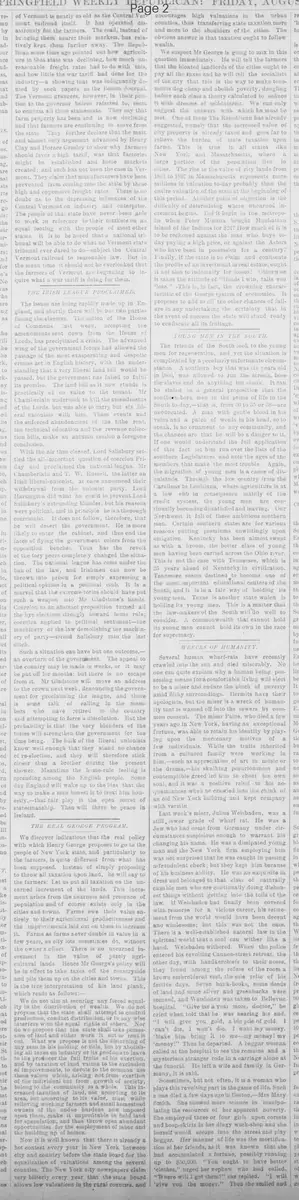
We discover indications that the real policy with which Henry George proposes to go to the people of New York state, and particularly to the farmers, is quite different from what has been supposed. Instead of simply proposing to throw all taxation upon land, he will say to the farmers: Let us put all taxation on the unearned increment of the lands. This increment arises from the nearness and presence of population and of course exists only in the cities and towns. Farms owe their value entirely to their agricultural productiveness and the improvements laid out on them to increase it. Farms as farms never double in value in a few years, as city lots sometimes do, without the owner's effort. There is no unearned increment in the value of purely agricultural lands. Hence Mr. George's policy will be in effect to take taxes off the countryside and pile them up on the cities and towns. This is the true interpretation of his land plank, which reads as follows:-
We do not aim at securing any forced equality in the distribution of wealth. We do not propose that the state shall attempt to control production, conduct distribution, or in any wise interfere with the equal rights of others. Nor do we propose that the state shall take possession of land and either work it out or rent it out. What we propose is not the disturbing of any man in his holding or title, but by abolishing all taxes on industry or its products to leave to the producer the full fruits of his exertion, and by taxation of land values to the exclusion of improvements, to devote to the common use those values which, arising not from exertion of the individual but from growth of society, belong to the community as a whole. This increased taxation of land, not according to its area, but according to its value, must while relieving working farmers and small homestead owners of the undue burdens now imposed upon them, make it unprofitable to hold land for speculation, and thus throw open abundant opportunities for the employment of labor and the building up of homes.
Now it is well known that there is already a hot contest every year in New York between city and country before the state board for the equalization of valuations among the several counties. The New York city newspapers claim very bitterly every year that the state board allows low valuations in the rural counties, and encourages high valuations in the urban counties, thus transferring state taxation more and more to the shoulders of the cities. The obvious answer is that taxation ought to follow wealth.
We suspect Mr. George is going to mix in this question immediately. He will tell the farmers that the bloated landlords of the cities ought to pay all the taxes and he will tell the socialists of the city that this is the way to make tenements dog cheap and abolish poverty, dangling before each class a theory calculated to seduce it with dreams of self-interest. We can only suggest the answers with which he must be met. (One of these The Republican has already suggested, namely that the increased value of city property is already taxed and goes far to relieve the burden of state taxation upon farms. This is true in all states like New York and Massachusetts, where a large portion of the population live in cities. The rise in the value of city lands from 1870 to 1887, in Massachusetts represents more millions in valuation to-day probably than the entire valuation of the state at the beginning of this period. Another point of objection is the difficulty of determining where unearned increment begins. Did it begin in the metropolis when Peter Minuit bought Manhattan Island of the Indians for $24? How much of it is to be reckoned against the man who buys to-day paying a high price, or against the Astors who have been in possession for a century.
Finally, if the state is to claim and confiscate the profits of an investment in real estate, ought it not also to indemnify for losses? Otherwise it takes the attitude of "Heads I win, tails you lose." This is, in fact, the crowning characteristic of the George system of economies. It proposes to add to all the other chances of failure in any undertaking the certainty that in the event of success the state will stand ready to confiscate all its fruitage.
We discover indications that the real policy with which Henry George proposes to go to the people of New York state, and particularly to the farmers, is quite different from what has been supposed. Instead of simply proposing to throw all taxation upon land, he will say to the farmers: Let us put all taxation on the unearned increment of the lands. This increment arises from the nearness and presence of population and of course exists only in the cities and towns. Farms owe their value entirely to their agricultural productiveness and the improvements laid out on them to increase it. Farms as farms never double in value in a few years, as city lots sometimes do, without the owner's effort. There is no unearned increment in the value of purely agricultural lands. Hence Mr. George's policy will be in effect to take taxes off the countryside and pile them up on the cities and towns. This is the true interpretation of his land plank, which reads as follows:-
We do not aim at securing any forced equality in the distribution of wealth. We do not propose that the state shall attempt to control production, conduct distribution, or in any wise interfere with the equal rights of others. Nor do we propose that the state shall take possession of land and either work it out or rent it out. What we propose is not the disturbing of any man in his holding or title, but by abolishing all taxes on industry or its products to leave to the producer the full fruits of his exertion, and by taxation of land values to the exclusion of improvements, to devote to the common use those values which, arising not from exertion of the individual but from growth of society, belong to the community as a whole. This increased taxation of land, not according to its area, but according to its value, must while relieving working farmers and small homestead owners of the undue burdens now imposed upon them, make it unprofitable to hold land for speculation, and thus throw open abundant opportunities for the employment of labor and the building up of homes.
Now it is well known that there is already a hot contest every year in New York between city and country before the state board for the equalization of valuations among the several counties. The New York city newspapers claim very bitterly every year that the state board allows low valuations in the rural counties, and encourages high valuations in the urban counties, thus transferring state taxation more and more to the shoulders of the cities. The obvious answer is that taxation ought to follow wealth.
We suspect Mr. George is going to mix in this question immediately. He will tell the farmers that the bloated landlords of the cities ought to pay all the taxes and he will tell the socialists of the city that this is the way to make tenements dog cheap and abolish poverty, dangling before each class a theory calculated to seduce it with dreams of self-interest. We can only suggest the answers with which he must be met. (One of these The Republican has already suggested, namely that the increased value of city property is already taxed and goes far to relieve the burden of state taxation upon farms. This is true in all states like New York and Massachusetts, where a large portion of the population live in cities. The rise in the value of city lands from 1870 to 1887, in Massachusetts represents more millions in valuation to-day probably than the entire valuation of the state at the beginning of this period. Another point of objection is the difficulty of determining where unearned increment begins. Did it begin in the metropolis when Peter Minuit bought Manhattan Island of the Indians for $24? How much of it is to be reckoned against the man who buys to-day paying a high price, or against the Astors who have been in possession for a century.
Finally, if the state is to claim and confiscate the profits of an investment in real estate, ought it not also to indemnify for losses? Otherwise it takes the attitude of "Heads I win, tails you lose." This is, in fact, the crowning characteristic of the George system of economies. It proposes to add to all the other chances of failure in any undertaking the certainty that in the event of success the state will stand ready to confiscate all its fruitage.
What sub-type of article is it?
Economic Policy
Taxation
What keywords are associated?
Henry George
Single Tax
Land Values
Unearned Increment
Taxation Policy
New York Farmers
Urban Taxation
What entities or persons were involved?
Henry George
Farmers
New York State
New York City
Socialists
Peter Minuit
Astors
Editorial Details
Primary Topic
Critique Of Henry George's Land Tax Policy
Stance / Tone
Oppositional To Henry George's Single Tax Proposal
Key Figures
Henry George
Farmers
New York State
New York City
Socialists
Peter Minuit
Astors
Key Arguments
George's Policy Shifts Taxation From Farms To Urban Unearned Land Increments
Farms Lack Unearned Increment, Benefiting Countryside At Cities' Expense
George's Plank Aims To Tax Land Values Excluding Improvements For Common Use
Opposes Speculation By Making Land Holding Unprofitable
City Property Values Already Taxed, Relieving Rural Burdens
Difficulty In Determining Unearned Increment Origins
State Should Indemnify Losses If Confiscating Gains, Avoiding 'Heads I Win, Tails You Lose'