Thank you for visiting SNEWPapers!
Sign up free
Literary
November 7, 1935
The Prison Mirror
Stillwater, Washington County, Minnesota
What is this article about?
In a 1940 American city street, a family cheers the Rainbow Division marching to war, while a wounded WWI veteran in a wheelchair bitterly describes war's brutal realities to a nurse, critiquing its glorification and futility.
Clipping
OCR Quality
98%
Excellent
Full Text
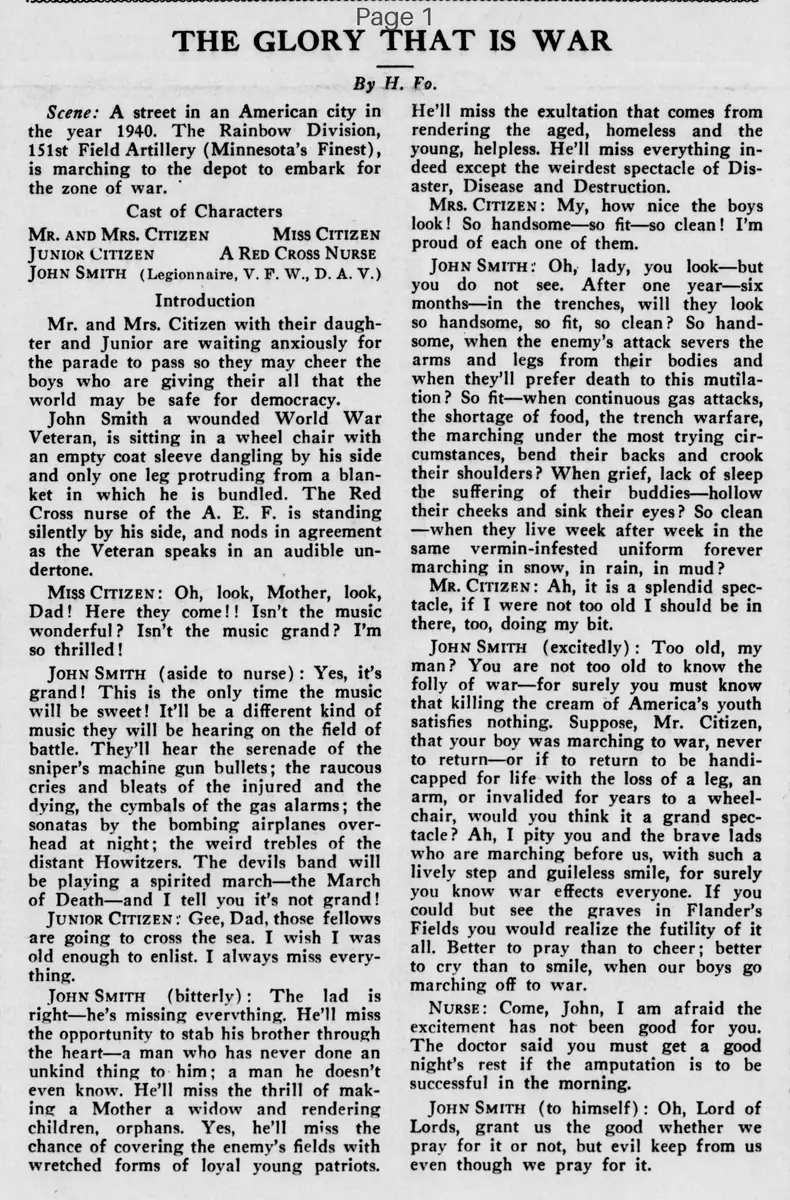
THE
GLORY THAT IS WAR
Scene: A street in an American city in the year 1940. The Rainbow Division, 151st Field Artillery (Minnesota's Finest), is marching to the depot to embark for the zone of war.
Cast of Characters
Mr. And Mrs. Citizen
Miss Citizen
Junior Citizen
A Red Cross Nurse
John Smith (Legionnaire, V. F. W., D. A. V.)
Introduction
Mr. and Mrs. Citizen with their daughter and Junior are waiting anxiously for the parade to pass so they may cheer the boys who are giving their all that the world may be safe for democracy.
John Smith a wounded World War Veteran, is sitting in a wheel chair with an empty coat sleeve dangling by his side and only one leg protruding from a blanket in which he is bundled. The Red Cross nurse of the A. E. F. is standing silently by his side, and nods in agreement as the Veteran speaks in an audible undertone.
Miss Citizen: Oh, look, Mother, look, Dad! Here they come!! Isn't the music wonderful? Isn't the music grand? I'm so thrilled!
John Smith (aside to nurse): Yes, it's grand! This is the only time the music will be sweet! It'll be a different kind of music they will be hearing on the field of battle. They'll hear the serenade of the sniper's machine gun bullets; the raucous cries and bleats of the injured and the dying, the cymbals of the gas alarms; the sonatas by the bombing airplanes overhead at night; the weird trebles of the distant Howitzers. The devils band will be playing a spirited march-the March of Death-and I tell you it's not grand!
Junior Citizen: Gee, Dad, those fellows are going to cross the sea. I wish I was old enough to enlist. I always miss everything.
John Smith (bitterly): The lad is right-he's missing everything. He'll miss the opportunity to stab his brother through the heart-a man who has never done an unkind thing to him; a man he doesn't even know. He'll miss the thrill of making a Mother a widow and rendering children, orphans. Yes, he'll miss the chance of covering the enemy's fields with wretched forms of loyal young patriots.
He'll miss the exultation that comes from rendering the aged, homeless and the young, helpless. He'll miss everything indeed except the weirdest spectacle of Disaster, Disease and Destruction.
Mrs. Citizen: My, how nice the boys look! So handsome so fit-so clean! I'm proud of each one of them.
John Smith: Oh, lady, you look-but you do not see. After one year-six months-in the trenches, will they look so handsome, so fit, so clean? So handsome, when the enemy's attack severs the arms and legs from their bodies and when they'll prefer death to this mutilation? So fit--when continuous gas attacks, the shortage of food, the trench warfare, the marching under the most trying circumstances, bend their backs and crook their shoulders? When grief, lack of sleep the suffering of their buddies -hollow their cheeks and sink their eyes? So clean --when they live week after week in the same vermin-infested uniform forever marching in snow, in rain, in mud?
Mr. Citizen: Ah, it is a splendid spectacle, if I were not too old I should be in there, too, doing my bit.
John Smith (excitedly): Too old, my man? You are not too old to know the folly of war--for surely you must know that killing the cream of America's youth satisfies nothing. Suppose, Mr. Citizen, that your boy was marching to war, never to return-or if to return to be handicapped for life with the loss of a leg, an arm, or invalided for years to a wheel-chair, would you think it a grand spectacle? Ah, I pity you and the brave lads who are marching before us, with such a lively step and guileless smile, for surely you know war effects everyone. If you could but see the graves in Flander's Fields you would realize the futility of it all. Better to pray than to cheer; better to cry than to smile, when our boys go marching off to war.
Nurse: Come, John, I am afraid the excitement has not been good for you. The doctor said you must get a good night's rest if the amputation is to be successful in the morning.
John Smith (to himself): Oh, Lord of Lords, grant us the good whether we pray for it or not, but evil keep from us even though we pray for it.
GLORY THAT IS WAR
Scene: A street in an American city in the year 1940. The Rainbow Division, 151st Field Artillery (Minnesota's Finest), is marching to the depot to embark for the zone of war.
Cast of Characters
Mr. And Mrs. Citizen
Miss Citizen
Junior Citizen
A Red Cross Nurse
John Smith (Legionnaire, V. F. W., D. A. V.)
Introduction
Mr. and Mrs. Citizen with their daughter and Junior are waiting anxiously for the parade to pass so they may cheer the boys who are giving their all that the world may be safe for democracy.
John Smith a wounded World War Veteran, is sitting in a wheel chair with an empty coat sleeve dangling by his side and only one leg protruding from a blanket in which he is bundled. The Red Cross nurse of the A. E. F. is standing silently by his side, and nods in agreement as the Veteran speaks in an audible undertone.
Miss Citizen: Oh, look, Mother, look, Dad! Here they come!! Isn't the music wonderful? Isn't the music grand? I'm so thrilled!
John Smith (aside to nurse): Yes, it's grand! This is the only time the music will be sweet! It'll be a different kind of music they will be hearing on the field of battle. They'll hear the serenade of the sniper's machine gun bullets; the raucous cries and bleats of the injured and the dying, the cymbals of the gas alarms; the sonatas by the bombing airplanes overhead at night; the weird trebles of the distant Howitzers. The devils band will be playing a spirited march-the March of Death-and I tell you it's not grand!
Junior Citizen: Gee, Dad, those fellows are going to cross the sea. I wish I was old enough to enlist. I always miss everything.
John Smith (bitterly): The lad is right-he's missing everything. He'll miss the opportunity to stab his brother through the heart-a man who has never done an unkind thing to him; a man he doesn't even know. He'll miss the thrill of making a Mother a widow and rendering children, orphans. Yes, he'll miss the chance of covering the enemy's fields with wretched forms of loyal young patriots.
He'll miss the exultation that comes from rendering the aged, homeless and the young, helpless. He'll miss everything indeed except the weirdest spectacle of Disaster, Disease and Destruction.
Mrs. Citizen: My, how nice the boys look! So handsome so fit-so clean! I'm proud of each one of them.
John Smith: Oh, lady, you look-but you do not see. After one year-six months-in the trenches, will they look so handsome, so fit, so clean? So handsome, when the enemy's attack severs the arms and legs from their bodies and when they'll prefer death to this mutilation? So fit--when continuous gas attacks, the shortage of food, the trench warfare, the marching under the most trying circumstances, bend their backs and crook their shoulders? When grief, lack of sleep the suffering of their buddies -hollow their cheeks and sink their eyes? So clean --when they live week after week in the same vermin-infested uniform forever marching in snow, in rain, in mud?
Mr. Citizen: Ah, it is a splendid spectacle, if I were not too old I should be in there, too, doing my bit.
John Smith (excitedly): Too old, my man? You are not too old to know the folly of war--for surely you must know that killing the cream of America's youth satisfies nothing. Suppose, Mr. Citizen, that your boy was marching to war, never to return-or if to return to be handicapped for life with the loss of a leg, an arm, or invalided for years to a wheel-chair, would you think it a grand spectacle? Ah, I pity you and the brave lads who are marching before us, with such a lively step and guileless smile, for surely you know war effects everyone. If you could but see the graves in Flander's Fields you would realize the futility of it all. Better to pray than to cheer; better to cry than to smile, when our boys go marching off to war.
Nurse: Come, John, I am afraid the excitement has not been good for you. The doctor said you must get a good night's rest if the amputation is to be successful in the morning.
John Smith (to himself): Oh, Lord of Lords, grant us the good whether we pray for it or not, but evil keep from us even though we pray for it.
What sub-type of article is it?
Satire
Dialogue
What themes does it cover?
War Peace
Political
Moral Virtue
What keywords are associated?
Anti War Satire
Veteran Monologue
Military Parade
War Horrors
1940 America
Wounded Soldier
Futility Of War
Literary Details
Title
The Glory That Is War
Subject
Anti War Commentary On A Military Parade
Form / Style
Dramatic Scene In Dialogue Form
Key Lines
Yes, It's Grand! This Is The Only Time The Music Will Be Sweet! It'll Be A Different Kind Of Music They Will Be Hearing On The Field Of Battle.
The Lad Is Right He's Missing Everything. He'll Miss The Opportunity To Stab His Brother Through The Heart A Man Who Has Never Done An Unkind Thing To Him; A Man He Doesn't Even Know.
Oh, Lady, You Look But You Do Not See. After One Year Six Months In The Trenches, Will They Look So Handsome, So Fit, So Clean?
Better To Pray Than To Cheer; Better To Cry Than To Smile, When Our Boys Go Marching Off To War.
Oh, Lord Of Lords, Grant Us The Good Whether We Pray For It Or Not, But Evil Keep From Us Even Though We Pray For It.