Thank you for visiting SNEWPapers!
Sign up free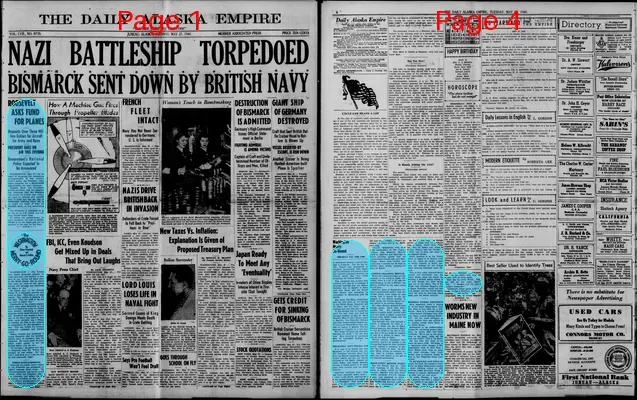
The Daily Alaska Empire
Juneau, Juneau County, Alaska
What is this article about?
On May 27, President Roosevelt requests $3.3B for military aircraft and prepares a crucial fireside chat on U.S. policy amid WWII, with insights into postponements, British counsel on French territories, historical Spanish parallels, and a profile of diplomat Michael McDermott. (248 characters)
Merged-components note: Merged main story continuation from page 1 to page 4 and included overlapping image; relabeled from 'editorial' to 'story' as content is a factual news article about presidential policy, not opinion.
Clippings

1 of 2
OCR Quality
Full Text
Requests Over Three Million Dollars for Aircraft for Army and Navy
PRESIDENT GOES ON AIR THIS EVENING
Government's National Policy Expected to Be Announced
WASHINGTON, May 27.--In the midst of preparing the momentous pronouncement of this Government's policy, the President today asked Congress for a $3,319,000,000 appropriation for more airplanes.
Stephen Early, the President's private secretary, told the newsmen this afternoon that the President will extend his fireside chat tonight an extra 15 minutes and asserted that "I think you can say that by Wednesday morning there will be no longer any doubt of what the national policy of this government is."
The President is scheduled to go on the air at 6:30 o'clock this evening, Pacific Coast Time.
In asking the appropriation for more airplanes, the sum of $2,790,000,000 is for the Army and the remainder of the sum for the Navy.
WASHINGTON - The fireside chat which Roosevelt delivers tonight has been the hardest to prepare of any during his eight years in the White House. For he knows that upon the basis of this speech history will adjudge his leadership for peace or war.
He knows that, as the Chicago Times' R. J. Finnegan recently sent word to him: "The ball is on dead center. The public is waiting for the lead. You can pick it up and run with it either way."
Illustrative of the mental anguish which must beset Roosevelt at this time is a remark he made to a friend very recently, describing a similar situation which faced Woodrow Wilson. Roosevelt was Assistant Secretary of the Navy and together with other naval advisers urged Wilson to mobilize the fleet in the Atlantic in preparation for the possibility of war. This was before the German submarine campaign had become severe.
Wilson refused and explained to young Roosevelt that the administration must let Germany take the initiative. He would make no move which might appear to put the United States into the war.
"At the time," Roosevelt now says, "I disagreed with Mr. Wilson and thought he was wrong. But now that I look back on it I can see that he was absolutely right."
THREE POSTPONEMENTS
Although the public hasn't known it, the President has postponed tonight's message three times. The first postponement was known to the public-when the President was ill and uncertain just before the Pan American reception of May 14.
The second postponement was on May 16, when the President seriously considered sending a special message to Congress. Just the day before, France had announced its complete partnership with Hitler, and the President had issued a blunt and vigorous statement warning the French people that they risked alienating the United States.
(Continued on Page Four)
Washington
Merry-
Go-Round
(Continued from Page One)
seriously considered sending a special message to Congress. Just the day before, France had announced its complete partnership with Hitler, and the President had issued a blunt and vigorous statement warning the French people that they risked alienating the United States.
This statement was to have been followed next day by a message to Congress warning that the Monroe Doctrine was in danger if Hitler took over Dakar and the French West Africa; also presaging the occupation of Martinique and the Azores.
But when the State Department sent the first draft of the message to the White House. Roosevelt said he didn't like its "form." So no message was sent that day-May 16.
It was decided that he would wait until the next week and send the message probably on May 22. So on Monday, May 19, when Senate Leader Barkley, Vice-President Wallace, and other Congressional leaders conferred at the White House they were told to expect a Monroe Doctrine message to Congress in a few days.
But within 12 hours the President changed his mind - for the third time. Next morning he announced that no immediate message was contemplated.
CHURCHILL SOFT-PEDALS FDR
It is sure to be denied but what happened in the interim was this: The President received direct word from the British suggesting that the United States not get too heavily involved in the South Atlantic between Dakar and South America, because it would divert U. S. effort away from convoys and the North Atlantic.
American airplanes ships, tanks and other material might have to be sent to the South America-West Africa trouble zone, it was suggested to the President. This would take away from the supplies expected by Great Britain under the lease-lend bill and would weaken Britain's resistance at home and in the Mediterranean.
NOTE: Meanwhile even such rabid isolationists at the Chicago Tribune. plus Senators Bennett Clark of Missouri and Reynolds of North Carolina agreed that the United States should take over Martinique. Some went further and urged that a careful eye be kept on French West Africa, jumping-off place to Brazil.
FRENCH FOLLOWED BRITISH
Roosevelt's decisions today are the toughest in the world to make. Obviously there is a lot to be said for concentrating on aid to Britain, not getting involved in too many areas at one time.
However. some of Roosevelt's advisers emphatically believe that the United States must shape its own course, that it cannot be the tail wagged by the British bulldog. In other words, the United States cannot afford to be another France.
For years, Britain dictated French foreign policy. Paris went where London led.
For instance. the French General Staff, shortly after civil war broke in Spain. urged that France send 50,000 troops and 500 airplanes into Spain.
The Spanish war, they advised, is merely a rehearsal for what is to come. If Hitler can win in Spain. French generals told Premier Blum, he will go ahead in the rest of Europe. But if we can make an example of him by a defeat in Spain, that will be the end of Hitler.
French military strategists were especially worried at having a new Germanized Spain on their southern border. making it necessary to protect two borders at once. So Premier Blum, acting on military advice, went to London, offered to send men and planes to the aid of the Spanish government.
MOTH-EATEN BRITISH POLICY
But the British said no. They were thinking of the Rio Tinto mines in Spain, owned by British interests, together with other heavy British holdings which General Franco had promised to protect.
In fact, it leaked out later that certain British big business appeasers had even encouraged Franco to start the revolution
So the French. following British advice as usual, sent no adequate help to Spain. Later when Hitler had won in Spain and attacked France, France had two borders to defend, had to keep one army on the Spanish border.
South America is to the United States as Spain is to France-only more so. Once an enemy crosses the South Atlantic to South America the defense of the United States becomes infinitely more difficult.
That is why some Administration advisers are convinced that the United States must not follow too carefully a British policy which in the past decade has been wrong eight out of ten times. For if the British had followed France's lead in Spain, Gibraltar would not now be in danger, and the United States would not even be worrying about Dakar and the South Atlantic.
IRISHMAN GUIDES DIPLOMATS
More important news is coming out of the State Department these days than at any time for a generation. Most of it funnels through a white-haired Irishman from Peabody. Mass., named Michael McDermott. He has more influence on public opinion than any official in the Capital except Steve Early at the White House.
McDermott is no cookie-pusher. Among the tip-toeing gentry diplomacy, he moves with flat-footed frankness. "We've got to tell something to the press. Why not tell them the truth?" This is his motto.
For the first five steps in his career he was a clerk. He began as an insurance clerk, became a War Department clerk in 1917, then a White House clerk, then an Army field clerk overseas, then confidential clerk to General Tasker H. Bliss at the Versailles Peace Conference.
He did important work behind the scenes, but kept the common touch. When the State Department needed a press relations officer in 1927. newsmen asked Secretary Frank B. Kellogg to appoint McDermott. He has held that job ever since.
He works through a long day, then goes to bed with a telephone. In the middle of the night, the telephone rings. Bert Hulen of New York Times wants to know the latest on the Zamzam. McDermott leans on his elbow, tells what he knows, falls to sleep again.
Next day he meets Hulen. "Did you call me last night. Bert?"
"Yes." "I thought you did, but I couldn't remember."
McDermott keeps going only because he has a fireman's faculty of sleeping soundly between fires.
What sub-type of article is it?
What themes does it cover?
What keywords are associated?
What entities or persons were involved?
Where did it happen?
Story Details
Key Persons
Location
Washington
Event Date
May 27
Story Details
President Roosevelt requests $3,319,000,000 for aircraft for Army and Navy, prepares fireside chat on national policy amid WWII tensions, reflects on Wilson's decisions, postpones messages multiple times due to events in France and British advice, discusses historical parallels with French policy in Spain, and profiles State Department press officer Michael McDermott.