Thank you for visiting SNEWPapers!
Sign up free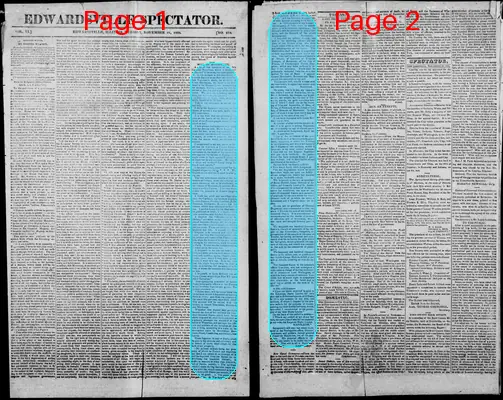
Edwardsville Spectator
Edwardsville, Madison County, Illinois
What is this article about?
Publication of Napoleon Bonaparte's will, dated April 15, 1821, from Longwood, St. Helena. It expresses his death in the Apostolic religion, wishes for burial in France, sentiments for his wife Marie Louise and son, forgiveness of betrayers, disavowal of certain works, bequests to family, servants, and soldiers, and multiple codicils with additional legacies. Registered in London with effects under £1000.
Merged-components note: Continuation of the 'Will of Bonaparte' article across page 1 and 2, as the text flows directly from one component to the next.
Clippings

1 of 2
OCR Quality
Full Text
A copy of the testament of the late Emperor Napoleon, which is deposited in Doctors' Commons, has been published. In the preface to this document, it is stated that not more than two days before Napoleon's death, he dictated to Count Montholon, the letter to be delivered to Sir Hudson Lowe, announcing his decease, leaving a space for the insertion of the day and hour of his dissolution. We give the following extract from this interesting document:
"This 15th April, 1821, at Longwood, Island of St. Helena.
This is my testament, or act of my last will.
I die in the Apostolic religion, in the bosom of which I was born, more than fifty years since.
It is my wish that my ashes may repose on the banks of the Seine, in the midst of the French people, whom I have loved so well.
I have always had reason to be pleased with my dearest wife, Marie Louise. I retain for her, to my last moment, the most tender sentiments—I beseech her to watch, in order to preserve my son from the snares which yet environ his infancy.
I recommend to my son, never to forget that he was born a French Prince, and never to allow himself to become an instrument in the hands of the triumvirs, who oppress the nations of Europe; he ought never to fight against France, or to injure her in any manner. He ought to adopt my motto—"Every thing for the French people."
I die prematurely, assassinated by the English oligarchy and its * * * The English nation will not be slow in avenging me.
The two unfortunate results of the invasions of France, when she still had so many resources, are to be attributed to the treason of Marmont, Augereau, Talleyrand and La Fayette. I forgive them—may the posterity of France forgive them.
I thank my good and excellent mother, the Cardinal, my brothers Joseph, Lucien, Jerome, Paulina, Caroline, Julie, Hortense, Catharine, Eugene, for the interest which they continued to feel for me. I pardon Louis for the libel which he published in 1820; it is replete with false assertions and falsified documents.
I disavow the "Manuscript of St. Helena," and other works, under the titles of Maxims, Sayings, &c. which persons have been pleased to publish for the last six years. These are not rules which guarded my life. I caused the Duc d'Enghien to be arrested and tried, because that step was essential to the safety, interest and honor of the French people, when the Count d'Artois was maintaining by his confession, sixty assassins at Paris. Under similar circumstances, I would act in the same way.
I bequeath to my son the boxes, orders, and other articles, such as my plate, field bed, saddles, spurs, chapel-plate; books, linen, which I have been accustomed to wear and use. It is my wish that this slight bequest may be dear to him, as recalling the memory of a father, of whom the universe will discourse to him.
I bequeath to Lady Holland the antique cameo which Pope Pius VII gave me at Tolentino."
After specifying a number of individuals (principally officers in the French army) to whom legacies are given, Napoleon proceeds:-
"These sums will be raised from the six millions which I deposited on leaving Paris in 1815; and from the interest at the rate of five per cent. since July, 1815. The account will be settled with the banker, by counts Montholon, Bertrand, and Marchand.
Whatever that deposit may produce beyond the sum of five millions six hundred thousand francs, which have been above disposed of, shall be distributed as a gratuity amongst the wounded at the battle of Waterloo, and amongst the officers and soldiers of the battalion of the Isle of Elba, according to a scale to be determined upon by Montholon, Bertrand, Montholon, Bertrand, Druot, Cambronne, and the surgeon Larrey.
These legacies, in case of death, shall be paid to the widows and children; and in default of such, shall revert to the bulk of my property.
"My private domain being my property of which no French law deprives me that I am aware of, an account of it will be required from the Baron de la Bouillere, the treasurer thereof; it ought to amount to more than 200,000,000 of francs, namely, 1. The savings which I made during fourteen years out of my civil list, which amounted to more than 12,000,000 francs per annum, if my memory be good. 2. The produce of this portfolio. 3. The furniture of my houses.
Palaces, such as it was in 1814, including the palaces of Rome, Florence and Turin. All this furniture was purchased with moneys accruing from the civil list. 4. The proceeds of my houses in the kingdom of Italy, such as money, plate, jewels, furniture, equipages; the accounts will be rendered by prince Eugene, and the Steward of the crown Compaguoni.
NAPOLEON.
I bequeath my private domain, one half to the surviving officers and soldiers of the French army who have fought since 1792 to 1815, for the glory and independence of the nation. The distribution shall be made in proportion to their appointments upon active service. One half to the towns and districts of Alsace, of Lorraine of Franche Compte, of Burgundy, of the Isle of France, of Champagne Forest, Dauphine, which may have suffered by either of the invasions. There shall be previously deducted from the sum one million for that of Metz. I appoint Counts Montholon, Bertrand and Marchand, the executors of my will. This present will, wholly written with my own hand; is signed and sealed with my own arms.
NAPOLEON.
My arms, that is to say, my sword-- that which I wore at Austerlitz, the sabre of Sobiesky, my dagger, my broadsword, my hanger, my two pair of Versailles pistols, my gold travelling box, that of which I made use on the morning of Ulm and Austerlitz, of Jena, of Eylau, of Friedland, of the Island of Lobau, of Moscow, of Montmirail. In this point of view it is my wish that it may be precious in the eyes of my son."
It has been deposited with Count Bertrand since 1814. A number of other articles are also directed to be given to young Napoleon, on his attaining the age of sixteen years. A codicil dated Longwood, April 9th, 1821. begins thus :--
" Out of the settlement of my civil list of Italy, such as money, jewels, plate, linen, equipages, of which the Viceroy is the depository, and which belonged to me. I dispose of two millions, which I bequeath to my most faithful servants. I hope that my son Eugene Napoleon will pay them faithfully. He cannot forget the forty millions which I gave him in Italy, and in distribution of the inheritance of his mother."
Extract from the fourth codicil:
" This 4th of April, 1821. Longwood.
"By the dispositions which we have heretofore made, we have not fulfilled all our obligations, which has decided us to make this fourth codicil. We bequeath to the son or grandson of Baron Dutheil, Lieut. General of Artillery, and formerly Lord of St. Andre, who commanded the school of Auxonne before the revolution, the sum of one hundred thousand francs, as a memento of gratitude for the care which that brave General took of us when we were a Lieutenant and a Captain under his orders.
To the son or grandson of General Dugommier, who commanded in chief the army of Toulon, the sum of one hundred thousand francs. It is a testimonial of remembrance for the marks of esteem, of affection, and of friendship, which that brave and intrepid General gave to us.
We bequeath one hundred thousand francs to the son or grandson of the Deputy of the Convention, Gasperin, representative of the people at the army of Toulon, for having protected and sanctioned with his authority the plan which we had given, which procured the capture of that city, and which was contrary to that sent by the committee of public safety.
We bequeath one hundred thousand francs to the widow, son, or grandson of our Aid-de-Camp, Muiron, killed at our side at Arcola, covering us with his body.
Ten thousand francs to the subaltern officer Cantillon, who has undergone a trial, upon a charge of having endeavored to assassinate Lord Wellington, of which he was pronounced innocent. Cantillon had as much right to assassinate that oligarchist, as the latter had to send me to perish on the rock of St. Helena."
A fifth codicil says-
" Upon the funds remitted in gold to the Empress, Marie Louise, my very dear and well-beloved spouse, at Orleans, in 1813, she remains in my debt two millions, of which I dispose by the present codicil, for the purpose of recompensing my most faithful servants, whom, moreover, I recommend to the protection of my dear Marie Louise."
On the back of the codicil is written--
"This is my codicil or act of my last will, the execution of which I recommend to my wife, the Empress Marie Louise.
NAPOLEON."
Bonaparte's will was last week registered in the Prerogative office, Doctors' Commons, and probate thereof granted to Count de Montholon, one of the executors. His personal effects in this country are sworn to be under the value of £1000. The will is all in Napoleon's hand writing
London paper.
What sub-type of article is it?
What keywords are associated?
What entities or persons were involved?
Where did it happen?
Foreign News Details
Primary Location
Longwood, Island Of St. Helena
Event Date
15th April, 1821
Key Persons
Outcome
bequests including personal items to son, cameo to lady holland, legacies to officers and soldiers from deposits and private domain estimated over 200,000,000 francs, half to french army survivors 1792-1815, half to invaded regions; codicils add legacies to specific individuals and servants; will registered in london, effects under £1000.
Event Details
Napoleon's will dictates his death in Apostolic religion, burial wish on Seine banks, tender sentiments for Marie Louise and advice to son against fighting France, claims assassination by English oligarchy, attributes French defeats to traitors Marmont, Augereau, Talleyrand, La Fayette whom he forgives, thanks family, pardons Louis, disavows St. Helena manuscript and justifies Duc d'Enghien's execution, bequeaths items to son and cameo to Lady Holland, legacies from 1815 deposit and interest to army officers, surplus to Waterloo wounded and Elba battalion, private domain to army and invaded regions, appoints executors Montholon, Bertrand, Marchand; codicils dated April 9th, 4th, and fifth dispose additional millions to servants and specific legacies to descendants of Dutheil, Dugommier, Gasperin, Muiron, Cantillon.