Thank you for visiting SNEWPapers!
Sign up free
Boon's Lick Times
Fayette, Howard County, Missouri
What is this article about?
On May 4 in the U.S. Senate, debate occurred on a bill to authorize temporary military occupation of Yucatan to protect white inhabitants from Indian attacks. Senators Hannegan and Cass pushed for immediate action citing humanitarian crisis, while Calhoun and others sought delay for reflection. The bill was set as special order for the next day.
Clipping
OCR Quality
Full Text
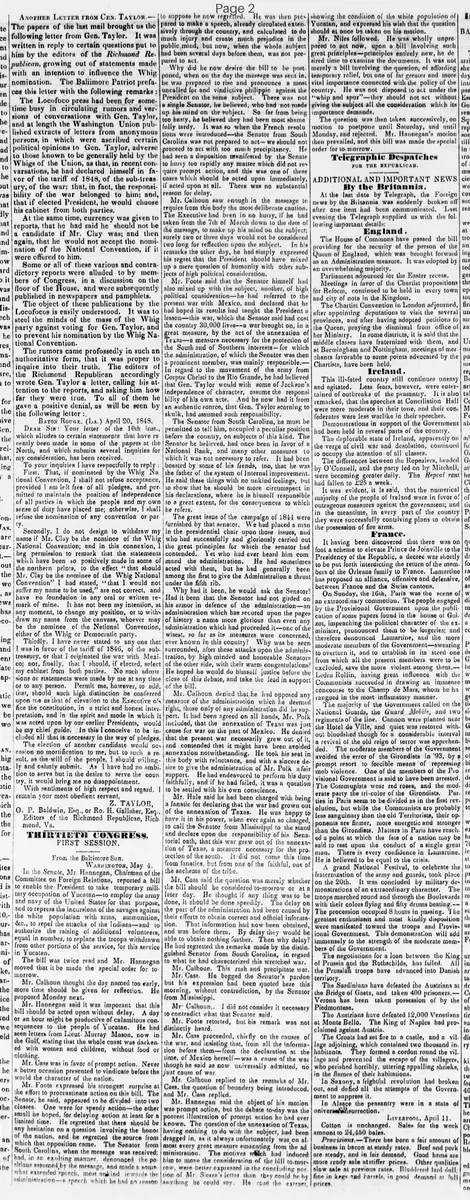
FIRST SESSION.
From the Baltimore Sun.
WASHINGTON, May 4.
In the Senate, Mr. Hannegan, Chairman of the
Committee on Foreign Relations, reported a bill
to enable the President to take temporary military
occupation of Yucatan—to employ the army
and navy of the United States for that purpose,
and to repress the incursions of the savages against
the white population with arms, ammunition,
&c., to repel the attacks of the Indians—and to
authorize the raising of additional volunteers,
equal in number, to replace the troops withdrawn
from other portions of the service, for this service
in Yucatan.
The bill was twice read and Mr. Hannegan
moved that it be made the special order for
tomorrow.
Mr. Calhoun thought the day named too early,
more time should be given for reflection. He
proposed Monday next.
Mr. Hannegan said it was important that this
bill should be acted upon without delay. A day
or an hour might be productive of calamitous
consequences to the people of Yucatan. He had
seen letters from Lieut. Murray Mason, now in
the Gulf, stating that the whole coast was darkened
with women and children, without food or
clothing.
Mr. Cass was in favor of prompt action. Never
a better occasion presented to vindicate before the
world the character of the nation.
Mr. Foote expressed his strongest surprise at
the effort to procrastinate action on this bill. The
Senate, he said, appeared to be divided into two
classes. One were for speedy action—the other
small he hoped, for delaying action at least for a
limited time. He regretted that there should be
any hesitation on a question involving the honor
of the nation, and he regretted the source from
which that opposition came. The Senator from
South Carolina, when the message was received;
had, in an exulting manner, denounced the positions
assumed by the message, and made a some-
what extended speech, most unkind towards the
administration—a speech which he had reason to
suppose he now regretted. He was then prepared
to make a speech, already circulated extensively
through the country, and calculated to do
much injury and create much prejudice in the
public mind, but now, when the whole subject
had been several days before them, was not prepared
to act.
Why did he now desire the bill to be postponed,
when on the day the message was sent in,
he was prepared to rise and pronounce a most
uncalled for and vindictive philippic against the
President on the same subject. There was not
a single Senator, he believed, who had not made
up his mind on the subject. So far from being
too hasty, he believed they had been most shame-
fully tardy. It was so when the French resolutions
were introduced—the Senator from South
Carolina was not prepared to act—we should not
proceed to act with too much precipitancy. He
had seen a disposition manifested by the Senate
to hurry too rapidly any matter which did not require
prompt action, and this was one of these
cases which should be acted upon immediately
if acted upon at all. There was no substantial
reason for delay.
Mr. Calhoun saw enough in the message to
require from this body the most deliberate caution.
The Executive had been in no hurry, if he had
taken from the 7th of March down to the date of
the message, to make up his mind on the subject:
surely two or three days would not be considered
too long for reflection upon the subject. In his
remarks the other day, he had simply expressed
his regret that the President should have mixed
up a mere question of humanity with other subjects
of high political consideration.
Mr. Foote said that the Senator himself had
also mixed up with the subject, another, of high
political consideration—he had referred to the
present war with Mexico, and declared that he
had hoped its results had taught the President a
lesson—this war, which the Senator said had cost
the country 30,000 lives—a war brought on, in a
great measure, by the act of the annexation of
Texas—a measure necessary for the protection of
the South and of Southern interests—for which
the administration, of which the Senator was then
a prominent member, was mainly responsible.—
In regard to the movement of the army from
Corpus Christi to the Rio Grande, he had believed
that Gen. Taylor would with some of Jackson's
independence of character, assume the responsibility
of his own acts. And he now had it from
an authentic source, that Gen. Taylor scorning to
skulk, had assumed such responsibility.
The Senator from South Carolina, he must be
permitted to tell him, occupied a peculiar position
before the country, on subjects of this kind. The
Senator he believed, had once been in favor of a
National Bank, and many other measures to
which it was not necessary to refer. It had been
boasted by some of his friends, too, that he was
the father of the system of Internal improvement.
He said these things with no unkind feelings, but
to show that he should be more circumspect in
his declarations, where he is himself responsible
to a great extent, for the consequences to which
he refers.
The great issue of the campaign of 1844 were
furnished by that senator. We had placed a man
in the presidential chair upon those issues, and
who had successfully and gloriously carried out
the great principles for which the senator had
contended. Yet who had ever heard him commend
the administration. He had sometimes
acted with them, but he had generally been
among the first to give the Administration a thrust
under the fifth rib.
Why had it been, he would ask the Senator?
Had it been that the Senator had not girded on
his armor in defence of the administration—an
administration which has secured upon the pages
of history a name more glorious than even any
administration which had preceded it—one of the
wisest, so far as its measures were concerned,
ever known in this country? Why was he seen
surrounded, after these attacks upon the administration,
by high minded and honorable Senators
of the other side, with their warm congratulations?
He hoped he would do himself justice before the
close of this debate, and take the lead in support
of the bill.
Mr. Calhoun denied that he had opposed any
measure of the administration which he deemed
right, those only of any administration did he support.
It had been agreed on all hands, Mr. Polk
included, that the annexation of Texas was just
cause for war on the part of Mexico. He denied
that the present war necessarily grew out of it,
and contended that it might have been avoided
annexation notwithstanding. He took his seat in
this body with reluctance, and with a sincere desire
to give the administration of Mr. Polk a fair
support. He had endeavored to perform his duty
faithfully, and if he had failed, it was a question
to be settled with his own conscience.
Mr. Hale said he had been charged with being
a fanatic for declaring that the war had grown out
of the annexation of Texas. He was happy to
have it in his power, whenever again so charged
to call the Senator from Mississippi to the stand
and declare upon the responsibility of his Senatorial
oath, that this war grew out of the annexation
of Texas, a measure necessary for the protection
of the south. It did not come this time
from fanatics, but from one of the faithful, one of
the sachems of the tribe.
Mr. Cass said the question was merely whether
the bill should be considered to-morrow or at a
later day. He thought if any thing was to be
done, it should be done speedily. The delay on
the part of the administration had been caused by
their efforts to obtain correct and official information.
That information had now been obtained,
and was before them. By delay they would be
able to obtain nothing further. Then why delay?
He had regretted the remarks made by the distinguished
Senator from South Carolina, in regard
to what he had characterized this wretched war.
Mr. Calhoun. This rash and precipitate war.
Mr. Cass. He begged the Senator's pardon
but his expression had been quoted here this
morning, without contradiction, by the Senator
from Mississippi.
Mr. Calhoun. I did not consider it necessary
to contradict what that Senator said.
Mr. Foote retorted, but his remark was not
distinctly heard.
Mr. Cass proceeded, chiefly on the causes of
the war, and insisting that, from all the information
before them—from the declaration at the
time, of Mexico herself—was a cause of the war
though he said as now universally admitted, no
just cause of war.
Mr. Calhoun replied to the remarks of Mr.
Cass, the question of boundary being introduced,
and Mr. Cass replied.
Mr. Hannegan said the object of his motion
was prompt action, but the debate to-day was the
poorest illustration of prompt action he had ever
known. The question of the annexation of Texas,
having nothing to do with the subject, had been
dragged in, as it always unfortunately was on almost
every great measure emanating from the administration.
The motives which had induced
him to move the consideration of the bill tomorrow,
were better expressed in the concluding portion
of Mr. Sierra's letter than they could be by
anything he could say. He read the extract
showing the condition of the white population of
Yucatan, and expressed his wish that the question
should at once be taken on his motion.
Mr. Niles followed. He was wholly unprepared
to act now, upon a bill involving such
great principles—principles entirely new, he desired
time to examine the documents. It was not
merely a bill involving the question, of affording
temporary relief, but one of far greater and more
vital importance connected with the policy of the
country. He was not disposed to act under the
"whip and spur"—they should not act without
giving the subject all the consideration which its
importance demands.
The question was then taken successively, on
motion to postpone until Saturday, and until
Monday, and rejected. Mr. Hannegan's motion
then prevailed, and this bill was made the special
order for to-morrow.
What sub-type of article is it?
What keywords are associated?
What entities or persons were involved?
Where did it happen?
Domestic News Details
Primary Location
Washington
Event Date
May 4
Key Persons
Outcome
the bill was made the special order for tomorrow after motions to postpone were rejected. reports of dire conditions in yucatan with women and children without food or clothing.
Event Details
Mr. Hannegan reported a bill authorizing the President to temporarily occupy Yucatan militarily, using army and navy to protect white population from savage incursions and Indian attacks, and to raise volunteers. Debate focused on timing: Hannegan, Cass, and Foote urged immediate action due to humanitarian crisis; Calhoun, Niles sought delay for reflection. Discussion veered into criticisms of the Mexican War and Texas annexation. Motions to postpone to Saturday or Monday rejected.