Thank you for visiting SNEWPapers!
Sign up free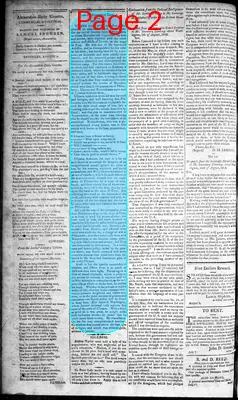
Literary
August 4, 1810
Alexandria Daily Gazette, Commercial & Political
Alexandria, Virginia
What is this article about?
Essay retelling Sophocles' tragedy of Philoctetes, highlighting the moral triumph of honest policy over deceitful craft, as Ulysses tricks but Neoptolemus restores the arrows, and divine intervention aids virtue; contrasts with Washington's guileless wisdom.
Clipping

OCR Quality
95%
Excellent
Full Text
From the Connecticut Courant.
MONITOR.
There is one of the tragedies of Sophocles, an admirable moral, couched under the veil of heathen fable. Philoctetes, to whom Hercules had bequeathed his bow and arrows, went together with the other princes and chiefs of Greece, to the siege of Troy. He was son of the renowned Achilles, and as distinguished for his valor as his birth; but having been bit by a serpent; an incurable and most painful ulcer ensued; and his perpetual groans and lamentation disturbed and disheartened the Grecian camp. For this reason the Grecian chiefs had him conveyed to Lemnos, a desolated island, where he remained for ten years alone, and in intolerable anguish. At the end of that time, it being declared by an Oracle that Troy could never be conquered without the arrows of Hercules which were then in the possession of Philoctetes; Ulysses and Neoptolemus were sent to Lemnos to obtain them. Ulysses, notorious above all men for craft and intrigue, and well knowing that Philoctetes bore the Grecians an implacable hatred for their cruel usage of him, laid a cunning plan to get the arrows from him by fraud; and this plan he communicated to Neoptolemus; at the same time insisting that he should become the instrument of its execution: Neoptolemus, who was a generous hearted young prince, was at first struck with horror at the base propositions, and says,
"I was not born to flatter or betray,
What open arms can do
Behold me prompt to act, but ne'er to fraud
Will I descend—
O king believe me,
Rather, much rather, would I fall by virtue.
Than rise by guilt to certain victory."
Ulysses, however, (so easy is it for an arch-deceiver to corrupt the integrity of an inexperienced youth) gained his point at last, by his cunning sophistry and horrid persuasions; and Neoptolemus submitted to an act of treachery which his soul abhorred. He first insinuated himself into the confidence of Philoctetes, by a train of falsehoods, and then robbed him of his arrows; which he bore off to the ship, that lay ready to sail back to the coast of Troy. But reflecting afterward on the baseness of the deed, and stung with remorse and pity, he, in despite of the injunctions and threats of Ulysses, went back and restored the arrows to Philoctetes. After all the arts of fair persuasion to induce Philoctetes to go to the siege of Troy, or at least to send his arrows thither, had been used in vain, and there seemed no possibility left that the point could be gained in a fair and honorable way, Hercules descended from Heaven, and effected what mere men could not do, a change of will in Philoctetes.; who then voluntarily went with Neoptolemus to the Grecian camp, carrying with him his bow and arrows; and Troy was conquered by their means. In a word, open and honest policy, aided by the powers above, was finally crowned with more complete success than could have been obtained by the deep-laid fraudulent plan of the crafty Ulysses. Craft is but the ignoble counterfeit of wisdom, and differs from it as much as darkness does from light. Partaking as it does of moral turpitude, which it perpetually strives to conceal, it exposes itself by its very attempts at concealment, as the serpent tells us where to strike him, by coiling his head. Whether in the private or public walks of life, whether in the common intercourse between neighbors and fellow-citizens, or in the great concern of princes and statesmen—an honest policy will be found to wear best. Our beloved Washington, whom heaven crowned with success, had none of the craft of Ulysses. With a mind as good as it was great, he sought noble ends by honest means; by means that he could never blush to own. He was admirable for his real, unsophisticated wisdom: for wisdom that soared above the base arts of intrigue, and which was without guile, without hypocrisy.
MONITOR.
There is one of the tragedies of Sophocles, an admirable moral, couched under the veil of heathen fable. Philoctetes, to whom Hercules had bequeathed his bow and arrows, went together with the other princes and chiefs of Greece, to the siege of Troy. He was son of the renowned Achilles, and as distinguished for his valor as his birth; but having been bit by a serpent; an incurable and most painful ulcer ensued; and his perpetual groans and lamentation disturbed and disheartened the Grecian camp. For this reason the Grecian chiefs had him conveyed to Lemnos, a desolated island, where he remained for ten years alone, and in intolerable anguish. At the end of that time, it being declared by an Oracle that Troy could never be conquered without the arrows of Hercules which were then in the possession of Philoctetes; Ulysses and Neoptolemus were sent to Lemnos to obtain them. Ulysses, notorious above all men for craft and intrigue, and well knowing that Philoctetes bore the Grecians an implacable hatred for their cruel usage of him, laid a cunning plan to get the arrows from him by fraud; and this plan he communicated to Neoptolemus; at the same time insisting that he should become the instrument of its execution: Neoptolemus, who was a generous hearted young prince, was at first struck with horror at the base propositions, and says,
"I was not born to flatter or betray,
What open arms can do
Behold me prompt to act, but ne'er to fraud
Will I descend—
O king believe me,
Rather, much rather, would I fall by virtue.
Than rise by guilt to certain victory."
Ulysses, however, (so easy is it for an arch-deceiver to corrupt the integrity of an inexperienced youth) gained his point at last, by his cunning sophistry and horrid persuasions; and Neoptolemus submitted to an act of treachery which his soul abhorred. He first insinuated himself into the confidence of Philoctetes, by a train of falsehoods, and then robbed him of his arrows; which he bore off to the ship, that lay ready to sail back to the coast of Troy. But reflecting afterward on the baseness of the deed, and stung with remorse and pity, he, in despite of the injunctions and threats of Ulysses, went back and restored the arrows to Philoctetes. After all the arts of fair persuasion to induce Philoctetes to go to the siege of Troy, or at least to send his arrows thither, had been used in vain, and there seemed no possibility left that the point could be gained in a fair and honorable way, Hercules descended from Heaven, and effected what mere men could not do, a change of will in Philoctetes.; who then voluntarily went with Neoptolemus to the Grecian camp, carrying with him his bow and arrows; and Troy was conquered by their means. In a word, open and honest policy, aided by the powers above, was finally crowned with more complete success than could have been obtained by the deep-laid fraudulent plan of the crafty Ulysses. Craft is but the ignoble counterfeit of wisdom, and differs from it as much as darkness does from light. Partaking as it does of moral turpitude, which it perpetually strives to conceal, it exposes itself by its very attempts at concealment, as the serpent tells us where to strike him, by coiling his head. Whether in the private or public walks of life, whether in the common intercourse between neighbors and fellow-citizens, or in the great concern of princes and statesmen—an honest policy will be found to wear best. Our beloved Washington, whom heaven crowned with success, had none of the craft of Ulysses. With a mind as good as it was great, he sought noble ends by honest means; by means that he could never blush to own. He was admirable for his real, unsophisticated wisdom: for wisdom that soared above the base arts of intrigue, and which was without guile, without hypocrisy.
What sub-type of article is it?
Essay
Fable
What themes does it cover?
Moral Virtue
Political
What keywords are associated?
Philoctetes
Ulysses
Neoptolemus
Honest Policy
Craft Deceit
Washington
Sophocles
Moral Lesson
What entities or persons were involved?
From The Connecticut Courant
Literary Details
Title
Monitor.
Author
From The Connecticut Courant
Subject
Moral On Honest Policy Versus Craft, Drawn From Sophocles' Philoctetes And Washington's Example
Form / Style
Prose Retelling Of A Classical Tragedy With Moral Commentary
Key Lines
"I Was Not Born To Flatter Or Betray,
What Open Arms Can Do
Behold Me Prompt To Act, But Ne'er To Fraud
Will I Descend—
O King Believe Me,
Rather, Much Rather, Would I Fall By Virtue.
Than Rise By Guilt To Certain Victory."