Thank you for visiting SNEWPapers!
Sign up free
The Sentinel
Trenton, Mercer County, New Jersey
What is this article about?
Description of nocturnal police searches in Russia, known as domiciliary visits, and examples of innocent people arrested due to revolutionary pamphlets or false denunciations, often leading to severe consequences like imprisonment or madness.
Merged-components note: Continuation of the same story on domiciliary visits in Russia, split due to parsing.
Clipping
OCR Quality
Full Text
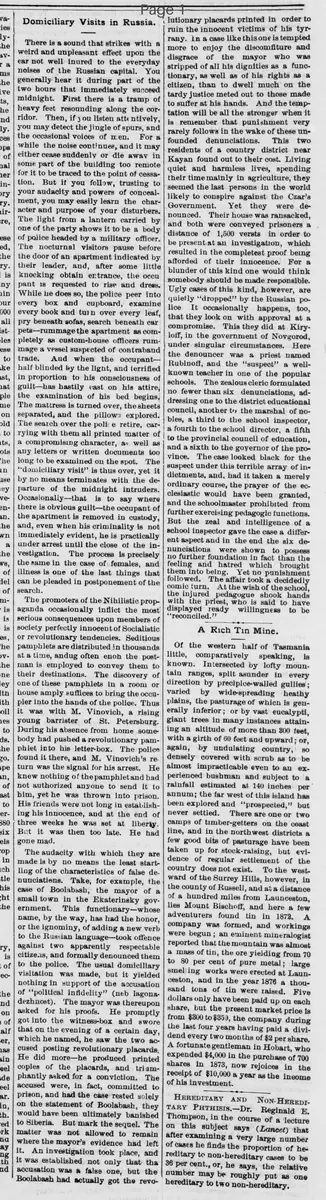
There is a sound that strikes with a weird and unpleasant effect upon the ear not well inured to the everyday noises of the Russian capital. You generally hear it during part of the two hours that immediately succeed midnight. First there is a tramp of heavy feet resounding along the corridor. Then, if you listen attentively, you may detect the jingle of spurs, and the occasional voices of men. For a while the noise continues, and it may either cease suddenly or die away in some part of the building too remote for it to be traced to the point of cessation. But if you follow, trusting to your audacity and powers of concealment, you may easily learn the character and purpose of your disturbers.
The light from a lantern carried by one of the party shows it to be a body of police headed by a military officer. The nocturnal visitors pause before the door of an apartment indicated by their leader, and, after some little knocking obtain entrance, the occupant is requested to rise and dress. While he does so, the police peer into every box and cupboard, examine every book and turn over every leaf, pry beneath sofas, search beneath carpets-rummage the apartment as completely as custom-house officers rummage a vessel suspected of contraband trade. And when the occupant half blinded by the light, and terrified in proportion to his consciousness of guilt-has hastily cast on his attire, the examination of his bed begins,
The mattress is turned over, the sheets separated, and the pillows explored.
The search over the police retire, carrying with them all printed matter of a compromising character, as well as any letters or written documents too long to be examined on the spot. The "domiciliary visit" is thus over, yet it by no means terminates with the departure of the midnight intruders. Occasionally-that is to say where there is obvious guilt-the occupant of the apartment is removed in custody, and, even when his criminality is not immediately evident, he is practically under arrest until the close of the investigation. The process is precisely the same in the case of females, and illness is one of the last things that can be pleaded in postponement of the search.
The promoters of the Nihilistic propaganda occasionally inflict the most serious consequences upon members of society perfectly innocent of Socialistic or revolutionary tendencies. Seditious pamphlets are distributed in thousands at a time, and very often enough the postman is employed to convey them to their destinations. The discovery of one of these pamphlets in a room or house amply suffices to bring the occupant into the hands of the police. Thus it was with M. Vinovich, a rising young barrister of St. Petersburg.
During his absence from home somebody had pushed a revolutionary pamphlet into his letter-box. The police found it there, and M. Vinovich's return was the signal for his arrest. He knew nothing of the pamphlet and had not authorized anyone to send it to him, yet he was thrown into prison.
His friends were not long in establishing his innocence, and at the end of three weeks he was set at liberty.
But it was then too late. He had gone mad.
The audacity with which they are made is by no means the least startling of the characteristics of false denunciations. Take, for example, the case of Boolabash, the mayor of a small town in the Ekaterinsky government. This functionary-whose name, by the way, has had the honor, or the ignominy, of adding a new verb to the Russian language -took offence against two apparently respectable citizens, and formally denounced them to the police. The usual domiciliary visitation was made, but it yielded nothing in support of the accusation of "political infidelity" (neb lagodezhnost). The mayor was thereupon asked for his proofs. He promptly got into the witness-box and swore that on the evening of a certain day, which he named, he saw the two accused posting revolutionary placards.
He did more-he produced printed copies of the placards, and triumphantly asked for a conviction. The accused were, in fact, committed to prison, and had the case rested solely on the statement of Boolabash, they would have been ultimately banished to Siberia. But mark the sequel. The matter was not allowed to remain where the mayor's evidence had left it. An investigation took place, and it was established not only that the accusation was a false one, but the Boolabash had actually got the revolutionary placards printed in order to ruin the innocent victims of his tyranny. In a case like this one is tempted more to enjoy the discomfiture and disgrace of the mayor who was stripped of all his dignities as a functionary, as well as of his rights as a citizen, than to dwell much on the tardy justice meted out to those made to suffer at his hands. And the temptation will be all the stronger when it is remembered that punishment very rarely follows in the wake of these unfounded denunciations. This two residents of a country district near Kayan found out to their cost. Living quiet and harmless lives, spending their time mainly in agriculture, they seemed the last persons in the world likely to conspire against the Czar's Government. Yet they were denounced. Their house was ransacked, and both were conveyed prisoners a distance of 1,500 versts in order to be present at an investigation, which resulted in the completest proof being afforded of their innocence. For a blunder of this kind one would think somebody should be made responsible.
Ugly cases of this kind, however, are quietly "dropped" by the Russian police. It occasionally happens, too, that they look on with approval at a compromise. This they did at Kiryloff, in the government of Novgorod, under singular circumstances. Here the denouncer was a priest named Rubinoff, and the "suspect" a well-known teacher in one of the popular schools. The zealous cleric formulated no fewer than six denunciations, addressing one to the district educational council, another to the marshal of nobles, a third to the school inspector, a fourth to the school director, a fifth to the provincial council of education, and a sixth to the governor of the province. The case looked black for the suspect under this terrible array of indictments, and, had it taken a merely ordinary course, the prayer of the ecclesiastic would have been granted, and the schoolmaster prohibited from further exercising pedagogic functions.
But the zeal and intelligence of a school inspector gave the case a different aspect and in the end the six denunciations were shown to possess no further foundation in fact than the feeling and hatred which brought them into being. Yet no punishment followed. The affair took a decidedly comic turn. At the wish of the school, the injured pedagogue shook hands with the priest, who is said to have displayed ready willingness to be "reconciled."
What sub-type of article is it?
What themes does it cover?
What keywords are associated?
What entities or persons were involved?
Where did it happen?
Story Details
Key Persons
Location
Russia
Story Details
Nocturnal police searches in Russian apartments, thorough examinations for seditious materials, leading to arrests; examples include innocent barrister M. Vinovich driven mad by imprisonment over a pamphlet, mayor Boolabash's false denunciation exposed, innocent farmers near Kayan ransacked and transported, and priest Rubinoff's multiple baseless accusations against a teacher resolved without punishment.