Thank you for visiting SNEWPapers!
Sign up free
Literary
September 17, 1910
The News=Record
Enterprise, Wallowa County, Oregon
What is this article about?
In this chapter, after Kirby claims the plantation won in a gamble, the Randall family plans to leave while plotting against him. Tensions rise with accusations and family protection. Kirby interacts sadly with the child General, revealing his internal conflict, but Adele rejects him, taking the deed as a symbol of loss.
Merged-components note: Serialized fiction 'Cameo Kirby' continued across multiple components; image merged due to spatial overlap with story text and contextual relevance as illustration.
Clipping
OCR Quality
85%
Good
Full Text
[Continued.]
CHAPTER XIII.
Immediately following Kirby's dramatic declaration Adele had given a little cry and promptly fainted, while her brother attempted another ineffectual assault upon his enemy. With difficulty he was bundled out of the room by Aaron and M. Veaudry before blood was shed. Kirby being in no humor to stand further insults from his accuser. Then Adele was escorted from the room by old Mammy Lena, Croup's wife, while Judge Pleydell repaired to the balcony and dismissed the patiently waiting posse.
Unwillingly the posse dispersed, some even returning to New Orleans, while the indefatigable old judge retired indoors and sought his three friends, leaving Kirby and Bunce in undisputed possession of the ground floor.
"Well, gentlemen," began Pleydell in a businesslike voice, "there is only one thing to be done, and that is to adhere to our original plan. It is no time now to deplore our mutual blindness. The fact remains that that d--d low gambler has claimed the plantation, as we expected, though I admit he took an unlooked for and devilish roundabout method of doing so."
"If I had had any help he wouldn't be here now," interrupted Tom Randall sullenly, glowering at Aaron and M. Veaudry. "I'll fix him yet!"
"Not you alone, but the four of us," corrected Pleydell, "and we'll give him a fairer chance than he deserves. In the meantime, Tom, you must control yourself and keep out of his way until the ladies have left the house, for no violence must be indulged in in their presence. Your poor sister has stood about all she can bear, I reckon, though I'm glad she discovered in time the true character of that designing villain--"
"You mean to insinuate that he dared to pay his addresses to Adele?" cried Tom, springing to his feet in a fresh access of fury.
M. Veaudry laid a restraining hand upon his arm. "It is that I do not think Mr. Kirby has acted as other than a gentleman to a lady," he said pacifically, glancing significantly at Pleydell.
"Gentleman!" sneered young Randall.
"As if he knew the meaning of the word! But if he had dared to address Adele I would go down now and--"
"You must learn to control yourself, sir," interposed the judge, somewhat testily, irritated at the boy's mad outbursts. "I think you can safely leave the honor of the family in the mature and capable hands of your cousin. You have misinterpreted my words," he added, ignoring the other's shrug at the mention of Aaron's supposed abilities, "for Anatole is quite right. Mr. Kirby evidently has one virtue--he knows his limits--and your sister is not one to be impressed by such a character even if masquerading under such an honorable name as Colonel Moreau. To return to the real theme, is it agreed, then, that we adhere to our original plan?"
As Tom sulkily refused to speak, Aaron asked gravely: "You mean that the ladies go to your plantation, Judge Pleydell, while we remain for the ostensible purpose of formally handing over the estate to--to that man? The ladies are to be kept in ignorance of our real purpose?"
"I'd shoot him and be done with it."
sneered young Randall.
"He'll slip through your fingers again--see if he doesn't."
"Yes, the ladies are to be kept in entire ignorance," agreed Pleydell, ignoring the boy's observation, "likewise Mr. Kirby and that fat scoundrel who accompanies him--no warning, mind, for they are desperate characters who hesitate at nothing. Miss Adele will naturally abhor the idea of remaining under this roof one minute longer than is absolutely necessary. To complete our ostensible purpose inform the servants we are leaving, never to return, and let Miss Adele pack up and take with her such things as belonged to her mother and upon which this scoundrel can have no legal claim. By the way, we must assume charge of Colonel Moreau's portmanteau, with such effects as it may contain. It is our duty to inquire if he left any next of kin and to return his belongings to them. Poor gentleman--so honorable, chivalrous and courageous. I regret that I had not the extreme honor of meeting him while he was yet living."
As, in quest of the portmanteau, Aaron entered the deserted drawing room Kirby, pacing the balcony, hailed him from the window.
"Mr. Randall, if you think that excitable young cousin of yours is ready to listen to me there's something I've got to tell him," he said quietly, mastering his irritation.
"It is our intention that you shall see him, sir, as soon as the ladies have gone," replied Aaron, with a significance lost on the other.
"When the ladies have gone?" echoed Kirby, entirely without comprehension, for he had never contemplated such a move.
Mr. Randall nodded.
"Mr. Kirby," he said coldly, "in their sense of honor to the dead man who lost this place to you his children do not oppose your possession. But you can scarcely imagine they would be willing to pass the night under this roof once you had claimed it."
Without comment Kirby returned to the balcony. He looked old and careworn, for the words had stung him to the quick. Twice within the past hour he had sent a request for an interview to Adele, and as yet she had made no answer. This, then, was the explanation. Evidently he was deemed too unclean a thing even to look upon. He did not greatly wonder, for he could never efface the memory of her horrified look and cry when the mask had fallen and the bad prince stood revealed. After all, the penalty for his remaining had been immeasurably greater than he had anticipated.
Meanwhile Aaron had bent over the portmanteau, which still lay open upon a chair as Judge Pleydell had left it. In searching for Colonel Moreau's derringer the contents of the suit case had been somewhat disarranged, and the methodical Aaron now withdrew a badly crumpled coat, intending to fold it neatly before replacing it. As he did so a red morocco box fell from one of the pockets. Aaron, about to return it, suddenly started and held it under the light of an adjacent lamp, for the inscription on the lid which had arrested his attention was: "Margaret Randall to her husband, John Randall."
"Margaret Randall--that was Adele's mother," he exclaimed in wonder.
"What is that?" asked M. Veaudry, entering the room and noting the other's interest.
"Something that fell from Colonel Moreau's portmanteau," replied Aaron, opening the box and examining its contents.
"You see, it is the miniature of Adele's mother that that gambler won the night he won the plantation," nodding to the balcony where Kirby could be heard pacing back and forth. "You know he got even my poor cousin's jewels. This is set with diamonds. Look--half of them are gone."
"To the pawnshop, eh?" ventured M. Veaudry. "Yet you found it in Colonel Moreau's portmanteau? It is very strange. How has it come there?"
"No one knows but Colonel Moreau, and he can't answer anything now," said Aaron solemnly. "You better give this box to Tom."
Like his older brother, the General has proved an unwilling participant in Judge Pleydell's maneuver. The child strongly disapproved of the idea, for he was now summarily hauled out of bed and forced to exchange the known comforts of that article for the doubtful accommodations of the drawing room sofa.
"What for do they make me get up in the middle of the night?" he sleepily demanded as Croup made up the impromptu bed in the now deserted room.
"What for do they dress me again?"
"Yo's gwine to Jedge Pleydell's plantation, honey," patiently explained the old servant for the tenth time. "Dey go'n' pack up all yo' li'l' clothes an' all dem toys yo' had when yo' was a baby. Dey ain't gwine to 'sturb yo' so much hyah."
"But I don't want to go to Judge Pleydell's plantation," peevishly protested the child. "Aren't we ever coming back here to live again?"
"No'm, I don't hardly spect so, li'l' marse. Yo' kain't stay no mo' hyah, honey, an' ole Croup kain't go nowah wif yo' all's no mo'. Ole niggah got a new marse now. Yo' must sleep, honey. I wake yo' when dey ready, li'l' marse. Hesh, honey, hesb!" And Croup lightly tiptoed from the room as the General nodded drowsily and then closed his weary eyes.
And thus Kirby found him. As if conscious of the other's gaze, the boy instantly awoke with a start and sat bolt upright, throwing off his impromptu covers.
"I've got to have a talk with you," he said gravely. "No; I won't go to sleep, and if you leave I'll get up. I want some more light. I'm going to have some things the way I want them."
Recognizing that flight was useless and that the child was in deadly earnest, Kirby obediently turned up the
"It strikes me," he said mildly, "you'll come very near getting a good many things the way you want them."
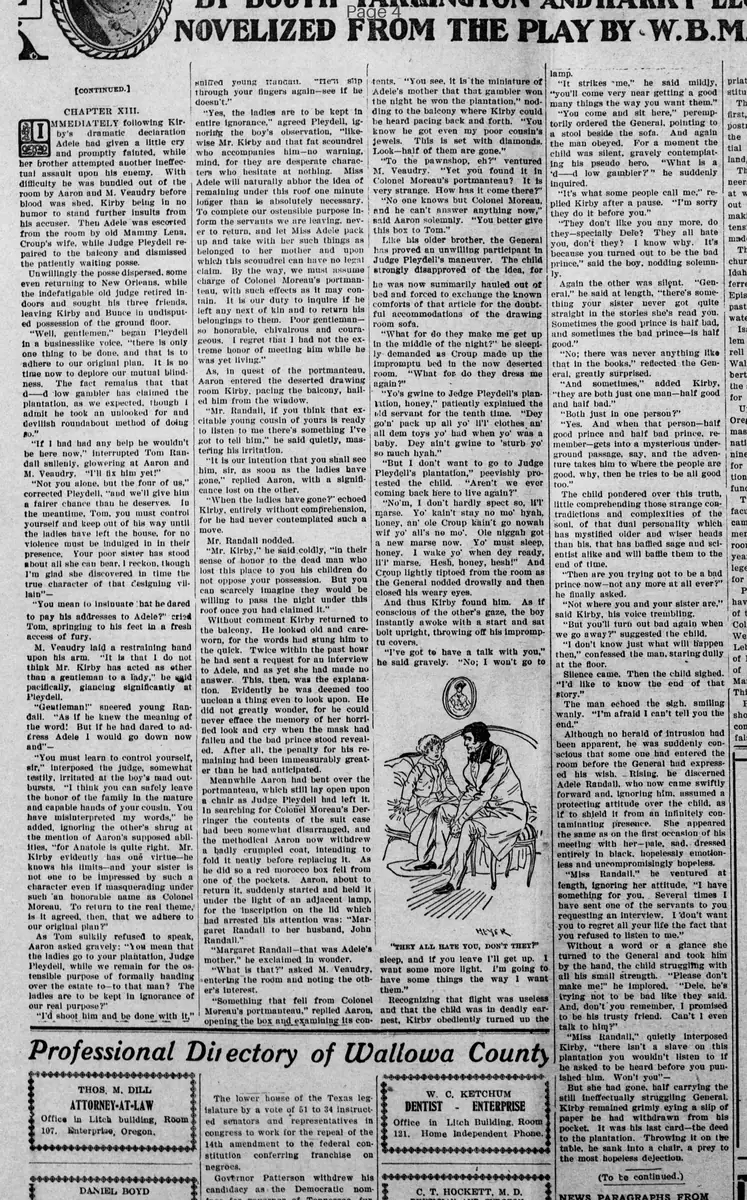
"You come and sit here," peremptorily ordered the General, pointing to a stool beside the sofa. And again the man obeyed. For a moment the child was silent, gravely contemplating his pseudo hero. "What is a d--d low gambler?" he suddenly inquired.
"It's what some people call me," replied Kirby after a pause. "I'm sorry they do it before you."
They don't like you any more, do they--specially Dele? They all hate you, don't they? I know why. It's because you turned out to be the bad prince," said the boy, nodding solemnly.
Again the other was silent. "General," he said at length, "there's something your sister never got quite straight in the stories she's read you. Sometimes the good prince is half bad, and sometimes the bad prince--is half good."
"No; there was never anything like that in the books," reflected the General, greatly surprised.
"And sometimes," added Kirby, "they are both just one man--half good and half bad."
"Both just in one person?"
"Yes. And when that person--half good prince and half bad prince, remember--gets into a mysterious underground passage, say, and the adventure takes him to where the people are good, why, then he tries to be all good too."
The child pondered over this truth, little comprehending those strange contradictions and complexities of the soul, of that dual personality which has mystified older and wiser heads than his, that has baffled sage and scientist alike and will baffle them to the end of time.
Then are you trying not to be a bad prince now--not any more at all ever? he finally asked.
"Not where you and your sister are," said Kirby, his voice trembling.
"But you'll turn out bad again when we go away?" suggested the child.
"I don't know just what will happen then," confessed the man, staring dully at the floor.
Silence came. Then the child sighed.
"I'd like to know the end of that story."
The man echoed the sigh, smiling wanly. "I'm afraid I can't tell you the end."
Although no herald of intrusion had been apparent, he was suddenly conscious that some one had entered the room before the General had expressed his wish. Rising, he discerned Adele Randall, who now came swiftly forward and, ignoring him, assumed a protecting attitude over the child, as if to shield it from an infinitely contaminating presence. She appeared the same as on the first occasion of his meeting with her--pale, sad, dressed entirely in black, hopelessly emotionless and uncompromisingly hopeless.
"Miss Randall," he ventured at length, ignoring her attitude, "I have something for you. Several times I have sent one of the servants to you requesting an interview. I don't want you to regret all your life the fact that you refused to listen to me."
Without a word or a glance she turned to the General and took him by the hand, the child struggling with all his small strength.
"Please don't make me!" he implored. "Dele, he's trying not to be bad like they said. And, don't you remember, I promised to be his trusty friend. Can't I even talk to him?"
"Miss Randall," quietly interposed Kirby, "there isn't a slave on this plantation you wouldn't listen to if he asked to be heard before you punished him. Won't you"--
But she had gone, half carrying the still ineffectually struggling General.
Kirby remained grimly eying a slip of paper he had withdrawn from his pocket. It was his last card--the deed to the plantation. Throwing it on the table, he sank into a chair, a prey to the most hopeless dejection.
(To be continued.)
CHAPTER XIII.
Immediately following Kirby's dramatic declaration Adele had given a little cry and promptly fainted, while her brother attempted another ineffectual assault upon his enemy. With difficulty he was bundled out of the room by Aaron and M. Veaudry before blood was shed. Kirby being in no humor to stand further insults from his accuser. Then Adele was escorted from the room by old Mammy Lena, Croup's wife, while Judge Pleydell repaired to the balcony and dismissed the patiently waiting posse.
Unwillingly the posse dispersed, some even returning to New Orleans, while the indefatigable old judge retired indoors and sought his three friends, leaving Kirby and Bunce in undisputed possession of the ground floor.
"Well, gentlemen," began Pleydell in a businesslike voice, "there is only one thing to be done, and that is to adhere to our original plan. It is no time now to deplore our mutual blindness. The fact remains that that d--d low gambler has claimed the plantation, as we expected, though I admit he took an unlooked for and devilish roundabout method of doing so."
"If I had had any help he wouldn't be here now," interrupted Tom Randall sullenly, glowering at Aaron and M. Veaudry. "I'll fix him yet!"
"Not you alone, but the four of us," corrected Pleydell, "and we'll give him a fairer chance than he deserves. In the meantime, Tom, you must control yourself and keep out of his way until the ladies have left the house, for no violence must be indulged in in their presence. Your poor sister has stood about all she can bear, I reckon, though I'm glad she discovered in time the true character of that designing villain--"
"You mean to insinuate that he dared to pay his addresses to Adele?" cried Tom, springing to his feet in a fresh access of fury.
M. Veaudry laid a restraining hand upon his arm. "It is that I do not think Mr. Kirby has acted as other than a gentleman to a lady," he said pacifically, glancing significantly at Pleydell.
"Gentleman!" sneered young Randall.
"As if he knew the meaning of the word! But if he had dared to address Adele I would go down now and--"
"You must learn to control yourself, sir," interposed the judge, somewhat testily, irritated at the boy's mad outbursts. "I think you can safely leave the honor of the family in the mature and capable hands of your cousin. You have misinterpreted my words," he added, ignoring the other's shrug at the mention of Aaron's supposed abilities, "for Anatole is quite right. Mr. Kirby evidently has one virtue--he knows his limits--and your sister is not one to be impressed by such a character even if masquerading under such an honorable name as Colonel Moreau. To return to the real theme, is it agreed, then, that we adhere to our original plan?"
As Tom sulkily refused to speak, Aaron asked gravely: "You mean that the ladies go to your plantation, Judge Pleydell, while we remain for the ostensible purpose of formally handing over the estate to--to that man? The ladies are to be kept in ignorance of our real purpose?"
"I'd shoot him and be done with it."
sneered young Randall.
"He'll slip through your fingers again--see if he doesn't."
"Yes, the ladies are to be kept in entire ignorance," agreed Pleydell, ignoring the boy's observation, "likewise Mr. Kirby and that fat scoundrel who accompanies him--no warning, mind, for they are desperate characters who hesitate at nothing. Miss Adele will naturally abhor the idea of remaining under this roof one minute longer than is absolutely necessary. To complete our ostensible purpose inform the servants we are leaving, never to return, and let Miss Adele pack up and take with her such things as belonged to her mother and upon which this scoundrel can have no legal claim. By the way, we must assume charge of Colonel Moreau's portmanteau, with such effects as it may contain. It is our duty to inquire if he left any next of kin and to return his belongings to them. Poor gentleman--so honorable, chivalrous and courageous. I regret that I had not the extreme honor of meeting him while he was yet living."
As, in quest of the portmanteau, Aaron entered the deserted drawing room Kirby, pacing the balcony, hailed him from the window.
"Mr. Randall, if you think that excitable young cousin of yours is ready to listen to me there's something I've got to tell him," he said quietly, mastering his irritation.
"It is our intention that you shall see him, sir, as soon as the ladies have gone," replied Aaron, with a significance lost on the other.
"When the ladies have gone?" echoed Kirby, entirely without comprehension, for he had never contemplated such a move.
Mr. Randall nodded.
"Mr. Kirby," he said coldly, "in their sense of honor to the dead man who lost this place to you his children do not oppose your possession. But you can scarcely imagine they would be willing to pass the night under this roof once you had claimed it."
Without comment Kirby returned to the balcony. He looked old and careworn, for the words had stung him to the quick. Twice within the past hour he had sent a request for an interview to Adele, and as yet she had made no answer. This, then, was the explanation. Evidently he was deemed too unclean a thing even to look upon. He did not greatly wonder, for he could never efface the memory of her horrified look and cry when the mask had fallen and the bad prince stood revealed. After all, the penalty for his remaining had been immeasurably greater than he had anticipated.
Meanwhile Aaron had bent over the portmanteau, which still lay open upon a chair as Judge Pleydell had left it. In searching for Colonel Moreau's derringer the contents of the suit case had been somewhat disarranged, and the methodical Aaron now withdrew a badly crumpled coat, intending to fold it neatly before replacing it. As he did so a red morocco box fell from one of the pockets. Aaron, about to return it, suddenly started and held it under the light of an adjacent lamp, for the inscription on the lid which had arrested his attention was: "Margaret Randall to her husband, John Randall."
"Margaret Randall--that was Adele's mother," he exclaimed in wonder.
"What is that?" asked M. Veaudry, entering the room and noting the other's interest.
"Something that fell from Colonel Moreau's portmanteau," replied Aaron, opening the box and examining its contents.
"You see, it is the miniature of Adele's mother that that gambler won the night he won the plantation," nodding to the balcony where Kirby could be heard pacing back and forth. "You know he got even my poor cousin's jewels. This is set with diamonds. Look--half of them are gone."
"To the pawnshop, eh?" ventured M. Veaudry. "Yet you found it in Colonel Moreau's portmanteau? It is very strange. How has it come there?"
"No one knows but Colonel Moreau, and he can't answer anything now," said Aaron solemnly. "You better give this box to Tom."
Like his older brother, the General has proved an unwilling participant in Judge Pleydell's maneuver. The child strongly disapproved of the idea, for he was now summarily hauled out of bed and forced to exchange the known comforts of that article for the doubtful accommodations of the drawing room sofa.
"What for do they make me get up in the middle of the night?" he sleepily demanded as Croup made up the impromptu bed in the now deserted room.
"What for do they dress me again?"
"Yo's gwine to Jedge Pleydell's plantation, honey," patiently explained the old servant for the tenth time. "Dey go'n' pack up all yo' li'l' clothes an' all dem toys yo' had when yo' was a baby. Dey ain't gwine to 'sturb yo' so much hyah."
"But I don't want to go to Judge Pleydell's plantation," peevishly protested the child. "Aren't we ever coming back here to live again?"
"No'm, I don't hardly spect so, li'l' marse. Yo' kain't stay no mo' hyah, honey, an' ole Croup kain't go nowah wif yo' all's no mo'. Ole niggah got a new marse now. Yo' must sleep, honey. I wake yo' when dey ready, li'l' marse. Hesh, honey, hesb!" And Croup lightly tiptoed from the room as the General nodded drowsily and then closed his weary eyes.
And thus Kirby found him. As if conscious of the other's gaze, the boy instantly awoke with a start and sat bolt upright, throwing off his impromptu covers.
"I've got to have a talk with you," he said gravely. "No; I won't go to sleep, and if you leave I'll get up. I want some more light. I'm going to have some things the way I want them."
Recognizing that flight was useless and that the child was in deadly earnest, Kirby obediently turned up the
"It strikes me," he said mildly, "you'll come very near getting a good many things the way you want them."
"You come and sit here," peremptorily ordered the General, pointing to a stool beside the sofa. And again the man obeyed. For a moment the child was silent, gravely contemplating his pseudo hero. "What is a d--d low gambler?" he suddenly inquired.
"It's what some people call me," replied Kirby after a pause. "I'm sorry they do it before you."
They don't like you any more, do they--specially Dele? They all hate you, don't they? I know why. It's because you turned out to be the bad prince," said the boy, nodding solemnly.
Again the other was silent. "General," he said at length, "there's something your sister never got quite straight in the stories she's read you. Sometimes the good prince is half bad, and sometimes the bad prince--is half good."
"No; there was never anything like that in the books," reflected the General, greatly surprised.
"And sometimes," added Kirby, "they are both just one man--half good and half bad."
"Both just in one person?"
"Yes. And when that person--half good prince and half bad prince, remember--gets into a mysterious underground passage, say, and the adventure takes him to where the people are good, why, then he tries to be all good too."
The child pondered over this truth, little comprehending those strange contradictions and complexities of the soul, of that dual personality which has mystified older and wiser heads than his, that has baffled sage and scientist alike and will baffle them to the end of time.
Then are you trying not to be a bad prince now--not any more at all ever? he finally asked.
"Not where you and your sister are," said Kirby, his voice trembling.
"But you'll turn out bad again when we go away?" suggested the child.
"I don't know just what will happen then," confessed the man, staring dully at the floor.
Silence came. Then the child sighed.
"I'd like to know the end of that story."
The man echoed the sigh, smiling wanly. "I'm afraid I can't tell you the end."
Although no herald of intrusion had been apparent, he was suddenly conscious that some one had entered the room before the General had expressed his wish. Rising, he discerned Adele Randall, who now came swiftly forward and, ignoring him, assumed a protecting attitude over the child, as if to shield it from an infinitely contaminating presence. She appeared the same as on the first occasion of his meeting with her--pale, sad, dressed entirely in black, hopelessly emotionless and uncompromisingly hopeless.
"Miss Randall," he ventured at length, ignoring her attitude, "I have something for you. Several times I have sent one of the servants to you requesting an interview. I don't want you to regret all your life the fact that you refused to listen to me."
Without a word or a glance she turned to the General and took him by the hand, the child struggling with all his small strength.
"Please don't make me!" he implored. "Dele, he's trying not to be bad like they said. And, don't you remember, I promised to be his trusty friend. Can't I even talk to him?"
"Miss Randall," quietly interposed Kirby, "there isn't a slave on this plantation you wouldn't listen to if he asked to be heard before you punished him. Won't you"--
But she had gone, half carrying the still ineffectually struggling General.
Kirby remained grimly eying a slip of paper he had withdrawn from his pocket. It was his last card--the deed to the plantation. Throwing it on the table, he sank into a chair, a prey to the most hopeless dejection.
(To be continued.)
What sub-type of article is it?
Prose Fiction
What themes does it cover?
Moral Virtue
Social Manners
Love Romance
What keywords are associated?
Plantation Dispute
Gambling Deception
Family Honor
Child Innocence
Romantic Rejection
Literary Details
Title
Chapter Xiii.
Key Lines
"Sometimes The Good Prince Is Half Bad, And Sometimes The Bad Prince Is Half Good."
"And Sometimes," Added Kirby, "They Are Both Just One Man Half Good And Half Bad."
"Not Where You And Your Sister Are," Said Kirby, His Voice Trembling.