Thank you for visiting SNEWPapers!
Sign up free
Editorial
February 23, 1814
Daily National Intelligencer
Washington, District Of Columbia
What is this article about?
Editorial argues for US territorial sovereignty against British violations like impressment and seizures in US waters, citing 1804-1806 incidents. Proposes maritime protection lines along US coast to prevent foreign interference, advocating retaliation and naval enforcement for honorable peace. Signed CINCINNATUS, Albany, Feb. 11, 1814.
Clipping
OCR Quality
98%
Excellent
Full Text
THE NATIONAL INTELLIGENCER
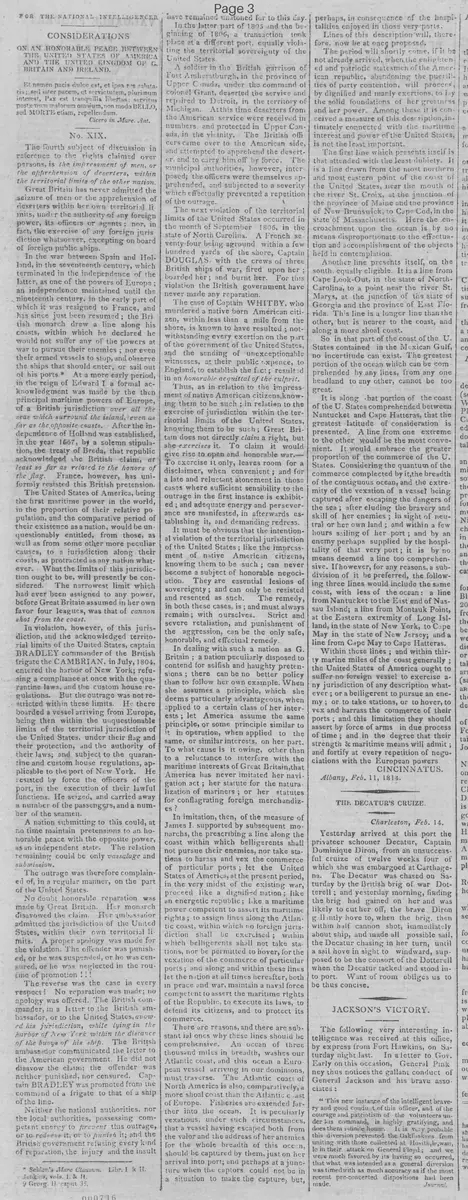
CONSIDERATIONS
ON AN HONORABLE PEACE BETWEEN
THE UNITED STATES OF AMERICA
AND THE UNITED KINGDOM OF G.
BRITAIN AND IRELAND.
Et nomen pacis dulce est, et ipsa res salutarism sed inter pacem, et servitutem, plurimum interest. Pax est tranquilla libertas; servitus postea num malorum omnium, non modo bello, sed morte etiam, repellendum.
Cicero in Marc. Ant.
No. XIX.
The fourth subject of discussion in reference to the rights claimed over persons, is the impressment of men, or the apprehension of deserters, within the territorial limits of the other nation.
Great Britain has never admitted the seizure of men or the apprehension of deserters within her own territorial limits, under the authority of any foreign power, its officers or agents; nor, in fact, the exercise of any foreign jurisdiction whatsoever, excepting on board of foreign public ships.
In the war between Spain and Holland, in the seventeenth century, which terminated in the independence of the latter, as one of the powers of Europe; an independence maintained until the nineteenth century, in the early part of which it was resigned to France, and has since just been resumed: the British monarch drew a line along his coasts, within which he declared he would not suffer any of the powers at war to pursue their enemies; nor even their armed vessels to stop, and observe the ships that should enter, or sail out of his ports.* At a more early period, in the reign of Edward I. a formal acknowledgment was made by the then principal maritime powers of Europe, of a British jurisdiction over all the seas which surround the island, even as far as the opposite coasts. After the independence of Holland was established, in the year 1667, by a solemn stipulation, the treaty of Breda, that republic acknowledged the British claim, at least so far as related to the honors of the flag. France, however, has uniformly resisted this British pretension.
The United States of America, being the first maritime power in the world, in the proportion of their relative population, and the comparative period of their existence as a nation, would be unquestionably entitled, from those, as well as from some other more peculiar causes, to a jurisdiction along their coasts, as protracted as any nation whatever. What the limits of this jurisdiction ought to be, will presently be considered. The narrowest limit which had ever been assigned to any power, before Great Britain assumed in her own favor four leagues, was that of cannon shot from the coast.
In violation, however, of this jurisdiction, and the acknowledged territorial limits of the United States, captain Bradley commander of the British frigate the CAMBRIAN, in July, 1804, entered the harbor of New York: refusing a compliance at once with the quarantine laws, and the custom house regulations. But the outrage was not restricted within these limits. He there boarded a vessel arriving from Europe, being then within the unquestionable limits of the territorial jurisdiction of the United States, under their flag and their protection, and the authority of their laws; and subject to the quarantine and custom house regulations, applicable to the port of New York. He resisted by force the officers of the port, in the execution of their lawful functions. He seized, and carried away a number of the passengers, and a number of the seamen.
A nation submitting to this could, at no time maintain pretensions to an honorable peace with the opposite power, as an independent state. The relation remaining could be only vassalage and submission.
The outrage was therefore complained of, in a regular manner, on the part of the United States. No doubt honorable reparation was made by Great Britain. Her monarch disavowed the claim. Her ambassador admitted the jurisdiction of the United States, within their own territorial limits. A proper apology was made for the violation. The offender was punished, or he was suspended, or he was censured, or he was neglected in the routine of promotion!!!
The reverse was the case in every respect! No reparation was made; no apology was offered. The British commander, in a letter to the British ambassador, or to the United States, avowed his jurisdiction, while lying in the harbor of New York within the distance of the buoys of his ship. The British ambassador communicated the letter to the American government. He did not disavow the claim; the offender was neither punished, nor censured. Captain Bradley was promoted from the command of a frigate to that of a ship of the line.
Neither the national authorities, nor the local authorities, possessing competent energy to prevent this outrage, or to redress it, or to punish it; and the British government refusing every kind of reparation, the injury and the insult have remained unatoned for to this day.
In the latter part of 1805 and the beginning of 1806, a transaction took place at a different port, equally violating the territorial sovereignty of the United States.
A soldier in the British garrison of Fort Amherstburgh, in the province of Upper Canada, under the command of colonel Grant, deserted the service and repaired to Detroit, in the territory of Michigan. At this time deserters from the American service were received in numbers, and protected in Upper Canada, in the vicinity. The British officers came over to the American side, and attempted to apprehend the deserter, and to carry him off by force. The municipal authorities, however, interposed; the officers were themselves apprehended, and subjected to a severity which effectually prevented a repetition of the outrage.
The next violation of the territorial limits of the United States occurred in the month of September 1806, in the state of North Carolina. A French seventy-four being aground within a few hundred yards of the shore, Captain Douglas, with the crews of three British ships of war, fired upon her; boarded her; and burnt her. For this violation the British government have never made any reparation.
The case of Captain Whitby, who murdered a native born American citizen, within less than a mile from the shore, is known to have resulted; notwithstanding every exertion on the part of the government of the United States, and the sending of unexceptionable witnesses, at their public expense, to England, to establish the fact; resulted in an honorable acquittal of the culprit.
Thus, as in relation to the impressment of native American citizens, knowing them to be such; in relation to the exercise of jurisdiction within the territorial limits of the United States, knowing them to be such: Great Britain does not directly claim a right, but she exercises it. To claim it would give rise to open and honorable war. To exercise it only, leaves room for a disclaimer, when convenient; and for a late and reluctant atonement in those cases where sufficient sensibility to the outrage in the first instance is exhibited; and adequate energy and perseverance are manifested, in afterwards establishing it, and demanding redress.
It must be obvious that the intentional violation of the territorial jurisdiction of the United States; like the impressment of native American citizens, knowing them to be such; can never become a subject of honorable negotiation. They are essential lesions of sovereignty; and can only be resisted and resented as such. The remedy, in both these cases, is; and must always remain; with ourselves. Strict and severe retaliation, and punishment of the aggression, can be the only safe, honorable, and effectual remedy.
In dealing with such a nation as G. Britain; a nation peculiarly disposed to contend for selfish and haughty pretensions; there can be no better policy than to follow her own example. When she assumes a principle, which she deems particularly advantageous, when applied to a certain class of her interests: let America assume the same principle, or some principle similar to it in operation, when applied to the same, or similar interests, on her part.
To what cause is it owing, other than to a reluctance to interfere with the maritime interests of Great Britain, that America has never imitated her navigation act; her statute for the naturalization of mariners; or her statutes for confiscating foreign merchandizes?
In imitation, then, of the measure of James I. supported by subsequent monarchs, the prescribing a line along the coast within which belligerents shall not pursue their enemies, nor take stations to harass and vex the commerce of particular ports; let the United States of America, at the present period, in the very midst of the existing war, proceed like a dignified nation; like an energetic republic; like a maritime power competent to assert its maritime rights; to assign lines along the Atlantic coast, within which no foreign jurisdiction shall be exercised; within which belligerents shall not take stations, nor be permitted to hover, for the vexation of the commerce of particular ports; and along and within these lines let the nation at all times hereafter, both in peace and war, maintain a naval force competent to assert the maritime rights of the Republic, to execute its laws, to defend its citizens, and to protect its commerce.
There are reasons, and there are substantial ones why these lines should be comprehensive. An ocean of three thousand miles in breadth, washes our Atlantic coast, and this ocean a European vessel arriving in our dominions, must traverse. The Atlantic coast of North America is also, comparatively, a more shoal coast than the Atlantic coast of Europe. Fisheries are extended farther into the ocean. It is peculiarly vexatious, under such circumstances, that a vessel having escaped both from the valor and the address of her enemies for the whole breadth of this ocean, should be captured by them, just on her arrival into port; and perhaps at a juncture when the captors could not be in a situation to make the capture, but, perhaps, in consequence of the hospitalities enjoyed in those very ports.
Lines of this description will, therefore, now be at once proposed.
The period will shortly come, if it be not already arrived, when the enlightened and patriotic statesmen of the American republic, abandoning the puerilities of party contention, will proceed by dignified and manly exertions, to lay the solid foundations of her greatness and her power. Among these it is conceived a measure of this description, intimately connected with the maritime interest and power of the United States, is not the least important.
The first line which presents itself is that attended with the least dubiety. It is a line drawn from the most northern and most eastern point of the coast of the United States, near the mouth of the river St. Croix, at the junction of the province of Maine and the province of New Brunswick, to Cape Cod, in the state of Massachusetts. Here the encroachment upon the ocean is by no means disproportionate to the effectuation and accomplishment of the objects held in contemplation.
Another line presents itself, on the south, equally eligible. It is a line from Cape Look-Out, in the state of North Carolina, to a point near the river St. Marys, at the junction of the state of Georgia and the province of East Florida. This line is a longer line than the other, but is nearer to the coast, and along a more shoal coast.
So in that part of the coast of the U. States contained in the Mexican Gulf, no incertitude can exist. The greatest portion of the ocean which can be comprehended by any lines, from any one headland to any other, cannot be too great.
It is along that portion of the coast of the U. States comprehended between Nantucket and Cape Hatteras, that the greatest latitude of consideration is presented. A line from one extreme to the other would be the most convenient. It would embrace the greater proportion of the commerce of the U. States. Considering the quantum of the commerce comprehended by it, the breadth of the contiguous ocean, and the extremity of the vexation of a vessel being captured after escaping the dangers of the sea; after eluding the bravery and skill of her enemies; in sight of neutral or her own land; and within a few hours sailing of her port; and by an enemy perhaps supplied by the hospitality of that very port; it is by no means deemed a line too comprehensive. If however, for any reasons, a subdivision of it be preferred, the following three lines would include the same coast, with less of the ocean: a line from Nantucket to the East end of Nassau Island; a line from Montauk Point, at the Eastern extremity of Long Island, in the state of New York, to Cape May in the state of New Jersey; and a line from Cape May to Cape Hatteras.
Within these lines; and within thirty marine miles of the coast generally; the United States of America ought to suffer no foreign vessel to exercise any jurisdiction of any description whatever; or a belligerent to pursue an enemy; or to take stations, or to hover, to vex and harass the commerce of their ports: and this limitation they should assert by force of arms in due process of time; and in the degree that their strength & maritime means will admit; and fortify at every repetition of negotiations with the European powers.
CINCINNATUS.
Albany, Feb. 11, 1814.
CONSIDERATIONS
ON AN HONORABLE PEACE BETWEEN
THE UNITED STATES OF AMERICA
AND THE UNITED KINGDOM OF G.
BRITAIN AND IRELAND.
Et nomen pacis dulce est, et ipsa res salutarism sed inter pacem, et servitutem, plurimum interest. Pax est tranquilla libertas; servitus postea num malorum omnium, non modo bello, sed morte etiam, repellendum.
Cicero in Marc. Ant.
No. XIX.
The fourth subject of discussion in reference to the rights claimed over persons, is the impressment of men, or the apprehension of deserters, within the territorial limits of the other nation.
Great Britain has never admitted the seizure of men or the apprehension of deserters within her own territorial limits, under the authority of any foreign power, its officers or agents; nor, in fact, the exercise of any foreign jurisdiction whatsoever, excepting on board of foreign public ships.
In the war between Spain and Holland, in the seventeenth century, which terminated in the independence of the latter, as one of the powers of Europe; an independence maintained until the nineteenth century, in the early part of which it was resigned to France, and has since just been resumed: the British monarch drew a line along his coasts, within which he declared he would not suffer any of the powers at war to pursue their enemies; nor even their armed vessels to stop, and observe the ships that should enter, or sail out of his ports.* At a more early period, in the reign of Edward I. a formal acknowledgment was made by the then principal maritime powers of Europe, of a British jurisdiction over all the seas which surround the island, even as far as the opposite coasts. After the independence of Holland was established, in the year 1667, by a solemn stipulation, the treaty of Breda, that republic acknowledged the British claim, at least so far as related to the honors of the flag. France, however, has uniformly resisted this British pretension.
The United States of America, being the first maritime power in the world, in the proportion of their relative population, and the comparative period of their existence as a nation, would be unquestionably entitled, from those, as well as from some other more peculiar causes, to a jurisdiction along their coasts, as protracted as any nation whatever. What the limits of this jurisdiction ought to be, will presently be considered. The narrowest limit which had ever been assigned to any power, before Great Britain assumed in her own favor four leagues, was that of cannon shot from the coast.
In violation, however, of this jurisdiction, and the acknowledged territorial limits of the United States, captain Bradley commander of the British frigate the CAMBRIAN, in July, 1804, entered the harbor of New York: refusing a compliance at once with the quarantine laws, and the custom house regulations. But the outrage was not restricted within these limits. He there boarded a vessel arriving from Europe, being then within the unquestionable limits of the territorial jurisdiction of the United States, under their flag and their protection, and the authority of their laws; and subject to the quarantine and custom house regulations, applicable to the port of New York. He resisted by force the officers of the port, in the execution of their lawful functions. He seized, and carried away a number of the passengers, and a number of the seamen.
A nation submitting to this could, at no time maintain pretensions to an honorable peace with the opposite power, as an independent state. The relation remaining could be only vassalage and submission.
The outrage was therefore complained of, in a regular manner, on the part of the United States. No doubt honorable reparation was made by Great Britain. Her monarch disavowed the claim. Her ambassador admitted the jurisdiction of the United States, within their own territorial limits. A proper apology was made for the violation. The offender was punished, or he was suspended, or he was censured, or he was neglected in the routine of promotion!!!
The reverse was the case in every respect! No reparation was made; no apology was offered. The British commander, in a letter to the British ambassador, or to the United States, avowed his jurisdiction, while lying in the harbor of New York within the distance of the buoys of his ship. The British ambassador communicated the letter to the American government. He did not disavow the claim; the offender was neither punished, nor censured. Captain Bradley was promoted from the command of a frigate to that of a ship of the line.
Neither the national authorities, nor the local authorities, possessing competent energy to prevent this outrage, or to redress it, or to punish it; and the British government refusing every kind of reparation, the injury and the insult have remained unatoned for to this day.
In the latter part of 1805 and the beginning of 1806, a transaction took place at a different port, equally violating the territorial sovereignty of the United States.
A soldier in the British garrison of Fort Amherstburgh, in the province of Upper Canada, under the command of colonel Grant, deserted the service and repaired to Detroit, in the territory of Michigan. At this time deserters from the American service were received in numbers, and protected in Upper Canada, in the vicinity. The British officers came over to the American side, and attempted to apprehend the deserter, and to carry him off by force. The municipal authorities, however, interposed; the officers were themselves apprehended, and subjected to a severity which effectually prevented a repetition of the outrage.
The next violation of the territorial limits of the United States occurred in the month of September 1806, in the state of North Carolina. A French seventy-four being aground within a few hundred yards of the shore, Captain Douglas, with the crews of three British ships of war, fired upon her; boarded her; and burnt her. For this violation the British government have never made any reparation.
The case of Captain Whitby, who murdered a native born American citizen, within less than a mile from the shore, is known to have resulted; notwithstanding every exertion on the part of the government of the United States, and the sending of unexceptionable witnesses, at their public expense, to England, to establish the fact; resulted in an honorable acquittal of the culprit.
Thus, as in relation to the impressment of native American citizens, knowing them to be such; in relation to the exercise of jurisdiction within the territorial limits of the United States, knowing them to be such: Great Britain does not directly claim a right, but she exercises it. To claim it would give rise to open and honorable war. To exercise it only, leaves room for a disclaimer, when convenient; and for a late and reluctant atonement in those cases where sufficient sensibility to the outrage in the first instance is exhibited; and adequate energy and perseverance are manifested, in afterwards establishing it, and demanding redress.
It must be obvious that the intentional violation of the territorial jurisdiction of the United States; like the impressment of native American citizens, knowing them to be such; can never become a subject of honorable negotiation. They are essential lesions of sovereignty; and can only be resisted and resented as such. The remedy, in both these cases, is; and must always remain; with ourselves. Strict and severe retaliation, and punishment of the aggression, can be the only safe, honorable, and effectual remedy.
In dealing with such a nation as G. Britain; a nation peculiarly disposed to contend for selfish and haughty pretensions; there can be no better policy than to follow her own example. When she assumes a principle, which she deems particularly advantageous, when applied to a certain class of her interests: let America assume the same principle, or some principle similar to it in operation, when applied to the same, or similar interests, on her part.
To what cause is it owing, other than to a reluctance to interfere with the maritime interests of Great Britain, that America has never imitated her navigation act; her statute for the naturalization of mariners; or her statutes for confiscating foreign merchandizes?
In imitation, then, of the measure of James I. supported by subsequent monarchs, the prescribing a line along the coast within which belligerents shall not pursue their enemies, nor take stations to harass and vex the commerce of particular ports; let the United States of America, at the present period, in the very midst of the existing war, proceed like a dignified nation; like an energetic republic; like a maritime power competent to assert its maritime rights; to assign lines along the Atlantic coast, within which no foreign jurisdiction shall be exercised; within which belligerents shall not take stations, nor be permitted to hover, for the vexation of the commerce of particular ports; and along and within these lines let the nation at all times hereafter, both in peace and war, maintain a naval force competent to assert the maritime rights of the Republic, to execute its laws, to defend its citizens, and to protect its commerce.
There are reasons, and there are substantial ones why these lines should be comprehensive. An ocean of three thousand miles in breadth, washes our Atlantic coast, and this ocean a European vessel arriving in our dominions, must traverse. The Atlantic coast of North America is also, comparatively, a more shoal coast than the Atlantic coast of Europe. Fisheries are extended farther into the ocean. It is peculiarly vexatious, under such circumstances, that a vessel having escaped both from the valor and the address of her enemies for the whole breadth of this ocean, should be captured by them, just on her arrival into port; and perhaps at a juncture when the captors could not be in a situation to make the capture, but, perhaps, in consequence of the hospitalities enjoyed in those very ports.
Lines of this description will, therefore, now be at once proposed.
The period will shortly come, if it be not already arrived, when the enlightened and patriotic statesmen of the American republic, abandoning the puerilities of party contention, will proceed by dignified and manly exertions, to lay the solid foundations of her greatness and her power. Among these it is conceived a measure of this description, intimately connected with the maritime interest and power of the United States, is not the least important.
The first line which presents itself is that attended with the least dubiety. It is a line drawn from the most northern and most eastern point of the coast of the United States, near the mouth of the river St. Croix, at the junction of the province of Maine and the province of New Brunswick, to Cape Cod, in the state of Massachusetts. Here the encroachment upon the ocean is by no means disproportionate to the effectuation and accomplishment of the objects held in contemplation.
Another line presents itself, on the south, equally eligible. It is a line from Cape Look-Out, in the state of North Carolina, to a point near the river St. Marys, at the junction of the state of Georgia and the province of East Florida. This line is a longer line than the other, but is nearer to the coast, and along a more shoal coast.
So in that part of the coast of the U. States contained in the Mexican Gulf, no incertitude can exist. The greatest portion of the ocean which can be comprehended by any lines, from any one headland to any other, cannot be too great.
It is along that portion of the coast of the U. States comprehended between Nantucket and Cape Hatteras, that the greatest latitude of consideration is presented. A line from one extreme to the other would be the most convenient. It would embrace the greater proportion of the commerce of the U. States. Considering the quantum of the commerce comprehended by it, the breadth of the contiguous ocean, and the extremity of the vexation of a vessel being captured after escaping the dangers of the sea; after eluding the bravery and skill of her enemies; in sight of neutral or her own land; and within a few hours sailing of her port; and by an enemy perhaps supplied by the hospitality of that very port; it is by no means deemed a line too comprehensive. If however, for any reasons, a subdivision of it be preferred, the following three lines would include the same coast, with less of the ocean: a line from Nantucket to the East end of Nassau Island; a line from Montauk Point, at the Eastern extremity of Long Island, in the state of New York, to Cape May in the state of New Jersey; and a line from Cape May to Cape Hatteras.
Within these lines; and within thirty marine miles of the coast generally; the United States of America ought to suffer no foreign vessel to exercise any jurisdiction of any description whatever; or a belligerent to pursue an enemy; or to take stations, or to hover, to vex and harass the commerce of their ports: and this limitation they should assert by force of arms in due process of time; and in the degree that their strength & maritime means will admit; and fortify at every repetition of negotiations with the European powers.
CINCINNATUS.
Albany, Feb. 11, 1814.
What sub-type of article is it?
Foreign Affairs
War Or Peace
Constitutional
What keywords are associated?
Impressment
Territorial Jurisdiction
Maritime Rights
British Violations
Honorable Peace
Naval Protection
Sovereignty
What entities or persons were involved?
Great Britain
United States
Captain Bradley
British Frigate Cambrian
Captain Douglas
Captain Whitby
British Monarch
British Ambassador
Editorial Details
Primary Topic
British Violations Of Us Territorial Jurisdiction And Proposals For Protective Maritime Lines
Stance / Tone
Strongly Pro Us Sovereignty, Critical Of British Aggressions, Advocating Retaliation And Naval Assertion
Key Figures
Great Britain
United States
Captain Bradley
British Frigate Cambrian
Captain Douglas
Captain Whitby
British Monarch
British Ambassador
Key Arguments
Great Britain Exercises Jurisdiction In Us Waters Without Claiming It Openly To Avoid War
Incidents Like 1804 New York Seizure And 1806 North Carolina Attack Violate Us Sovereignty
Us Must Retaliate Strictly Against Impressment And Territorial Violations
Propose Maritime Lines Along Us Coast To Exclude Foreign Jurisdiction And Belligerent Pursuits
Maintain Naval Force Within Lines To Protect Commerce And Rights
Imitate British Policies For Us Maritime Interests