Thank you for visiting SNEWPapers!
Sign up free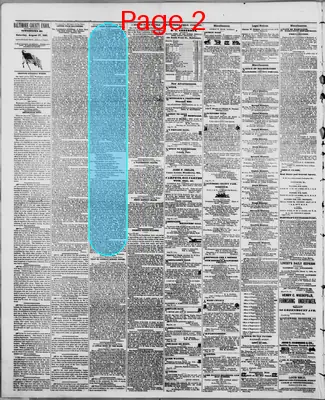
Letter to Editor
August 27, 1881
The Baltimore County Union
Towson, Baltimore County, Maryland
What is this article about?
Traveler 'Rambler' writes from Nantucket on August 16, 1881, describing cool invigorating weather, the Clan Coffin reunion with 400-500 attendees marred by a death, seaweed collections, booming post office business, and historical records including 17th-century Indian land deeds to Tristram Coffin and a 1687 patent, witnessed by Peter Folger.
Clipping

OCR Quality
95%
Excellent
Full Text
Correspondence Baltimore County Union,
Letter From Nantucket, Mass,
Nantucket, August 16th, 1881.
Messrs. Editors:—We are still here enjoying the invigorating air of this charming island. Sunday was a warm day for Nantucket, the warmest I have ever felt any time I have been here: the thermometer registered 84 degrees. On Monday it had fallen to 64, and that night, with only one window in the room up, I slept under a blanket. It is blowing very hard now, and the boat that should have arrived about 7 p. m. is not here yet (8:30 p. m.) and probably it will not venture to come here to-night. A winter overcoat is not too heavy or warm for one to wear while walking out to-night, and with all the windows down in the room in which I am writing, and with the heat of a coal oil lamp, it is not too warm. While it is occasionally quite warm here in the daytime the heat is not oppressive and the nights are delightfully cool and a blanket is sometimes quite acceptable.
The re-union of the "Clan Coffin" began to-day with a clam bake, etc., at Surf Side, and between 400 and 500 of the clan were there. More of them would have been present but one of them who came here sometime since in delicate health died on Monday and about 50 of his friends accompanied his remains to his home on the mainland.—They are here from the far West, and one lady of the clan is here from Nova Scotia.
My friend Capt. L. A. Carl and two of his sisters are still here, and the ladies have made a fine collection of seaweed which they have arranged beautifully. It was quite a treat to see them. The sight of them has quite excited some of the ladies of our party, who have determined also to make a collection of algæ.
The postmaster tells me that the business of his office has increased very much; that one of his assistants, who has been in the office between 20 and 30 years, says that during all that time there has not been so much business done in the office as at present. He said they handled now about 3,000 letters a day, including the letters that are sent away as well as those that are sent here.
I went to-day to the office of Registry of Deeds of Nantucket county and entertained myself for some time in looking over the early records.—Among them I found the record of a deed from Wanackmanack and Mickanoose, head sachems of Nantucket Island, by which they grant unto Thos. Mayhew, of Martha's Vineyard, Tristram Coffin (the forefather of the clan now assembled here) and to others, all the land, meadows, marshes (that is marshes) timbers, wood and all the appurtenances thereunto belonging, which it then describes. "provided that none of the Indian inhabitants in or about said woodland, or whatsoever Indians inhabit the same, shall be removed without full satisfaction." The deed further grants all their interest and right of pasturage for all cattle in consideration of £12 (English money) already paid and £14 to be paid within three months. It is witnessed in the following manner by Peter Folger, who was Benjamin Franklin's grandfather: "I do witness this deed to be a true deed according to the interpretation of Felix the interpreter, and I also heard Wanackmanack, but not Mickanoose, affirm the sale of the next, (I presume this is intended for annexed.) and he do say he will do whatever come of it. Witness my hand this 17- 1 mo. 63-61. PETER FOLGER."
This is the same Peter Folger, whose name is written with two F's as above, who wrote a piece of verse called "A Looking-Glass for the Times; or, the Former Spirit of New England Reviewed in this Generation." containing some fifty odd stanzas of four lines each, some of which are very amusing, for instance:
"Indeed I really believe
it's not your business
To meddle with the Church of Christ
in matters more or less."
And again another verse runs thus:
"If that you do mistake the verse
for its uncomely dress,
I tell thee true, I never thought
that it would pass the press."
This remarkable composition concludes thus:
"From Sherbon town where now I dwell,
my name I do put here,
Without offence your real friend,
it is Peter Folger.
April 23d, 1676."
The present town of Nantucket was called Sherburne until the latter part of the 18th century when the name was changed to Nantucket, by which name this island has always been known. Some claim that the town of Sherburne was not on the site where the town of Nantucket now stands. The name of the town was variously spelt, thus Sherbon, as Peter Folger spelt it, Sharborn and Sherburne, and perhaps in other ways. I also saw the original grant or patent written on parchment and dated June 20th, 1687, by which Thos. Dongan, "Captain Governor in Chief and Vice Admiral in and over the province of New York and territories depending, etc., under his most sacred Majesty, James the Second," granted by and with the advice of his council to John Gardner, James Coffin and others, "stockholders and inhabitants of Nantuckett herein erected and made one body corporate and politic and willed and determined to be called by the name of the trustees, of the freeholders and commonality of the towne of Sherborne, and their survivors, the island of Nantucket." It then proceeds to give the terms, etc., of the grant. It is signed by Dongan in a clear, bold hand, and is endorsed as follows: "By command of his Excellency"—the last word being evidently a contraction of the word "excellency." And also it is further endorsed as follows: "May it please your Excellency, the Attorney General hath perused this patent and finds nothing contained therein prejudicial to His Majesty's interests.—Examined June the 27th, 1687. W. Nicolls."
Strange to state it appears not to have been sent to Nantucket for nearly 80 years, for on it is the further endorsement: "Received November 23d, 1763, and recorded in the Sixth Book of Records, at Sherborn, in the county of Nantucket, page 350 to 356, per Nathan Coffin."
Other strange and interesting records are to be found in the office of the Registry of Deeds. The present Register is Capt. Wm. H. Macy, author of the well-known book called "There She Blows; or the Log of the Arethusa," relating incidents in a whaling expedition, and I found him very polite, affable and communicative. I must bring my long letter to a close, and subscribe myself.
Yours very truly,
RAMBLER.
Letter From Nantucket, Mass,
Nantucket, August 16th, 1881.
Messrs. Editors:—We are still here enjoying the invigorating air of this charming island. Sunday was a warm day for Nantucket, the warmest I have ever felt any time I have been here: the thermometer registered 84 degrees. On Monday it had fallen to 64, and that night, with only one window in the room up, I slept under a blanket. It is blowing very hard now, and the boat that should have arrived about 7 p. m. is not here yet (8:30 p. m.) and probably it will not venture to come here to-night. A winter overcoat is not too heavy or warm for one to wear while walking out to-night, and with all the windows down in the room in which I am writing, and with the heat of a coal oil lamp, it is not too warm. While it is occasionally quite warm here in the daytime the heat is not oppressive and the nights are delightfully cool and a blanket is sometimes quite acceptable.
The re-union of the "Clan Coffin" began to-day with a clam bake, etc., at Surf Side, and between 400 and 500 of the clan were there. More of them would have been present but one of them who came here sometime since in delicate health died on Monday and about 50 of his friends accompanied his remains to his home on the mainland.—They are here from the far West, and one lady of the clan is here from Nova Scotia.
My friend Capt. L. A. Carl and two of his sisters are still here, and the ladies have made a fine collection of seaweed which they have arranged beautifully. It was quite a treat to see them. The sight of them has quite excited some of the ladies of our party, who have determined also to make a collection of algæ.
The postmaster tells me that the business of his office has increased very much; that one of his assistants, who has been in the office between 20 and 30 years, says that during all that time there has not been so much business done in the office as at present. He said they handled now about 3,000 letters a day, including the letters that are sent away as well as those that are sent here.
I went to-day to the office of Registry of Deeds of Nantucket county and entertained myself for some time in looking over the early records.—Among them I found the record of a deed from Wanackmanack and Mickanoose, head sachems of Nantucket Island, by which they grant unto Thos. Mayhew, of Martha's Vineyard, Tristram Coffin (the forefather of the clan now assembled here) and to others, all the land, meadows, marshes (that is marshes) timbers, wood and all the appurtenances thereunto belonging, which it then describes. "provided that none of the Indian inhabitants in or about said woodland, or whatsoever Indians inhabit the same, shall be removed without full satisfaction." The deed further grants all their interest and right of pasturage for all cattle in consideration of £12 (English money) already paid and £14 to be paid within three months. It is witnessed in the following manner by Peter Folger, who was Benjamin Franklin's grandfather: "I do witness this deed to be a true deed according to the interpretation of Felix the interpreter, and I also heard Wanackmanack, but not Mickanoose, affirm the sale of the next, (I presume this is intended for annexed.) and he do say he will do whatever come of it. Witness my hand this 17- 1 mo. 63-61. PETER FOLGER."
This is the same Peter Folger, whose name is written with two F's as above, who wrote a piece of verse called "A Looking-Glass for the Times; or, the Former Spirit of New England Reviewed in this Generation." containing some fifty odd stanzas of four lines each, some of which are very amusing, for instance:
"Indeed I really believe
it's not your business
To meddle with the Church of Christ
in matters more or less."
And again another verse runs thus:
"If that you do mistake the verse
for its uncomely dress,
I tell thee true, I never thought
that it would pass the press."
This remarkable composition concludes thus:
"From Sherbon town where now I dwell,
my name I do put here,
Without offence your real friend,
it is Peter Folger.
April 23d, 1676."
The present town of Nantucket was called Sherburne until the latter part of the 18th century when the name was changed to Nantucket, by which name this island has always been known. Some claim that the town of Sherburne was not on the site where the town of Nantucket now stands. The name of the town was variously spelt, thus Sherbon, as Peter Folger spelt it, Sharborn and Sherburne, and perhaps in other ways. I also saw the original grant or patent written on parchment and dated June 20th, 1687, by which Thos. Dongan, "Captain Governor in Chief and Vice Admiral in and over the province of New York and territories depending, etc., under his most sacred Majesty, James the Second," granted by and with the advice of his council to John Gardner, James Coffin and others, "stockholders and inhabitants of Nantuckett herein erected and made one body corporate and politic and willed and determined to be called by the name of the trustees, of the freeholders and commonality of the towne of Sherborne, and their survivors, the island of Nantucket." It then proceeds to give the terms, etc., of the grant. It is signed by Dongan in a clear, bold hand, and is endorsed as follows: "By command of his Excellency"—the last word being evidently a contraction of the word "excellency." And also it is further endorsed as follows: "May it please your Excellency, the Attorney General hath perused this patent and finds nothing contained therein prejudicial to His Majesty's interests.—Examined June the 27th, 1687. W. Nicolls."
Strange to state it appears not to have been sent to Nantucket for nearly 80 years, for on it is the further endorsement: "Received November 23d, 1763, and recorded in the Sixth Book of Records, at Sherborn, in the county of Nantucket, page 350 to 356, per Nathan Coffin."
Other strange and interesting records are to be found in the office of the Registry of Deeds. The present Register is Capt. Wm. H. Macy, author of the well-known book called "There She Blows; or the Log of the Arethusa," relating incidents in a whaling expedition, and I found him very polite, affable and communicative. I must bring my long letter to a close, and subscribe myself.
Yours very truly,
RAMBLER.
What sub-type of article is it?
Informative
Historical
Reflective
What keywords are associated?
Nantucket
Clan Coffin
Historical Deeds
Peter Folger
Weather
Post Office
Seaweed Collection
What entities or persons were involved?
Rambler
Messrs. Editors
Letter to Editor Details
Author
Rambler
Recipient
Messrs. Editors
Main Argument
shares personal observations and historical discoveries from a visit to nantucket, highlighting the island's weather, community events, and early colonial records.
Notable Details
Deed From Indian Sachems Wanackmanack And Mickanoose To Tristram Coffin Et Al. In 1661
Witnessed By Peter Folger, Benjamin Franklin's Grandfather
Excerpts From Peter Folger's 1676 Poem 'A Looking Glass For The Times'
1687 Patent From Thomas Dongan To Nantucket Inhabitants, Received In 1763
Clan Coffin Reunion At Surf Side With 400 500 Attendees
Increased Postal Business Handling 3,000 Letters Daily