Thank you for visiting SNEWPapers!
Sign up free
Letter to Editor
April 21, 1790
Gazette Of The United States
New York, New York County, New York
What is this article about?
Philosophical letter refuting the maxim 'Admiration and acquaintance are incompatible,' arguing that genuine excellence in human nature allows admiration to persist and grow through close acquaintance, as seen in friendships, education, and marriage.
Clipping
OCR Quality
92%
Excellent
Full Text
FOR THE GAZETTE OF THE UNITED STATES.
"Admiration and acquaintance are incompatible."
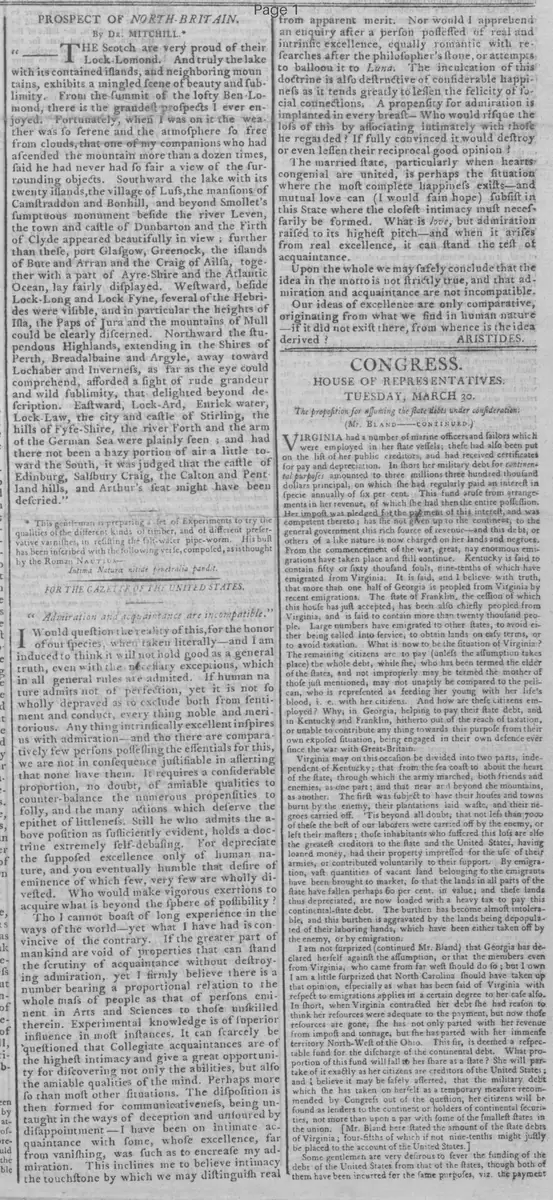
Would question the reality of this, for the honor of our species, when taken literally—and I am induced to think it will not hold good as a general truth, even with the necessary exceptions, which in all general rules are admitted. If human nature admits not of perfection, yet it is not so wholly depraved as to exclude both from sentiment and conduct, every thing noble and meritorious. Any thing intrinsically excellent inspires us with admiration—and tho there are comparatively few persons possessing the essentials for this, we are not in consequence justifiable in asserting that none have them. It requires a considerable proportion, no doubt, of amiable qualities to counter-balance the numerous propensities to folly, and the many actions which deserve the above position as sufficiently evident, holds a doctrine epithet of littleness. Still he who admits the doctrine extremely self-debasing. For depreciate the supposed excellence only of human nature, and you eventually humble that desire of eminence of which few, very few are wholly divested. Who would make vigorous exertions to acquire what is beyond the sphere of possibility? Tho I cannot boast of long experience in the ways of the world—yet what I have had is convincing of the contrary. If the greater part of mankind are void of properties that can stand ing admiration, yet I firmly believe there is a number bearing a proportional relation to the whole mass of people as that of persons eminent in Arts and Sciences to those unskilled therein. Experimental knowledge is of superior influence in most instances. It can scarcely be questioned that Collegiate acquaintances are of the highest intimacy and give a great opportunity for discovering not only the abilities, but also the amiable qualities of the mind. Perhaps more so than most other situations. The disposition is then formed for communicativeness, being untaught in the ways of deception and unsoured by disappointment—I have been on intimate acquaintance with some, whose excellence, far from vanishing, was such as to increase my admiration. This inclines me to believe intimacy from apparent merit. Nor would I apprehend an enquiry after a person possessed of real and intrinsic excellence, equally romantic with researches after the philosopher's stone, or attempts, to balloon it to Luna. The inculcation of this doctrine is also destructive of considerable happiness as it tends greatly to lessen the felicity of social connections. A propensity for admiration is implanted in every breast— Who would risk the loss of this by associating intimately with those he regarded? If fully convinced it would destroy or even lessen their reciprocal good opinion? The married state, particularly when hearts congenial are united, is perhaps the situation where the most complete happiness exists and mutual love can (I would fain hope) subsist in this State where the closest intimacy must necessarily be formed. What is love, but admiration raised to its highest pitch—and when it arises from real excellence, it can stand the test of acquaintance.
Upon the whole we may safely conclude that the idea in the motto is not strictly true, and that admiration and acquaintance are not incompatible. Our ideas of excellence are only comparative, originating from what we find in human nature —if it did not exist there, from whence is the idea derived?
ARISTIDES.
"Admiration and acquaintance are incompatible."
Would question the reality of this, for the honor of our species, when taken literally—and I am induced to think it will not hold good as a general truth, even with the necessary exceptions, which in all general rules are admitted. If human nature admits not of perfection, yet it is not so wholly depraved as to exclude both from sentiment and conduct, every thing noble and meritorious. Any thing intrinsically excellent inspires us with admiration—and tho there are comparatively few persons possessing the essentials for this, we are not in consequence justifiable in asserting that none have them. It requires a considerable proportion, no doubt, of amiable qualities to counter-balance the numerous propensities to folly, and the many actions which deserve the above position as sufficiently evident, holds a doctrine epithet of littleness. Still he who admits the doctrine extremely self-debasing. For depreciate the supposed excellence only of human nature, and you eventually humble that desire of eminence of which few, very few are wholly divested. Who would make vigorous exertions to acquire what is beyond the sphere of possibility? Tho I cannot boast of long experience in the ways of the world—yet what I have had is convincing of the contrary. If the greater part of mankind are void of properties that can stand ing admiration, yet I firmly believe there is a number bearing a proportional relation to the whole mass of people as that of persons eminent in Arts and Sciences to those unskilled therein. Experimental knowledge is of superior influence in most instances. It can scarcely be questioned that Collegiate acquaintances are of the highest intimacy and give a great opportunity for discovering not only the abilities, but also the amiable qualities of the mind. Perhaps more so than most other situations. The disposition is then formed for communicativeness, being untaught in the ways of deception and unsoured by disappointment—I have been on intimate acquaintance with some, whose excellence, far from vanishing, was such as to increase my admiration. This inclines me to believe intimacy from apparent merit. Nor would I apprehend an enquiry after a person possessed of real and intrinsic excellence, equally romantic with researches after the philosopher's stone, or attempts, to balloon it to Luna. The inculcation of this doctrine is also destructive of considerable happiness as it tends greatly to lessen the felicity of social connections. A propensity for admiration is implanted in every breast— Who would risk the loss of this by associating intimately with those he regarded? If fully convinced it would destroy or even lessen their reciprocal good opinion? The married state, particularly when hearts congenial are united, is perhaps the situation where the most complete happiness exists and mutual love can (I would fain hope) subsist in this State where the closest intimacy must necessarily be formed. What is love, but admiration raised to its highest pitch—and when it arises from real excellence, it can stand the test of acquaintance.
Upon the whole we may safely conclude that the idea in the motto is not strictly true, and that admiration and acquaintance are not incompatible. Our ideas of excellence are only comparative, originating from what we find in human nature —if it did not exist there, from whence is the idea derived?
ARISTIDES.
What sub-type of article is it?
Philosophical
Reflective
Persuasive
What themes does it cover?
Morality
Social Issues
What keywords are associated?
Admiration
Acquaintance
Human Nature
Excellence
Social Connections
Marriage
Intimacy
What entities or persons were involved?
Aristides
Gazette Of The United States
Letter to Editor Details
Author
Aristides
Recipient
Gazette Of The United States
Main Argument
the maxim 'admiration and acquaintance are incompatible' is not true as a general rule; true excellence in human nature sustains and increases admiration through intimacy, as evidenced in personal experiences, education, and marriage.
Notable Details
Quotes And Refutes The Maxim
References Collegiate Acquaintances
Discusses Impact On Social Connections And Marriage
Alludes To Philosopher's Stone And Balloon To Luna