Thank you for visiting SNEWPapers!
Sign up free
Story
June 2, 1865
The Weekly Pioneer And Democrat
Saint Paul, Ramsey County, Minnesota
What is this article about?
Detailed account of the Grand Review of General Sherman's Western Army in Washington, comparing it to Meade's Eastern Army, highlighting key officers like Sherman, Logan, and Blair, and celebrating the end of the Civil War with enthusiastic public reception.
Clipping
OCR Quality
95%
Excellent
Full Text
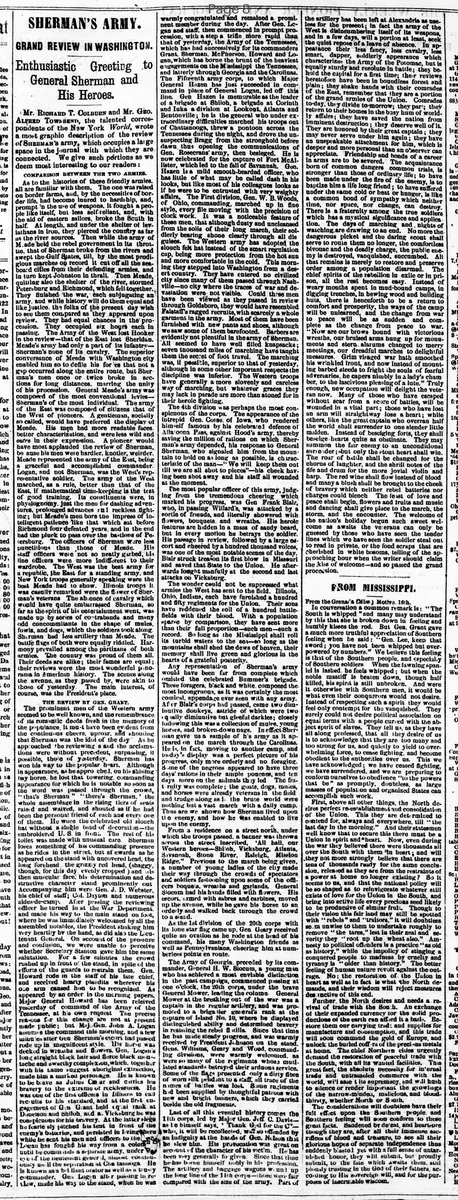
SHERMAN'S ARMY.
GRAND REVIEW IN WASHINGTON.
Enthusiastic
Greeting to
General Sherman and
His Heroes.
Mr. Richard T. Colburn and Mr. Geo.
Alfred Townsend, the talented correspondents
of the New York World, wrote
a most graphic description of the review
of Sherman's army, which occupies a large
space in the journal with which they are
connected. We give such portions as we
deem most interesting to our readers :
COMPARISON BETWEEN THE TWO ARMIES.
As to the histories of these friendly armies.
all are familiar with them. The one was raised
on border farms, and, by the necessities of border
life, had become inured to hardship, and,
prompt in the use of weapons. it fought a people
like itself, but less self-reliant, and, with
the aid of eastern sailors, broke the South in
half. At length, and under the shelter of leviathans
in iron, they pierced the country as far
as the river sources. Then while the army of
Meade held the rebel government in its throat.
tie. that of Sherman broke from the rivers and
swept the Gulf States, till, by the most prodigious
marches on record it cut off all the seaboard
cities from their defending armies, and
in turn kept Johnston in thrall. Then Meade,
quitting also the shelter of the river, stormed
Petersburg and Richmond, which fell together.
They finished the war, each subjugating an
army. and while history will do them equal and
like justice. the folks of the present day wish
to see them compared as they appeared upon
review. They had equal chances in the procession.
They occupied six hours each in
passing. The Army of the West lost Hooker
in the review - that of the East lost Sheridan.
Meade's army had only a part of its infantry-
Sherman's none of its cavalry. The superior
conversance of Meade with Washington city
enabled him so to defile his forces that not a
gap occurred along the entire route, but Sherman's
men once or twice broke in sections
for long distances, marring the unity
of his procession. General Meade's army was
composed of the most conventional levies-
Sherman's of the most individual. The army
of the East was composed of citizens that of
the West of pioneers. A gentleman, socially
so called, would have preferred the display of
Meade. His men had more readable faces.
better characterization, and were less wild and
outre in their expression. A pioneer would
have most applauded the review of Sherman,
because his men were hardier. knotier, weirder.
Meade represented the army of the East, being
a graceful and accomplished commander.
Logan, and not Sherman, was the West's representative
soldier. The army of the West
marched, as a rule, better than that of the
East. if mathematical time-keeping is the test
of good training. Its constituents were, in
physiognomy. just the men for dashing adventures,
prolonged advances and reckless fighting;
but Meade's men bore the impress of intelligent
patience like that which sat before
Richmond four defeated years, and in the end
had the pluck to pass over the bastions of Petersburg.
The officers of Sherman were less
punctitious than those of Meade. His
staff officers were not so neatly garbed, his
line officers were more indifferent to their
wardrobe. The West was the best army for
a republic, the East for a standing army, and
New York troops generally speaking were the
best Meade had to show. Illinois troops it
was casually remarked were the flower of Sherman's
veterans The absence of cavalry which
would have quite embarrassed Sherman's so
far as the spirit of his entertainment went. was
made up by series of contrabands and many
odd concomitants in the shape of mules,
fowls, and dogs, which the soldiers took along.
Sherman had less artillery than Meade. The
battle flags of both were equally riddled. Harmony
prevailed among the partisans of both
armies. The country was proud of them all.
Their deeds are alike: their fames are equal:
their reviews were the most wonderful panorama in American history. The scenes along
the avenue, as they passed by, were akin to
those of yesterday. The main interest, of
course, was the President's place.
THE REVIEW BY GEN. GRANT
The prominent men of the Western army
seemed to be well known, and the remembrance
of its romantic deeds fresh in the memory of
the populace, it must have been evident from
the continuous cheers, uproar. and shouting
that Sherman was the idol of the day. As he
approached the reviewing stand and the acclamations
were without precedent, surpassing, it
possible, those of yesterday. Sherman has
won his way to the popular heart. Although
in appearance, as he approached, on his shining
bay horse. he lost that towering. commanding
appearance for which he is notable so soon as
the word was passed through the crowd,
"that's Sheridan"
"there's Sherman, the
whole assemblage in the rising tiers of seats
raised and waived, and shouted as if he had
been the personal friend of each and every one
of them. He wore the celebrated old slouch
hat without a single band of decoration-the
embroidered U. S. in front. The rest of his
toilet was made with unusual care. Sherman
loses something of his commanding presence
as he rides in the street, but afterwards as he
appeared on the stand with uncovered head, the
long forehead. the grizzly red head, (shaggy,
though, for this day evenly cropped ) and his
muscular face, his determination and destructive
character stand prominently out
Accompanying him were Gen. J. D. Webster,
his chief of staff; Col. Dayton and numerous
aides-de-camp. After passing the reviewing
officer he turned in at the War Department.
and made his way to the main stand on foot,
where he was immediately welcomed by all the
assembled notables, the President shaking him
very heartily by the hand, as did also the Lieutenant
General. On account of the pressure
and confusion, we were unable to perceive
whether Secretary Stanton gave him the same
salutation.
For a few minutes the crowd
rushed up in front of the stand, in spite of the
efforts of the guards to restrain them. Gen.
Howard rode in the staff of his late chief.
and received hearty plaudits wherever his
one arm caused him to be recognized. As
appeared by an order in the morning papers.
Major General Howard has been relieved
yesterday of command of the Army of the
Tennessee, at his own request The precise
reasons for this change are not at present
made public; but Maj. Gen. John A. Logan
will assume the command this morning, and a few
minutes after Gen Sherman's escort had passed
rode up in magnificent style. His horse was
decked in wreaths and flowers, Gen. Logan's
long straight black hair and fierce black moustache
and swarthy complexion, which, together
with his name suggest aboriginal extraction.
made him a marked personage.
He is known
to be brave as Julius Caesar and carries his
bravery to the extreme of recklessness. He
was one of the first officers in Illinois to call
recruits to his standard, and at the first engagement
of Gen. Grant held equal rank at
Donelson and Shiloh, and at Vicksburg he was
conspicuous for his bravery. At the latter siege
he fearlessly pitched his tent in front of the
enemy's batteries. and persisted in living there
while he sent his men and officers to the rear
Logan has fought his way from a colonelcy
until he commands a separate army, under the
eye of the lieutenant general, almost continuously
until the separation at Chattanooga. He
is known as a brilliant orator as well as a trusty
commander. Gen. Logan after passing in review,
made his way to the stand, when he was
warmly congratulated and remained a prominent
member during the day. After Gen. Logan
and staff. then commenced in prompt procession,
with a step a trifle more rapid than
that of yesterday, the Army of the Tennessee,
which has had successively for its commanders
Grant, Sherman, McPherson, Howard and Logan,
which has borne the brunt of the heaviest
engagements on the Mississippi the Tennessee,
and latterly through Georgia and the Carolinas.
The Fifteenth army corps, to which Major
General Hazen has just succeeded in command
in place of General Logan, led off this
line. Gen. Hazen is memorable as the leader
of a brigade at Shiloh, a brigade at Corinth
and Iuka a division at Lookout, Atlanta and
Bentonville; he is the general who under extraordinary
difficulties marched his troops out
of Chattanooga, threw a pontoon across the
Tennessee during the night, and drove the unsuspecting
Bragg from the stronghold before
dawn. thus opening the communications of
Gen. Rosecrans' army, then besieged. He is
now celebrated for the capture of Fort McAllister,
which led to the fall of Savannah. Gen.
Hazen is a mild smooth-bearded officer, who
has little of what may be called dash in his
looks, but like most of his colleagues looks as
if he were to be entrusted with very weighty
affairs, The First division, Gen. W. B. Woods,
of Ohio, commanding, marched up in fine
style, every file moving with the precision of
clock work. It was a noticeable feature of
these men, that although dusty and uncleansed
from the soils of their long march, their soldierly
bearing, shone clearly through all disguises,
The Western army has adopted the
slouch felt hat instead of the smart regulation
cap, being more protection from the hot sun
and more comfortable in the cold. This morning
they stepped into Washington from a desert
country. They have entered no civilized
city since many of them passed through Nashville
- no city where the traces of war and devastation
were not visible. Could these men
have been viewed as they passed in review
through Goldsboro, they would have resembled
Falstaff's ragged recruits, with scarcely a whole
garment in the army. Most of them have been
furnished with new pants and shoes, although
we saw some of them barefooted. Barbers are
evidently not plentiful in the army of Sherman.
All seemed to have well filled knapsacks;
seven thousand miles of marching have taught
them the secret of foot travel. The marching
was. if possible, superior to that of yesterday,
although in some other important respects the
discipline was inferior. The Western troops
have generally a more slovenly and careless
way of marching. but whatever graces they
may lack in parade are more than atoned for in
their heroic fighting.
The 4th division was perhaps the most conspicuous
of the corps.
The appearance of the
intrepid Gen. Corse, of Iowa, who rendered
himself famous by his celebrated defence of
Allatoona Pass, against Hood's army, thereby
saving the million of rations on which Sherman's
army depended, his response to General
Sherman. who signaled him from the mountain to hold on as long as possible, is characteristic
of the man "We will keep them out
till we are all shot to pieces" - his cheek having been shot away and his staff all wounded
at the moment.
The most popular officer of this army, judging
from the tremendous cheering which
marked his progress, was Gen Frank Blair.
who, in passing Willard's, was attacked by a
sortie of friends. and literally showered with
flowers, bouquets. and wreaths. His heroic
features are hidden in a mass of sandy beard,
but in every motion he betrays the soldier.
His passage in review, followed by a large escort and cheered by a hundred thousand voices,
was one of the most notable scenes of the day.
Blair struck treason its first blow in Missouri
and saved that State to the Union. He afterwards
fought manfully at the second and last
attacks on Vicksburg.
The wonder could not be suppressed what
armies the West has sent to the field, Illinois,
Ohio, Indiana, each have furnished a hundred
and fifty regiments for the Union. Their sons
have reddened the soil of a hundred battlefields
with their blood. With a population
sparse by comparison, they have sent more
than their full proportion - such men - such a
record. So long as the Mississippi shall roll
its turbid waters to the sea - so long as the
mountains shall shed the dews of heaven, their
memory shall live green and glorious in the
hearts of a grateful posterity.
Any representation of Sherman's army
would have been far from complete which
omitted the celebrated Bummer's brigade.
These foragers, black and white. composed the
most incongruous, as it was certainly the most
comical, appendage ever seen with any army.
After Blair's corps had passed, came two diminutive donkeys, astride of which were two
equally diminutive but gleeful darkies; closely
following this was a collection of mules, young
horses. and broken-down nags. In effect Sherman gave us a sample of his army as it appeared
on the march through the Carolinas,
He is, in fact, moving to another camp, and
to-day's display was a perfect picture of his
progress, only more orderly and no foraging.
Some of the negroes appeared to have three
days' rations in their ample pouches, and ten
days more on the animals they led The fraternity
was complete; the goats, dogs, mules,
and horses were already veterans in the field
and trudge along as if the brute world were
nothing but a vast march with a daily camp.
Thus are we shown how Sherman lived upon
the enemy, and how he
was enabled to live
upon the enemy.
From a residence on a street north. under
which the troops passed. a banner was thrown
across the street inscribed, 'All hail, our
Western heroes - Shiloh, Vicksburg, Atlanta,
Savannah, Stone River,
Raleigh, Mission
Ridge." Previous to the march being given,
a number of young ladies of the city made
their way through the crowds of spectators
and soldiers festooning upon some of the officers bouquets, wreaths and garlands, General
Slocum had his hands filled with flowers. His
escort, armed with sabres and carbines, moved
up the avenue, while he gave his horse to an
orderly and walked back through the crowd
to a stand.
As the 1st division of the 20th corps with
its lone star flag came up. Gen Geary received
quite an ovation as he rode at the head of his
command, his many Washington friends as
well as Pennsylvanians, cheering him at numberless
points en route.
The Army of Georgia. preceded by its commander,
General H. W. Slocum, a young man
who has achieved a most enviable distinction
in the past campaign, commenced passing at
one o'clock, the 20th corps, under the brave
General Mower. leading the column. General
Mower at the breaking out of the war was a
captain in the regular artillery, and was promoted
to a brigadier general's rank at the
capture of Island No. 10, where he displayed
distinguished ability and determined bravery
in resisting the rebel flotilla.
Since that time
he has made steady progress, and was warmly
received by President Johnson on the stand.
Gens. Williams, Geary and Wood, commanding divisions, were warmly welcomed. as
were so many of the regiments whose mutilated standards betrayed their arduous service.
Some of the flags presented only a dirty fibre
of worn silk pendant to a staff, all trace of the
names of battles was lost. Some regiments
had been supplied by thoughtful patrons with
new and bright banners, which they carried
beside the old fragments.
Last of all this eventful history comes the
14th corps, led by Major Gen. Jeff. C. Davis-
as he himself says. Thank God for the C"
who, it will be recollected, was so offended by
an indignity at the hands of Gen. Nelson that
he slew him. His provocation was great on
account of the character of his victim. He has
been very generally forgiven. Since that time
he has borne himself nobly in his profession.
The artillery and baggage wagons wound up
the long line of the 14th corps - those were fair
compared with the size of the army. Part of
the artillery has been left at Alexandria as useless
for the present; in fact the army of the
West is disencumbering itself of its weapons,
and in a few days, will a portion at least, seek
the quiet repose of a leave of absence. In appearance their less fancy, less cavalry, less
smart, dapper, soldierly appearance which
characterizes the Army of the Potomac, but is
equally sturdy and resolute in battle; they behold
the capital for a first time: their reviews
heretofore have been in boundless forest and
plain; they shake hands with their comrades
of the East, remember that they are a portion
of the grand armies of the Union. Comrades
to-day; they divide to-morrow; they part; they
return to their homes in the busy hum of worldly
affairs; they have saved the nation from
imminent destruction; they deserve well of it.
They are honored by their great captain; they
may never serve under him again; they have
an unspeakable attachment for him, which is
deeper and more personal than an observer can
appreciate. Friendship and bonds of a career
in arms are to be severed. "The acquaintance
born of common dangers common trials, is
stronger than those of ordinary life; to have
been made under the fire of the enemy, is to
baptize him a life long friend ; to have suffered
under the same cold or heat or hunger, is like
a common bond of sympathy which neither
time, nor space, nor change, can destroy.
There is a fraternity among the true soldiers
which has a mystical significance and application.
The days of marching and nights of
watching, are drawing to an end. No more the
dangerous picket and the daring scout shall
serve to rouse them no longer, the comfortless
bivouac and the deadly charge, the public enemy
is destroyed, vanquished, succumbed. All
that remains is merely to restore and preserve
order among a population disarmed. The
chief spirits of the rebellion in exile or in prison,
all the rest becomes easy. Instead of
weary months spent in mud-bound camps, in
digging trenches, in hewing wood and building
huts. there is henceforth to be a return to
comfort and prosperity, the ways of the camp
will be unlearned, and the change from war
to peace will be as sudden and complete
as the change from peace to war.
Now are our brows bound with victorious
wreaths, our bruised arms hung up for monuments and stern alarums changed to merry
meetings, our dreadful marches to delightful
measures. Grim visaged war hath smoothed
his wrinkled front, and now instead of mounting
barbed steeds to fright the souls of fearful
adversaries, he capers nimbly in a lady's chamber,
to the lascivious pleasing of a lute." Truly
enough, new occupation will delight the veteran now. Many of those who have escaped
without scar from a score of battles, will be
wounded in a vital part; those who have lost
an arm will straightway lose a heart; while
others, like the great captain who overran half
the world shall surrender to one slender little
maiden. Instead of besieging forts, they shall
beseige hearts quite as obstinate. They may
summon the fair enemy to an unconditional
surrender; but only the stout heart shall win.
The roar of battle shall be changed for the
chorus of laughter, and the shrill notes of the
fife and drum for the more jovial violin and
harp. The red wine shall flow instead of blood
and many a blush shall be brought to the cheek
of bravery which neither rebel batteries nor
charges could blench The feast of love and
peace shall begin, flowers and fruits and music
and dancing shall give place to the march, the
storm, and the encounter. The welcome of
the nation's holiday begun such sweet welcome
as awaits the veterans can only be
guessed by those who have seen the tender
lines which we have seen the soldier steal out
to read in private, or the fond scraps that are
cherished in white bosoms, telling of the approaching
hour when the writer should claim
the kiss of welcome - and so passed the grand
procession.
GRAND REVIEW IN WASHINGTON.
Enthusiastic
Greeting to
General Sherman and
His Heroes.
Mr. Richard T. Colburn and Mr. Geo.
Alfred Townsend, the talented correspondents
of the New York World, wrote
a most graphic description of the review
of Sherman's army, which occupies a large
space in the journal with which they are
connected. We give such portions as we
deem most interesting to our readers :
COMPARISON BETWEEN THE TWO ARMIES.
As to the histories of these friendly armies.
all are familiar with them. The one was raised
on border farms, and, by the necessities of border
life, had become inured to hardship, and,
prompt in the use of weapons. it fought a people
like itself, but less self-reliant, and, with
the aid of eastern sailors, broke the South in
half. At length, and under the shelter of leviathans
in iron, they pierced the country as far
as the river sources. Then while the army of
Meade held the rebel government in its throat.
tie. that of Sherman broke from the rivers and
swept the Gulf States, till, by the most prodigious
marches on record it cut off all the seaboard
cities from their defending armies, and
in turn kept Johnston in thrall. Then Meade,
quitting also the shelter of the river, stormed
Petersburg and Richmond, which fell together.
They finished the war, each subjugating an
army. and while history will do them equal and
like justice. the folks of the present day wish
to see them compared as they appeared upon
review. They had equal chances in the procession.
They occupied six hours each in
passing. The Army of the West lost Hooker
in the review - that of the East lost Sheridan.
Meade's army had only a part of its infantry-
Sherman's none of its cavalry. The superior
conversance of Meade with Washington city
enabled him so to defile his forces that not a
gap occurred along the entire route, but Sherman's
men once or twice broke in sections
for long distances, marring the unity
of his procession. General Meade's army was
composed of the most conventional levies-
Sherman's of the most individual. The army
of the East was composed of citizens that of
the West of pioneers. A gentleman, socially
so called, would have preferred the display of
Meade. His men had more readable faces.
better characterization, and were less wild and
outre in their expression. A pioneer would
have most applauded the review of Sherman,
because his men were hardier. knotier, weirder.
Meade represented the army of the East, being
a graceful and accomplished commander.
Logan, and not Sherman, was the West's representative
soldier. The army of the West
marched, as a rule, better than that of the
East. if mathematical time-keeping is the test
of good training. Its constituents were, in
physiognomy. just the men for dashing adventures,
prolonged advances and reckless fighting;
but Meade's men bore the impress of intelligent
patience like that which sat before
Richmond four defeated years, and in the end
had the pluck to pass over the bastions of Petersburg.
The officers of Sherman were less
punctitious than those of Meade. His
staff officers were not so neatly garbed, his
line officers were more indifferent to their
wardrobe. The West was the best army for
a republic, the East for a standing army, and
New York troops generally speaking were the
best Meade had to show. Illinois troops it
was casually remarked were the flower of Sherman's
veterans The absence of cavalry which
would have quite embarrassed Sherman's so
far as the spirit of his entertainment went. was
made up by series of contrabands and many
odd concomitants in the shape of mules,
fowls, and dogs, which the soldiers took along.
Sherman had less artillery than Meade. The
battle flags of both were equally riddled. Harmony
prevailed among the partisans of both
armies. The country was proud of them all.
Their deeds are alike: their fames are equal:
their reviews were the most wonderful panorama in American history. The scenes along
the avenue, as they passed by, were akin to
those of yesterday. The main interest, of
course, was the President's place.
THE REVIEW BY GEN. GRANT
The prominent men of the Western army
seemed to be well known, and the remembrance
of its romantic deeds fresh in the memory of
the populace, it must have been evident from
the continuous cheers, uproar. and shouting
that Sherman was the idol of the day. As he
approached the reviewing stand and the acclamations
were without precedent, surpassing, it
possible, those of yesterday. Sherman has
won his way to the popular heart. Although
in appearance, as he approached, on his shining
bay horse. he lost that towering. commanding
appearance for which he is notable so soon as
the word was passed through the crowd,
"that's Sheridan"
"there's Sherman, the
whole assemblage in the rising tiers of seats
raised and waived, and shouted as if he had
been the personal friend of each and every one
of them. He wore the celebrated old slouch
hat without a single band of decoration-the
embroidered U. S. in front. The rest of his
toilet was made with unusual care. Sherman
loses something of his commanding presence
as he rides in the street, but afterwards as he
appeared on the stand with uncovered head, the
long forehead. the grizzly red head, (shaggy,
though, for this day evenly cropped ) and his
muscular face, his determination and destructive
character stand prominently out
Accompanying him were Gen. J. D. Webster,
his chief of staff; Col. Dayton and numerous
aides-de-camp. After passing the reviewing
officer he turned in at the War Department.
and made his way to the main stand on foot,
where he was immediately welcomed by all the
assembled notables, the President shaking him
very heartily by the hand, as did also the Lieutenant
General. On account of the pressure
and confusion, we were unable to perceive
whether Secretary Stanton gave him the same
salutation.
For a few minutes the crowd
rushed up in front of the stand, in spite of the
efforts of the guards to restrain them. Gen.
Howard rode in the staff of his late chief.
and received hearty plaudits wherever his
one arm caused him to be recognized. As
appeared by an order in the morning papers.
Major General Howard has been relieved
yesterday of command of the Army of the
Tennessee, at his own request The precise
reasons for this change are not at present
made public; but Maj. Gen. John A. Logan
will assume the command this morning, and a few
minutes after Gen Sherman's escort had passed
rode up in magnificent style. His horse was
decked in wreaths and flowers, Gen. Logan's
long straight black hair and fierce black moustache
and swarthy complexion, which, together
with his name suggest aboriginal extraction.
made him a marked personage.
He is known
to be brave as Julius Caesar and carries his
bravery to the extreme of recklessness. He
was one of the first officers in Illinois to call
recruits to his standard, and at the first engagement
of Gen. Grant held equal rank at
Donelson and Shiloh, and at Vicksburg he was
conspicuous for his bravery. At the latter siege
he fearlessly pitched his tent in front of the
enemy's batteries. and persisted in living there
while he sent his men and officers to the rear
Logan has fought his way from a colonelcy
until he commands a separate army, under the
eye of the lieutenant general, almost continuously
until the separation at Chattanooga. He
is known as a brilliant orator as well as a trusty
commander. Gen. Logan after passing in review,
made his way to the stand, when he was
warmly congratulated and remained a prominent
member during the day. After Gen. Logan
and staff. then commenced in prompt procession,
with a step a trifle more rapid than
that of yesterday, the Army of the Tennessee,
which has had successively for its commanders
Grant, Sherman, McPherson, Howard and Logan,
which has borne the brunt of the heaviest
engagements on the Mississippi the Tennessee,
and latterly through Georgia and the Carolinas.
The Fifteenth army corps, to which Major
General Hazen has just succeeded in command
in place of General Logan, led off this
line. Gen. Hazen is memorable as the leader
of a brigade at Shiloh, a brigade at Corinth
and Iuka a division at Lookout, Atlanta and
Bentonville; he is the general who under extraordinary
difficulties marched his troops out
of Chattanooga, threw a pontoon across the
Tennessee during the night, and drove the unsuspecting
Bragg from the stronghold before
dawn. thus opening the communications of
Gen. Rosecrans' army, then besieged. He is
now celebrated for the capture of Fort McAllister,
which led to the fall of Savannah. Gen.
Hazen is a mild smooth-bearded officer, who
has little of what may be called dash in his
looks, but like most of his colleagues looks as
if he were to be entrusted with very weighty
affairs, The First division, Gen. W. B. Woods,
of Ohio, commanding, marched up in fine
style, every file moving with the precision of
clock work. It was a noticeable feature of
these men, that although dusty and uncleansed
from the soils of their long march, their soldierly
bearing, shone clearly through all disguises,
The Western army has adopted the
slouch felt hat instead of the smart regulation
cap, being more protection from the hot sun
and more comfortable in the cold. This morning
they stepped into Washington from a desert
country. They have entered no civilized
city since many of them passed through Nashville
- no city where the traces of war and devastation
were not visible. Could these men
have been viewed as they passed in review
through Goldsboro, they would have resembled
Falstaff's ragged recruits, with scarcely a whole
garment in the army. Most of them have been
furnished with new pants and shoes, although
we saw some of them barefooted. Barbers are
evidently not plentiful in the army of Sherman.
All seemed to have well filled knapsacks;
seven thousand miles of marching have taught
them the secret of foot travel. The marching
was. if possible, superior to that of yesterday,
although in some other important respects the
discipline was inferior. The Western troops
have generally a more slovenly and careless
way of marching. but whatever graces they
may lack in parade are more than atoned for in
their heroic fighting.
The 4th division was perhaps the most conspicuous
of the corps.
The appearance of the
intrepid Gen. Corse, of Iowa, who rendered
himself famous by his celebrated defence of
Allatoona Pass, against Hood's army, thereby
saving the million of rations on which Sherman's
army depended, his response to General
Sherman. who signaled him from the mountain to hold on as long as possible, is characteristic
of the man "We will keep them out
till we are all shot to pieces" - his cheek having been shot away and his staff all wounded
at the moment.
The most popular officer of this army, judging
from the tremendous cheering which
marked his progress, was Gen Frank Blair.
who, in passing Willard's, was attacked by a
sortie of friends. and literally showered with
flowers, bouquets. and wreaths. His heroic
features are hidden in a mass of sandy beard,
but in every motion he betrays the soldier.
His passage in review, followed by a large escort and cheered by a hundred thousand voices,
was one of the most notable scenes of the day.
Blair struck treason its first blow in Missouri
and saved that State to the Union. He afterwards
fought manfully at the second and last
attacks on Vicksburg.
The wonder could not be suppressed what
armies the West has sent to the field, Illinois,
Ohio, Indiana, each have furnished a hundred
and fifty regiments for the Union. Their sons
have reddened the soil of a hundred battlefields
with their blood. With a population
sparse by comparison, they have sent more
than their full proportion - such men - such a
record. So long as the Mississippi shall roll
its turbid waters to the sea - so long as the
mountains shall shed the dews of heaven, their
memory shall live green and glorious in the
hearts of a grateful posterity.
Any representation of Sherman's army
would have been far from complete which
omitted the celebrated Bummer's brigade.
These foragers, black and white. composed the
most incongruous, as it was certainly the most
comical, appendage ever seen with any army.
After Blair's corps had passed, came two diminutive donkeys, astride of which were two
equally diminutive but gleeful darkies; closely
following this was a collection of mules, young
horses. and broken-down nags. In effect Sherman gave us a sample of his army as it appeared
on the march through the Carolinas,
He is, in fact, moving to another camp, and
to-day's display was a perfect picture of his
progress, only more orderly and no foraging.
Some of the negroes appeared to have three
days' rations in their ample pouches, and ten
days more on the animals they led The fraternity
was complete; the goats, dogs, mules,
and horses were already veterans in the field
and trudge along as if the brute world were
nothing but a vast march with a daily camp.
Thus are we shown how Sherman lived upon
the enemy, and how he
was enabled to live
upon the enemy.
From a residence on a street north. under
which the troops passed. a banner was thrown
across the street inscribed, 'All hail, our
Western heroes - Shiloh, Vicksburg, Atlanta,
Savannah, Stone River,
Raleigh, Mission
Ridge." Previous to the march being given,
a number of young ladies of the city made
their way through the crowds of spectators
and soldiers festooning upon some of the officers bouquets, wreaths and garlands, General
Slocum had his hands filled with flowers. His
escort, armed with sabres and carbines, moved
up the avenue, while he gave his horse to an
orderly and walked back through the crowd
to a stand.
As the 1st division of the 20th corps with
its lone star flag came up. Gen Geary received
quite an ovation as he rode at the head of his
command, his many Washington friends as
well as Pennsylvanians, cheering him at numberless
points en route.
The Army of Georgia. preceded by its commander,
General H. W. Slocum, a young man
who has achieved a most enviable distinction
in the past campaign, commenced passing at
one o'clock, the 20th corps, under the brave
General Mower. leading the column. General
Mower at the breaking out of the war was a
captain in the regular artillery, and was promoted
to a brigadier general's rank at the
capture of Island No. 10, where he displayed
distinguished ability and determined bravery
in resisting the rebel flotilla.
Since that time
he has made steady progress, and was warmly
received by President Johnson on the stand.
Gens. Williams, Geary and Wood, commanding divisions, were warmly welcomed. as
were so many of the regiments whose mutilated standards betrayed their arduous service.
Some of the flags presented only a dirty fibre
of worn silk pendant to a staff, all trace of the
names of battles was lost. Some regiments
had been supplied by thoughtful patrons with
new and bright banners, which they carried
beside the old fragments.
Last of all this eventful history comes the
14th corps, led by Major Gen. Jeff. C. Davis-
as he himself says. Thank God for the C"
who, it will be recollected, was so offended by
an indignity at the hands of Gen. Nelson that
he slew him. His provocation was great on
account of the character of his victim. He has
been very generally forgiven. Since that time
he has borne himself nobly in his profession.
The artillery and baggage wagons wound up
the long line of the 14th corps - those were fair
compared with the size of the army. Part of
the artillery has been left at Alexandria as useless
for the present; in fact the army of the
West is disencumbering itself of its weapons,
and in a few days, will a portion at least, seek
the quiet repose of a leave of absence. In appearance their less fancy, less cavalry, less
smart, dapper, soldierly appearance which
characterizes the Army of the Potomac, but is
equally sturdy and resolute in battle; they behold
the capital for a first time: their reviews
heretofore have been in boundless forest and
plain; they shake hands with their comrades
of the East, remember that they are a portion
of the grand armies of the Union. Comrades
to-day; they divide to-morrow; they part; they
return to their homes in the busy hum of worldly
affairs; they have saved the nation from
imminent destruction; they deserve well of it.
They are honored by their great captain; they
may never serve under him again; they have
an unspeakable attachment for him, which is
deeper and more personal than an observer can
appreciate. Friendship and bonds of a career
in arms are to be severed. "The acquaintance
born of common dangers common trials, is
stronger than those of ordinary life; to have
been made under the fire of the enemy, is to
baptize him a life long friend ; to have suffered
under the same cold or heat or hunger, is like
a common bond of sympathy which neither
time, nor space, nor change, can destroy.
There is a fraternity among the true soldiers
which has a mystical significance and application.
The days of marching and nights of
watching, are drawing to an end. No more the
dangerous picket and the daring scout shall
serve to rouse them no longer, the comfortless
bivouac and the deadly charge, the public enemy
is destroyed, vanquished, succumbed. All
that remains is merely to restore and preserve
order among a population disarmed. The
chief spirits of the rebellion in exile or in prison,
all the rest becomes easy. Instead of
weary months spent in mud-bound camps, in
digging trenches, in hewing wood and building
huts. there is henceforth to be a return to
comfort and prosperity, the ways of the camp
will be unlearned, and the change from war
to peace will be as sudden and complete
as the change from peace to war.
Now are our brows bound with victorious
wreaths, our bruised arms hung up for monuments and stern alarums changed to merry
meetings, our dreadful marches to delightful
measures. Grim visaged war hath smoothed
his wrinkled front, and now instead of mounting
barbed steeds to fright the souls of fearful
adversaries, he capers nimbly in a lady's chamber,
to the lascivious pleasing of a lute." Truly
enough, new occupation will delight the veteran now. Many of those who have escaped
without scar from a score of battles, will be
wounded in a vital part; those who have lost
an arm will straightway lose a heart; while
others, like the great captain who overran half
the world shall surrender to one slender little
maiden. Instead of besieging forts, they shall
beseige hearts quite as obstinate. They may
summon the fair enemy to an unconditional
surrender; but only the stout heart shall win.
The roar of battle shall be changed for the
chorus of laughter, and the shrill notes of the
fife and drum for the more jovial violin and
harp. The red wine shall flow instead of blood
and many a blush shall be brought to the cheek
of bravery which neither rebel batteries nor
charges could blench The feast of love and
peace shall begin, flowers and fruits and music
and dancing shall give place to the march, the
storm, and the encounter. The welcome of
the nation's holiday begun such sweet welcome
as awaits the veterans can only be
guessed by those who have seen the tender
lines which we have seen the soldier steal out
to read in private, or the fond scraps that are
cherished in white bosoms, telling of the approaching
hour when the writer should claim
the kiss of welcome - and so passed the grand
procession.
What sub-type of article is it?
Historical Event
Heroic Act
Tragedy
What themes does it cover?
Bravery Heroism
Triumph
Justice
What keywords are associated?
Sherman Army Review
Washington Parade
Civil War Victory
Union Troops
General Logan
General Blair
Bummer Brigade
Army Of Tennessee
Army Of Georgia
What entities or persons were involved?
General Sherman
General Grant
General Logan
General Howard
General Blair
General Slocum
General Hazen
General Corse
General Mower
General Geary
General Davis
President Johnson
Secretary Stanton
Where did it happen?
Washington
Story Details
Key Persons
General Sherman
General Grant
General Logan
General Howard
General Blair
General Slocum
General Hazen
General Corse
General Mower
General Geary
General Davis
President Johnson
Secretary Stanton
Location
Washington
Event Date
1865
Story Details
Graphic description of the Grand Review of Sherman's Western Army in Washington, comparing it to Meade's Eastern Army, detailing the march of various corps, enthusiastic reception of key officers, and reflections on the end of the Civil War and transition to peace.