Thank you for visiting SNEWPapers!
Sign up free
Hannibal Journal
Hannibal, Marion County, Missouri
What is this article about?
A severe hail storm and wind ravaged Essex County, New Jersey, on July 16, 1853, destroying crops on over 50 farms, damaging villages like Belleville and Lafayette, killing animals, and causing $30,000–$50,000 in losses.
Clipping
OCR Quality
Full Text
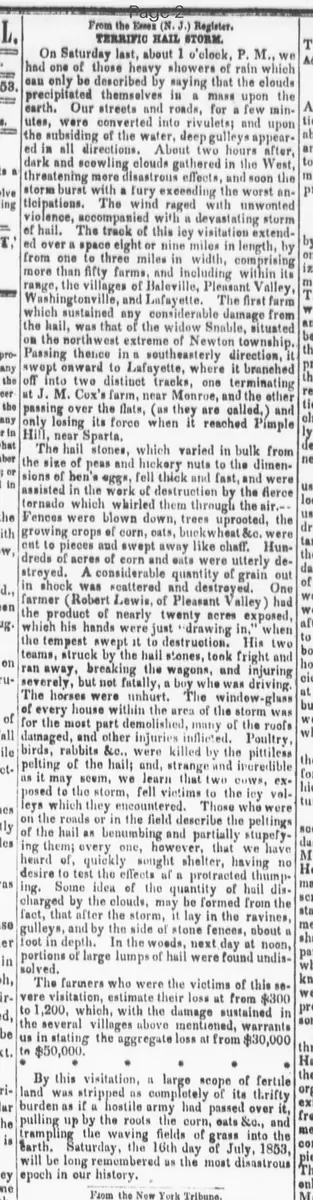
TERRIFIC HAIL STORM
On Saturday last, about 1 o'clock, P. M., we had one of those heavy showers of rain which can only be described by saying that the clouds precipitated themselves in a mass upon the earth. Our streets and roads, for a few minutes, were converted into rivulets; and upon the subsiding of the water, deep gulleys appeared in all directions. About two hours after, dark and scowling clouds gathered in the West, threatening more disastrous effects, and soon the storm burst with a fury exceeding the worst anticipations. The wind raged with unwonted violence, accompanied with a devastating storm of hail. The track of this icy visitation extended over a space eight or nine miles in length, by from one to three miles in width, comprising more than fifty farms, and including within its range, the villages of Belleville, Pleasant Valley, Washingtonville, and Lafayette. The first farm which sustained any considerable damage from the hail, was that of the widow Snable, situated on the northwest extreme of Newton township. Passing thence in a southeasterly direction, it swept onward to Lafayette, where it branched off into two distinct tracks, one terminating at J. M. Cox's farm, near Monroe, and the other passing over the flats, (as they are called,) and only losing its force when it reached Pimple Hill, near Sparta.
The hail stones, which varied in bulk from the size of peas and hickory nuts to the dimensions of hen's eggs, fell thick and fast, and were assisted in the work of destruction by the fierce tornado which whirled them through the air. Fences were blown down, trees uprooted, the growing crops of corn, oats, buckwheat &c. were cut to pieces and swept away like chaff. Hundreds of acres of corn and oats were utterly destroyed. A considerable quantity of grain out in shock was scattered and destroyed. One farmer (Robert Lewis, of Pleasant Valley) had the product of nearly twenty acres exposed, which his hands were just "drawing in," when the tempest swept it to destruction. His two teams, struck by the hail stones, took fright and ran away, breaking the wagons, and injuring severely, but not fatally, a boy who was driving. The horses were unhurt. The window-glass of every house within the area of the storm was for the most part demolished, many of the roofs damaged, and other injuries inflicted. Poultry, birds, rabbits &c., were killed by the pitiless pelting of the hail; and, strange and incredible as it may seem, we learn that two cows, exposed to the storm, fell victims to the icy volleys which they encountered. Those who were on the roads or in the field describe the peltings of the hail as benumbing and partially stupefying them; every one, however, that we have heard of, quickly sought shelter, having no desire to test the effects of a protracted thumping.
Some idea of the quantity of hail discharged by the clouds may be formed from the fact, that after the storm, it lay in the ravines, gulleys, and by the side of stone fences, about a foot in depth. In the woods, next day at noon, portions of large lumps of hail were found undissolved.
The farmers who were the victims of this severe visitation, estimate their loss at from $300 to $1,200, which, with the damage sustained in the several villages above mentioned, warrants us in stating the aggregate loss at from $30,000 to $50,000.
By this visitation, a large scope of fertile land was stripped as completely of its thrifty burden as if a "hostile army had passed over it, pulling up by the roots the corn, oats &c., and trampling the waving fields of grass into the earth. Saturday, the 16th day of July, 1853, will be long remembered as the most disastrous epoch in our history.
What sub-type of article is it?
What themes does it cover?
What keywords are associated?
What entities or persons were involved?
Where did it happen?
Story Details
Key Persons
Location
Essex County, New Jersey (Villages: Belleville, Pleasant Valley, Washingtonville, Lafayette; Townships: Newton; Areas: Near Monroe, Flats, Pimple Hill Near Sparta)
Event Date
July 16, 1853
Story Details
A violent hail storm with wind devastated farms and villages in Essex County, destroying crops, uprooting trees, damaging homes, killing animals including two cows, and causing injuries; hail accumulated up to a foot deep, with total losses estimated at $30,000 to $50,000.