Thank you for visiting SNEWPapers!
Sign up free
Editorial
March 27, 1805
Norfolk Gazette And Publick Ledger
Norfolk, Virginia
What is this article about?
A Federalist-leaning editorial dissects Thomas Jefferson's March 4, 1801, inaugural speech, condemning its stylistic flaws, grammatical errors, awkward phrasing, and political assertions on sovereignty, religion, and government, while mocking Jefferson's metaphors and logic.
Clipping
OCR Quality
96%
Excellent
Full Text
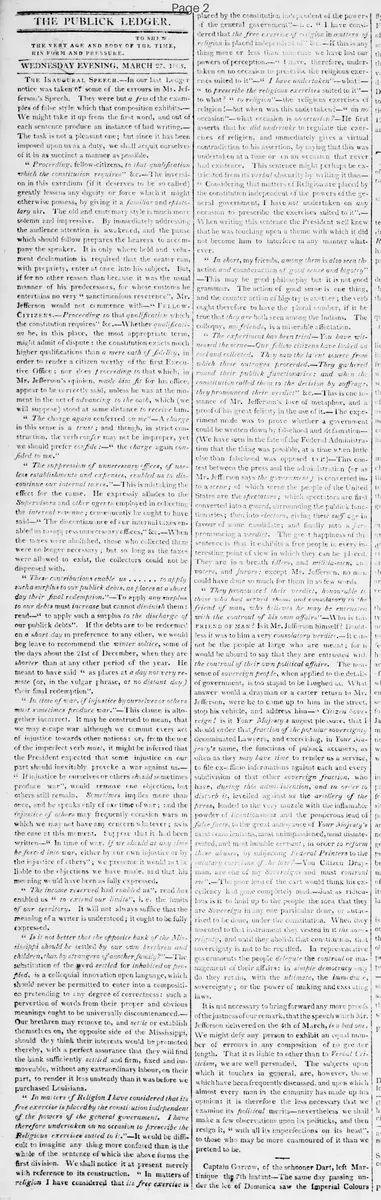
The Inaugural Speech.—In our last Ledger notice was taken of some of the errors in Mr. Jefferson's Speech. They were but a few of the examples of false style which that composition exhibits.—
We might take it up from the first word, and out of each sentence produce an instance of bad writing.—
The task is not a pleasant one; but since it has been imposed upon us as a duty, we shall acquit ourselves of it in as succinct a manner as possible.
"Proceeding, fellow-citizens, to that qualification which the constitution requires"&c.—The inversion in this exordium (if it deserves to be so called) greatly lessens any dignity or force which it might otherwise possess, by giving it a familiar and dictionary air. The old and customary style is much more solemn and impressive. By immediately addressing the audience attention is awakened, and the pause which should follow prepares the hearers to accompany the speaker. It is only where bold and vehement declamation is required that the orator can, with propriety, enter at once into his subject. But, if for no other reason than because it was the usual manner of his predecessors, for whose customs he entertains no very "sanctimonious reverence", Mr. Jefferson would not commence with—"Fellow-Citizens,—Proceeding to that qualification which the constitution requires"&c.—Whether qualification be, in this place, the most appropriate term, might admit of dispute: the constitution exacts much higher qualifications than a mere oath of fidelity, in order to render a citizen worthy of the first Executive Office: nor does proceeding to that which, in Mr. Jefferson's opinion, made him fit for his office, appear to be correctly said, unless he was at the moment in the act of advancing to the oath, which (we will suppose) stood at some distance to receive him.
"The charge again conferred on me"—A charge in this sense is a trust: and though, in strict construction, the verb confer may not be improper, yet we should prefer confide:—"the charge again confided to me."
"The suppression of unnecessary offices, of useless establishments and expenses, enabled us to discontinue our internal taxes."—This is mistaking the effect for the cause. He expressly alludes to the Supervisors and other agents employed in collecting the internal revenue: consequently he ought to have said—"The discontinuance of our internal taxes enabled us to suppress unnecessary offices,"&c.—When the taxes were abolished, those who collected them were no longer necessary; but so long as the taxes were allowed to exist, the collectors could not be dispensed with.
"These contributions enable us ...... to apply such a surplus to our publick debts, as places at a short day their final redemption."—To apply any surplus to our debts must increase but cannot diminish them: read—"to apply such a surplus to the discharge of our publick debts". If the debts are to be redeemed on a short day in preference to any other, we would beg leave to recommend the winter solstice, some of the days about the 21st of December, when they are shorter than at any other period of the year. He meant to have said "as places at a day not very remote (or, in the vulgar phrase, at no distant day) their final redemption".
"In time of war, if injustice by ourselves or others must sometimes produce war."—This clause is altogether incorrect. It may be construed to mean, that we may escape war although we commit every act of injustice towards other nations: or, from the use of the imperfect verb must, it might be inferred that the President expected that some injustice on our part should inevitably provoke a war against us.—
"If injustice by ourselves or others should sometimes produce war", would remove one objection, but others still remain. Sometimes may lies more than once, and he speaks only of one time of war; and the injustice of others may frequently occasion wars in which we may not have any concern whatever; as is the case at this moment. Suppose that it had been written—"In time of war, if we should at any time be forced into war, either by our own injustice or by the injustice of others"; we presume it would not be liable to the objections we have made, and that his meaning would have been as fully expressed.
"The income reserved had enabled us", read has enabled us "to extend our limits", i. e. the limits of our territory. It will not always suffice that the meaning of a writer is understood; it ought to be fully expressed.
"Is it not better that the opposite bank of the Mississippi should be settled by our own brethren and children, than by strangers of another family?"—The substitution of the word settled for inhabited or peopled, is a colloquial innovation upon language, which should never be permitted to enter into a composition pretending to any degree of correctness: such a perversion of words from their proper and obvious meanings ought to be universally discountenanced.—
Our brethren may remove to, and settle or establish themselves on, the opposite side of the Mississippi, should they think their interests would be promoted thereby, with a perfect assurance that they will find the bank sufficiently settled and firm, fixed and immovable, without any extraordinary labour, on their part, to render it less unsteady than it was before we purchased Louisiana.
"In matters of Religion I have considered that its free exercise is placed by the constitution independent of the powers of the general government. I have therefore undertaken on no occasion to prescribe the Religious exercises suited to it." It would be difficult to imagine any thing more confused than is the whole of the sentence of which the above forms the first division. We shall notice it at present merely with reference to its construction. "In matters of religion I have considered that its free exercise is placed by the constitution independent of the powers of the general government"— i. e. "I have considered that the free exercise of religion in matters of religion is placed independent of" &c.—If this is any thing more or less than nonsense we have lost our powers of perception.—"I have, therefore, undertaken on no occasion to prescribe the religious exercises suited to it"—"I have undertaken"—what?—"to prescribe the religious exercises suited to it"— to what? "to religion"—the religious exercises of religion!—but when was this undertaken?—"on no occasion"—what occasion is no occasion?— He first asserts that he did undertake to regulate the exercises of religion, and immediately gives a virtual contradiction to his assertion, by saying that this was undertaken at a time or on an occasion that never had existence. This sentence might perhaps be extricated from its verbal obscurity by writing it thus—
"Considering that matters of Religion are placed by the constitution independent of the powers of the general government, I have not undertaken on any occasion to prescribe the exercises suited to it".—
When writing this sentence the President well knew that he was touching upon a theme with which it did not become him to interfere in any manner whatever.
"In short, my friends, among them is also seen the action and counteraction of good sense and bigotry" —This may be good philosophy but it is not good grammar. The action of good sense is one thing, and the counter action of bigotry is another; the verb ought therefore to have the plural number, if it be true that they are both seen among the Indians. The colloquy, my friends, is a miserable affectation.
"The experiment has been tried—You have witnessed the scene—Our fellow citizens have looked on and collected. They saw the latent source from which these outrages proceeded.—They gathered round their publick functionaries: and when the constitution called them to the decision by suffrage they pronounced their verdict" &c.—This is one instance of Mr. Jefferson's love of metaphor, and a proof of his great felicity in the use of it.— The experiment made was to prove whether a government could be written down by falsehood and defamation— (We have seen in the fate of the Federal Administration that the thing was possible, at a time when little else than falsehood was opposed to it)—This contest between the press and the administration (or as Mr. Jefferson says the government) is converted into a scene; of which scene the people of the United States are the spectators; which spectators are first converted into a guard, surrounding the publick functionaries; then into electors, giving their suffrage in favour of some candidate; and finally into a jury pronouncing a verdict. The great happiness of this sentence is that it exhibits a free people in every interesting point of view in which they can be placed. They are in a breath idlers, and militia-men, voters, and jurors: except Mr. Jefferson, no man could have done so much for them in so few words
"They pronounced their verdict, honourable to those who had served them, and consolatory to the friend of man, who believes he may be entrusted with the controul of his own affairs" Who is this FRIEND OF MAN? Is it Mr. Jefferson himself? Doubtless it was to him a very consolatory verdict.—It cannot be the people at large who are meant; for it would be absurd to say that they are entrusted with the controul of their own political affairs. The nonsense of sovereign people, when applied to the details of government, is too stupid to be laughed at. What answer would a drayman or a carter return to Mr. Jefferson, were he to come up to him in the street, stop his vehicle, and address him—"Citizen Sovereign! is it Your Majesty's august pleasure, that I should order that fraction of the popular sovereignty denominated Lawyers, and exercising, in Your Majesty's name, the functions of publick accusers, as often as they may have time to render us a service, to file ex-officio informations against each and every subdivision of that other sovereign fraction, who have, during this administration, and in order to disturb it, levelled against us the artillery of the press, loaded to the very muzzle with the inflammable powder of licentiousness and the ponderous lead of false facts, to the great annoyance of Your Majesty's most conscientious, most unimpassioned, most disinterested, and most humble servant; in order to reform these abuses, by subjecting Federal Printers to the salutary coercion of the law?—You Citizen Drayman, are one of my Sovereigns and must controul me".—The poor lord of the cart would think his excellency had gone completely mad.—Just as ridiculous is it to hold up to the people the idea that they are Sovereign in any one particular done, or authorised to be done, under the constitution. When they assented to that instrument they vested in it the sovereignty, and until they abolish that constitution, that sovereignty is not to be recalled. In representative governments the people delegate the controul or management of their affairs: in simple democracy only do they retain, with the ultimate, the immediate, sovereignty; or the power of making and executing laws.
It is not necessary to bring forward any more proofs of the justness of our remark, that the speech which Mr. Jefferson delivered on the 4th of March, is a bad one. We might defy any person to exhibit an equal number of errors in any composition of no greater length. That it is liable to other than to verbal criticism, we are well persuaded. The subjects upon which it touches in general, are, however, those which have been frequently discussed, and upon which almost every man in the community has made up his opinion: it is therefore the less necessary that we examine its historical merits—nevertheless we shall make a few observations upon its politics, and then resign it, "with all its imperfections on its head", to those who may be more enamoured of it than we pretend to be.
We might take it up from the first word, and out of each sentence produce an instance of bad writing.—
The task is not a pleasant one; but since it has been imposed upon us as a duty, we shall acquit ourselves of it in as succinct a manner as possible.
"Proceeding, fellow-citizens, to that qualification which the constitution requires"&c.—The inversion in this exordium (if it deserves to be so called) greatly lessens any dignity or force which it might otherwise possess, by giving it a familiar and dictionary air. The old and customary style is much more solemn and impressive. By immediately addressing the audience attention is awakened, and the pause which should follow prepares the hearers to accompany the speaker. It is only where bold and vehement declamation is required that the orator can, with propriety, enter at once into his subject. But, if for no other reason than because it was the usual manner of his predecessors, for whose customs he entertains no very "sanctimonious reverence", Mr. Jefferson would not commence with—"Fellow-Citizens,—Proceeding to that qualification which the constitution requires"&c.—Whether qualification be, in this place, the most appropriate term, might admit of dispute: the constitution exacts much higher qualifications than a mere oath of fidelity, in order to render a citizen worthy of the first Executive Office: nor does proceeding to that which, in Mr. Jefferson's opinion, made him fit for his office, appear to be correctly said, unless he was at the moment in the act of advancing to the oath, which (we will suppose) stood at some distance to receive him.
"The charge again conferred on me"—A charge in this sense is a trust: and though, in strict construction, the verb confer may not be improper, yet we should prefer confide:—"the charge again confided to me."
"The suppression of unnecessary offices, of useless establishments and expenses, enabled us to discontinue our internal taxes."—This is mistaking the effect for the cause. He expressly alludes to the Supervisors and other agents employed in collecting the internal revenue: consequently he ought to have said—"The discontinuance of our internal taxes enabled us to suppress unnecessary offices,"&c.—When the taxes were abolished, those who collected them were no longer necessary; but so long as the taxes were allowed to exist, the collectors could not be dispensed with.
"These contributions enable us ...... to apply such a surplus to our publick debts, as places at a short day their final redemption."—To apply any surplus to our debts must increase but cannot diminish them: read—"to apply such a surplus to the discharge of our publick debts". If the debts are to be redeemed on a short day in preference to any other, we would beg leave to recommend the winter solstice, some of the days about the 21st of December, when they are shorter than at any other period of the year. He meant to have said "as places at a day not very remote (or, in the vulgar phrase, at no distant day) their final redemption".
"In time of war, if injustice by ourselves or others must sometimes produce war."—This clause is altogether incorrect. It may be construed to mean, that we may escape war although we commit every act of injustice towards other nations: or, from the use of the imperfect verb must, it might be inferred that the President expected that some injustice on our part should inevitably provoke a war against us.—
"If injustice by ourselves or others should sometimes produce war", would remove one objection, but others still remain. Sometimes may lies more than once, and he speaks only of one time of war; and the injustice of others may frequently occasion wars in which we may not have any concern whatever; as is the case at this moment. Suppose that it had been written—"In time of war, if we should at any time be forced into war, either by our own injustice or by the injustice of others"; we presume it would not be liable to the objections we have made, and that his meaning would have been as fully expressed.
"The income reserved had enabled us", read has enabled us "to extend our limits", i. e. the limits of our territory. It will not always suffice that the meaning of a writer is understood; it ought to be fully expressed.
"Is it not better that the opposite bank of the Mississippi should be settled by our own brethren and children, than by strangers of another family?"—The substitution of the word settled for inhabited or peopled, is a colloquial innovation upon language, which should never be permitted to enter into a composition pretending to any degree of correctness: such a perversion of words from their proper and obvious meanings ought to be universally discountenanced.—
Our brethren may remove to, and settle or establish themselves on, the opposite side of the Mississippi, should they think their interests would be promoted thereby, with a perfect assurance that they will find the bank sufficiently settled and firm, fixed and immovable, without any extraordinary labour, on their part, to render it less unsteady than it was before we purchased Louisiana.
"In matters of Religion I have considered that its free exercise is placed by the constitution independent of the powers of the general government. I have therefore undertaken on no occasion to prescribe the Religious exercises suited to it." It would be difficult to imagine any thing more confused than is the whole of the sentence of which the above forms the first division. We shall notice it at present merely with reference to its construction. "In matters of religion I have considered that its free exercise is placed by the constitution independent of the powers of the general government"— i. e. "I have considered that the free exercise of religion in matters of religion is placed independent of" &c.—If this is any thing more or less than nonsense we have lost our powers of perception.—"I have, therefore, undertaken on no occasion to prescribe the religious exercises suited to it"—"I have undertaken"—what?—"to prescribe the religious exercises suited to it"— to what? "to religion"—the religious exercises of religion!—but when was this undertaken?—"on no occasion"—what occasion is no occasion?— He first asserts that he did undertake to regulate the exercises of religion, and immediately gives a virtual contradiction to his assertion, by saying that this was undertaken at a time or on an occasion that never had existence. This sentence might perhaps be extricated from its verbal obscurity by writing it thus—
"Considering that matters of Religion are placed by the constitution independent of the powers of the general government, I have not undertaken on any occasion to prescribe the exercises suited to it".—
When writing this sentence the President well knew that he was touching upon a theme with which it did not become him to interfere in any manner whatever.
"In short, my friends, among them is also seen the action and counteraction of good sense and bigotry" —This may be good philosophy but it is not good grammar. The action of good sense is one thing, and the counter action of bigotry is another; the verb ought therefore to have the plural number, if it be true that they are both seen among the Indians. The colloquy, my friends, is a miserable affectation.
"The experiment has been tried—You have witnessed the scene—Our fellow citizens have looked on and collected. They saw the latent source from which these outrages proceeded.—They gathered round their publick functionaries: and when the constitution called them to the decision by suffrage they pronounced their verdict" &c.—This is one instance of Mr. Jefferson's love of metaphor, and a proof of his great felicity in the use of it.— The experiment made was to prove whether a government could be written down by falsehood and defamation— (We have seen in the fate of the Federal Administration that the thing was possible, at a time when little else than falsehood was opposed to it)—This contest between the press and the administration (or as Mr. Jefferson says the government) is converted into a scene; of which scene the people of the United States are the spectators; which spectators are first converted into a guard, surrounding the publick functionaries; then into electors, giving their suffrage in favour of some candidate; and finally into a jury pronouncing a verdict. The great happiness of this sentence is that it exhibits a free people in every interesting point of view in which they can be placed. They are in a breath idlers, and militia-men, voters, and jurors: except Mr. Jefferson, no man could have done so much for them in so few words
"They pronounced their verdict, honourable to those who had served them, and consolatory to the friend of man, who believes he may be entrusted with the controul of his own affairs" Who is this FRIEND OF MAN? Is it Mr. Jefferson himself? Doubtless it was to him a very consolatory verdict.—It cannot be the people at large who are meant; for it would be absurd to say that they are entrusted with the controul of their own political affairs. The nonsense of sovereign people, when applied to the details of government, is too stupid to be laughed at. What answer would a drayman or a carter return to Mr. Jefferson, were he to come up to him in the street, stop his vehicle, and address him—"Citizen Sovereign! is it Your Majesty's august pleasure, that I should order that fraction of the popular sovereignty denominated Lawyers, and exercising, in Your Majesty's name, the functions of publick accusers, as often as they may have time to render us a service, to file ex-officio informations against each and every subdivision of that other sovereign fraction, who have, during this administration, and in order to disturb it, levelled against us the artillery of the press, loaded to the very muzzle with the inflammable powder of licentiousness and the ponderous lead of false facts, to the great annoyance of Your Majesty's most conscientious, most unimpassioned, most disinterested, and most humble servant; in order to reform these abuses, by subjecting Federal Printers to the salutary coercion of the law?—You Citizen Drayman, are one of my Sovereigns and must controul me".—The poor lord of the cart would think his excellency had gone completely mad.—Just as ridiculous is it to hold up to the people the idea that they are Sovereign in any one particular done, or authorised to be done, under the constitution. When they assented to that instrument they vested in it the sovereignty, and until they abolish that constitution, that sovereignty is not to be recalled. In representative governments the people delegate the controul or management of their affairs: in simple democracy only do they retain, with the ultimate, the immediate, sovereignty; or the power of making and executing laws.
It is not necessary to bring forward any more proofs of the justness of our remark, that the speech which Mr. Jefferson delivered on the 4th of March, is a bad one. We might defy any person to exhibit an equal number of errors in any composition of no greater length. That it is liable to other than to verbal criticism, we are well persuaded. The subjects upon which it touches in general, are, however, those which have been frequently discussed, and upon which almost every man in the community has made up his opinion: it is therefore the less necessary that we examine its historical merits—nevertheless we shall make a few observations upon its politics, and then resign it, "with all its imperfections on its head", to those who may be more enamoured of it than we pretend to be.
What sub-type of article is it?
Partisan Politics
Constitutional
Press Freedom
What keywords are associated?
Jefferson Speech
Inaugural Critique
Stylistic Errors
Popular Sovereignty
Federalist View
Political Rhetoric
Constitutional Religion
What entities or persons were involved?
Mr. Jefferson
Federal Administration
The People Of The United States
The Constitution
Editorial Details
Primary Topic
Critique Of Thomas Jefferson's Inaugural Speech
Stance / Tone
Strongly Critical And Mocking
Key Figures
Mr. Jefferson
Federal Administration
The People Of The United States
The Constitution
Key Arguments
Inversion In Opening Reduces Dignity
Mistaking Effect For Cause In Tax Discussion
Awkward Phrasing On Public Debts Redemption
Incorrect Clause On War And Injustice
Colloquial Misuse Of 'Settled' For Mississippi Bank
Confused Sentence On Religion And Government
Grammatical Error In Indian Affairs Sentence
Overuse Of Mixed Metaphors In Press Contest Description
Absurd Notion Of Popular Sovereignty In Government Details