Thank you for visiting SNEWPapers!
Sign up free
Editorial
December 10, 1908
The Jeffersonian
Thomson, Atlanta, Mcduffie County, Fulton County, Georgia
What is this article about?
The editorial critiques two U.S. Supreme Court decisions: upholding state-mandated separation of white and black schools, and reversing a federal judge's injunction against Virginia and North Carolina's railway rate laws, emphasizing state courts' primacy.
Clipping
OCR Quality
98%
Excellent
Full Text
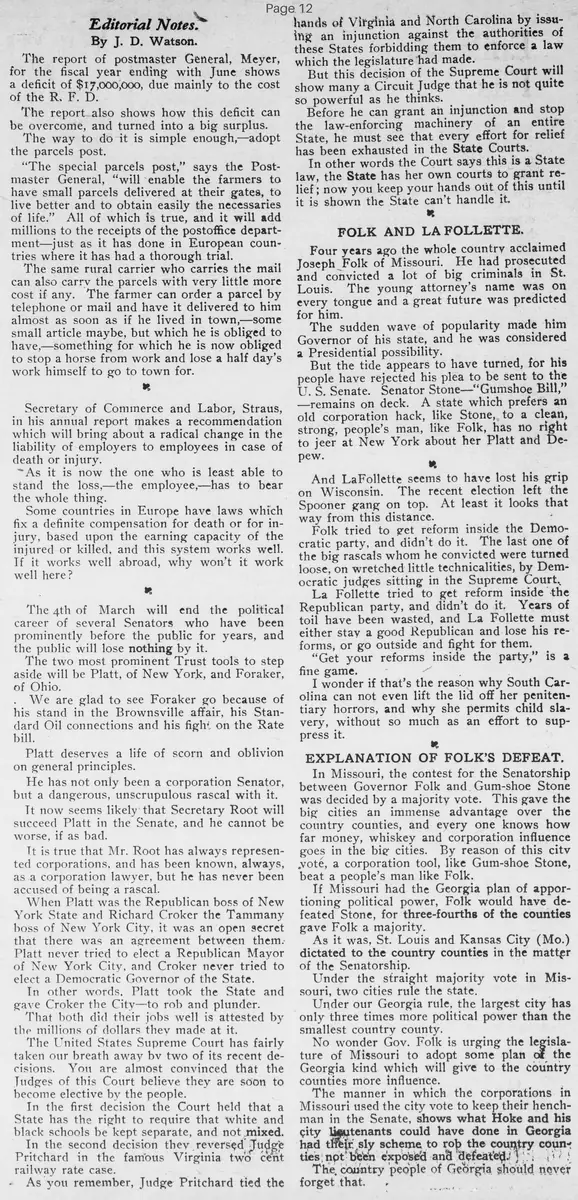
The United States Supreme Court has fairly taken our breath away by two of its recent decisions. You are almost convinced that the Judges of this Court believe they are soon to become elective by the people.
In the first decision the Court held that a State has the right to require that white and black schools be kept separate, and not mixed.
In the second decision they reversed Judge Pritchard in the famous Virginia two cent railway rate case.
As you remember, Judge Pritchard tied the hands of Virginia and North Carolina by issuing an injunction against the authorities of these States forbidding them to enforce a law which the legislature had made.
But this decision of the Supreme Court will show many a Circuit Judge that he is not quite so powerful as he thinks.
Before he can grant an injunction and stop the law-enforcing machinery of an entire State, he must see that every effort for relief has been exhausted in the State Courts.
In other words the Court says this is a State law, the State has her own courts to grant relief; now you keep your hands out of this until it is shown the State can't handle it.
In the first decision the Court held that a State has the right to require that white and black schools be kept separate, and not mixed.
In the second decision they reversed Judge Pritchard in the famous Virginia two cent railway rate case.
As you remember, Judge Pritchard tied the hands of Virginia and North Carolina by issuing an injunction against the authorities of these States forbidding them to enforce a law which the legislature had made.
But this decision of the Supreme Court will show many a Circuit Judge that he is not quite so powerful as he thinks.
Before he can grant an injunction and stop the law-enforcing machinery of an entire State, he must see that every effort for relief has been exhausted in the State Courts.
In other words the Court says this is a State law, the State has her own courts to grant relief; now you keep your hands out of this until it is shown the State can't handle it.
What sub-type of article is it?
Legal Reform
Constitutional
What keywords are associated?
Supreme Court
School Segregation
Railway Rate Case
Judicial Injunctions
State Sovereignty
What entities or persons were involved?
United States Supreme Court
Judge Pritchard
Virginia
North Carolina
Editorial Details
Primary Topic
Supreme Court Decisions Limiting Federal Judicial Power Over State Laws
Stance / Tone
Surprised And Explanatory, Highlighting Reduced Power Of Circuit Judges
Key Figures
United States Supreme Court
Judge Pritchard
Virginia
North Carolina
Key Arguments
State Has Right To Require Separate White And Black Schools
Supreme Court Reversed Judge Pritchard's Injunction In Virginia Two Cent Railway Rate Case
Federal Judges Must Exhaust State Court Remedies Before Enjoining State Laws
State Courts Should Handle Relief For State Laws Before Federal Intervention