Thank you for visiting SNEWPapers!
Sign up free
The Guardian
Boston, Suffolk County, Massachusetts
What is this article about?
President Eisenhower signed the Servicemen's and Veterans' Survivor Benefits Act on August 1, 1956, extending permanent contributory social security coverage to active-duty military personnel starting January 1, 1957, without affecting retirement pay. It includes shared taxes on basic pay, extended noncontributory credits through 1956, and reimbursements to the trust fund.
Clipping
OCR Quality
Full Text
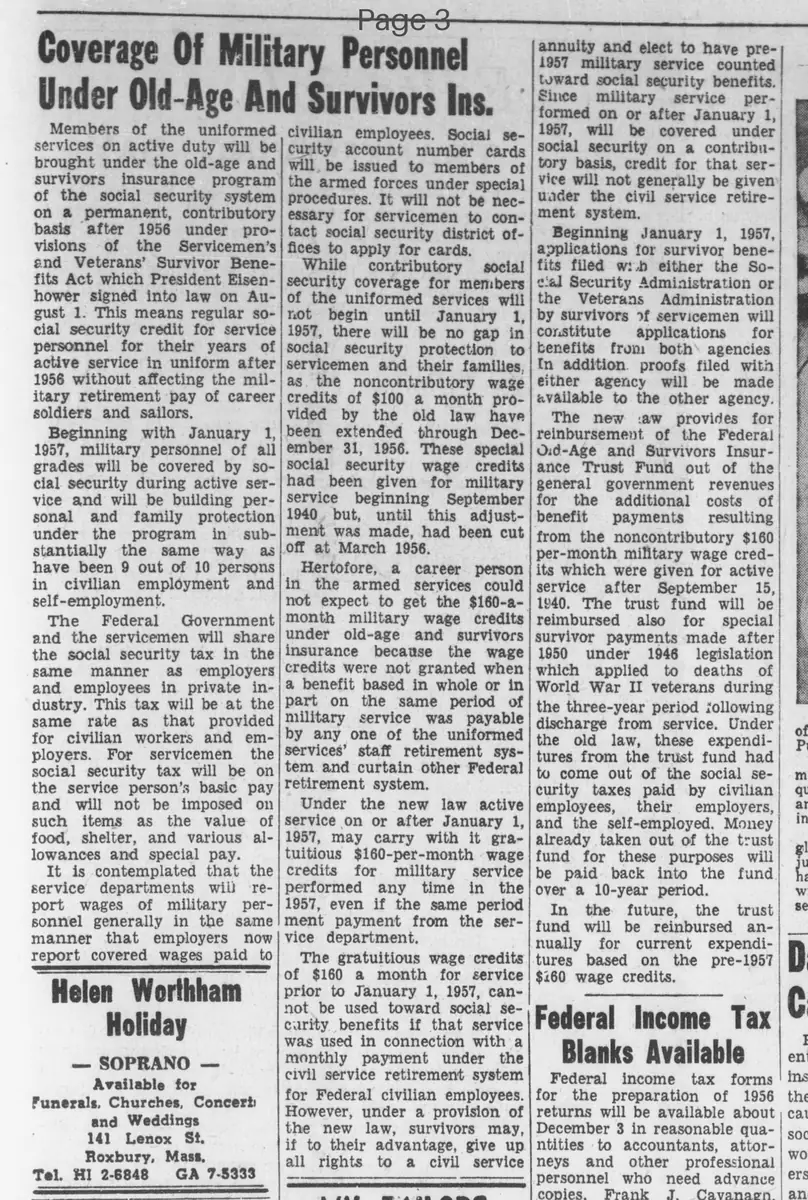
Members of the uniformed services on active duty will be brought under the old-age and survivors insurance program of the social security system on a permanent, contributory basis after 1956 under provisions of the Servicemen's and Veterans' Survivor Benefits Act which President Eisenhower signed into law on August 1. This means regular social security credit for service personnel for their years of active service in uniform after 1956 without affecting the military retirement pay of career soldiers and sailors.
Beginning with January 1, 1957, military personnel of all grades will be covered by social security during active service and will be building personal and family protection under the program substantially the same way as have been 9 out of 10 persons in civilian employment and self-employment.
The Federal Government and the servicemen will share the social security tax in the same manner as employers and employees in private industry. This tax will be at the same rate as that provided for civilian workers and employers. For servicemen the social security tax will be on the service person's basic pay and will not be imposed on such items as the value of food, shelter, and various allowances and special pay.
It is contemplated that the service departments will report wages of military personnel generally in the same manner that employers now report covered wages paid to civilian employees. Social security account number cards will be issued to members of the armed forces under special procedures. It will not be necessary for servicemen to contact social security district offices to apply for cards.
While contributory social security coverage for members of the uniformed services will not begin until January 1, 1957, there will be no gap in social security protection to servicemen and their families, as the noncontributory wage credits of $100 a month provided by the old law have been extended through December 31, 1956. These special social security wage credits had been given for military service beginning September 1940 but, until this adjustment was made, had been cut off at March 1956.
Heretofore, a career person in the armed services could not expect to get the $160-a-month military wage credits under old-age and survivors insurance because the wage credits were not granted when a benefit based in whole or in part on the same period of military service was payable by any one of the uniformed services' staff retirement system and certain other Federal retirement system.
Under the new law active service on or after January 1, 1957, may carry with it gratuitous $160-per-month wage credits for military service performed any time in 1957, even if the same period of service is used as a basis for retirement payment from the service department.
The gratuitous wage credits of $160 a month for service prior to January 1, 1957, cannot be used toward social security benefits if that service was used in connection with a monthly payment under the civil service retirement system for Federal civilian employees. However, under a provision of the new law, survivors may, if to their advantage, give up all rights to a civil service annuity and elect to have pre-1957 military service counted toward social security benefits.
Since military service performed on or after January 1, 1957, will be covered under social security on a contributory basis, credit for that service will not generally be given under the civil service retirement system.
Beginning January 1, 1957, applications for survivor benefits filed with either the Social Security Administration or the Veterans Administration by survivors of servicemen will constitute applications for benefits from both agencies. In addition, proofs filed with either agency will be made available to the other agency.
The new law provides for reimbursement of the Federal Old-Age and Survivors Insurance Trust Fund out of the general government revenues for the additional costs of benefit payments resulting from the noncontributory $160 per-month military wage credits which were given for active service after September 15, 1940. The trust fund will be reimbursed also for special survivor payments made after 1950 under 1946 legislation which applied to deaths of World War II veterans during the three-year period following discharge from service. Under the old law, these expenditures from the trust fund had to come out of the social security taxes paid by civilian employees, their employers, and the self-employed. Money already taken out of the trust fund for these purposes will be paid back into the fund over a 10-year period.
In the future, the trust fund will be reimbursed annually for current expenditures based on the pre-1957 $160 wage credits.
What sub-type of article is it?
What keywords are associated?
What entities or persons were involved?
Story Details
Key Persons
Event Date
August 1, 1956
Story Details
The Servicemen's and Veterans' Survivor Benefits Act extends contributory social security coverage to active-duty military personnel starting January 1, 1957, with shared taxes on basic pay, extended noncontributory credits through 1956, options for survivors to elect benefits, and trust fund reimbursements.