Thank you for visiting SNEWPapers!
Sign up free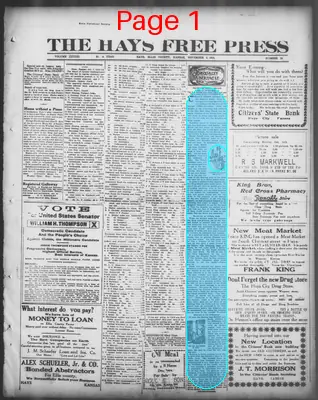
Literary
November 2, 1912
The Hays Free Press
Hays, Ellis County, Kansas
What is this article about?
This religious essay recounts the biblical story of John the Baptist's execution by Herod at Herodias's instigation, emphasizing his faithfulness unto death. It distinguishes John's earthly reward as an ancient worthy from the heavenly crown promised to the Church class since Pentecost, drawing on scriptures like Revelation, Psalms, and Hebrews.
Merged-components note: The image bbox overlaps spatially with the literary text bbox, indicating it is an illustrative element of the same biblical study article.
Clipping

OCR Quality
65%
Fair
Full Text
faithful Unto death. Mark vi, 14-29. Sept 1. "Be thou faithful unto death, and I will give thee a crown of life "—Revelation ii, 10.
TODAY'S STUDY includes John the Baptist's death. King Herod had put away his wife, and was living with the wife of his brother Philip—Herodias. John the Baptist in his preaching had referred to the fact that King Herod was living in violation of the Divine Law, and was likely to bring upon the people a war, for his wife was the daughter of King Aretas.
Herodias heard of John's teaching, and was both angry and fearful. Had Herod put her away, as would have been his duty, she would have been a disgraced woman, for the Herods were well known in Rome and elsewhere.
Herod feared John and feared the people who believed John to be a Prophet, but Herodias feared neither God nor man.
In deference to Herodias' wish, Herod had John arrested, but even then he liked to hear John talk. All the more Herodias feared the influence of John. The King's birthday came, and she encouraged him to ask to the banquet his principal friends. She dressed her own daughter in the airy costume of the dancing girls of the East, and sent her in to dance before them.
So great a condescension implied that the King should make some return. He asked the girl what he should give her, promising anything, even to the half of his kingdom, and the child returned to her mother for instructions. Herodias had gotten Herod into her net.
Now, in the presence of his friends, on his own birthday, at his own suggestion, he had obligated himself to do anything that might be asked. If the daughter demurred to ask for the head of John the Baptist, the mother probably told her that if John lived both of them would sooner or later be outcasts; that his death was necessary.
Bound by an Unholy Oath,
When the maiden made her request, the King was grieved, yet he felt himself bound to comply with his oath. The execution was accomplished, and the head was delivered to Herodias.
Alas, poor world: How many are its snares of pride and fear and attempts to increase its pleasures and honors!
In a previous study we heard Jesus' words, that no greater Prophet than John had arisen. We fully agree that he was a Prophet of the Lord, and that he will have a great reward in the future: with Abraham, Isaac and Jacob, he will come forth a perfect man, because he was found faithful, even unto death. He will be one of the class mentioned by the Lord through the Prophet David—"Instead of Thy fathers shall be Thy children, whom Thou [Messiah] shalt make Princes in all the earth."—Psalm xlv. 16.
Those who selected our lesson text evidently overlooked the fact that John the Baptist is not one of the Church class referred to in the Lord's words, "Be thou faithful unto death, and I will give thee a crown of life." (Revelation ii. 10.) John will indeed get everlasting life as a glorious portion, but he will not be a member of the Bride class. This honor belongs to us since Pentecost. We quote St. Paul's words concerning the Ancient Worthies: "All these died in faith, not having received the things promised them," "that they without us should not be made perfect." (Hebrews xi, 13, 38-40.)
We the Church, called to be joint heirs with Jesus, must get our share of the blessing first, the Bride and the Bridegroom must be perfected in the First Resurrection before the Kingdom can be established, and before the blessing can go even to the Ancient Worthies.
Wherein Is the Difference?
If John the Baptist was faithful unto death, wherein is the difference, and why should he receive an earthly reward and the Bride class receive the heavenly?
There are several reasons for this. In the matter of justice God could not show any preference, but in matters of favor, as the Scriptures declare, He may do what He will with His own.
Nothing in God's promise bound Him to give John the Baptist a place in the Bride class. The Apostle Peter declares that God foreknew this class, predestinated it as a class from before the foundation of the world: and He is now making a selection according to principles, to determine who may be of this class. He gave no opportunity to John the Baptist to be of this class, but permitted him to die when he had accomplished the work intended for him. None can be of this Bride class who died prior to Pentecost, for there the Holy Spirit was first given, and without this same Spirit no one can occupy the plane of sons; those under Moses and
TODAY'S STUDY includes John the Baptist's death. King Herod had put away his wife, and was living with the wife of his brother Philip—Herodias. John the Baptist in his preaching had referred to the fact that King Herod was living in violation of the Divine Law, and was likely to bring upon the people a war, for his wife was the daughter of King Aretas.
Herodias heard of John's teaching, and was both angry and fearful. Had Herod put her away, as would have been his duty, she would have been a disgraced woman, for the Herods were well known in Rome and elsewhere.
Herod feared John and feared the people who believed John to be a Prophet, but Herodias feared neither God nor man.
In deference to Herodias' wish, Herod had John arrested, but even then he liked to hear John talk. All the more Herodias feared the influence of John. The King's birthday came, and she encouraged him to ask to the banquet his principal friends. She dressed her own daughter in the airy costume of the dancing girls of the East, and sent her in to dance before them.
So great a condescension implied that the King should make some return. He asked the girl what he should give her, promising anything, even to the half of his kingdom, and the child returned to her mother for instructions. Herodias had gotten Herod into her net.
Now, in the presence of his friends, on his own birthday, at his own suggestion, he had obligated himself to do anything that might be asked. If the daughter demurred to ask for the head of John the Baptist, the mother probably told her that if John lived both of them would sooner or later be outcasts; that his death was necessary.
Bound by an Unholy Oath,
When the maiden made her request, the King was grieved, yet he felt himself bound to comply with his oath. The execution was accomplished, and the head was delivered to Herodias.
Alas, poor world: How many are its snares of pride and fear and attempts to increase its pleasures and honors!
In a previous study we heard Jesus' words, that no greater Prophet than John had arisen. We fully agree that he was a Prophet of the Lord, and that he will have a great reward in the future: with Abraham, Isaac and Jacob, he will come forth a perfect man, because he was found faithful, even unto death. He will be one of the class mentioned by the Lord through the Prophet David—"Instead of Thy fathers shall be Thy children, whom Thou [Messiah] shalt make Princes in all the earth."—Psalm xlv. 16.
Those who selected our lesson text evidently overlooked the fact that John the Baptist is not one of the Church class referred to in the Lord's words, "Be thou faithful unto death, and I will give thee a crown of life." (Revelation ii. 10.) John will indeed get everlasting life as a glorious portion, but he will not be a member of the Bride class. This honor belongs to us since Pentecost. We quote St. Paul's words concerning the Ancient Worthies: "All these died in faith, not having received the things promised them," "that they without us should not be made perfect." (Hebrews xi, 13, 38-40.)
We the Church, called to be joint heirs with Jesus, must get our share of the blessing first, the Bride and the Bridegroom must be perfected in the First Resurrection before the Kingdom can be established, and before the blessing can go even to the Ancient Worthies.
Wherein Is the Difference?
If John the Baptist was faithful unto death, wherein is the difference, and why should he receive an earthly reward and the Bride class receive the heavenly?
There are several reasons for this. In the matter of justice God could not show any preference, but in matters of favor, as the Scriptures declare, He may do what He will with His own.
Nothing in God's promise bound Him to give John the Baptist a place in the Bride class. The Apostle Peter declares that God foreknew this class, predestinated it as a class from before the foundation of the world: and He is now making a selection according to principles, to determine who may be of this class. He gave no opportunity to John the Baptist to be of this class, but permitted him to die when he had accomplished the work intended for him. None can be of this Bride class who died prior to Pentecost, for there the Holy Spirit was first given, and without this same Spirit no one can occupy the plane of sons; those under Moses and
What sub-type of article is it?
Essay
What themes does it cover?
Religious
Moral Virtue
What keywords are associated?
John Baptist
Herod
Herodias
Faithfulness
Bible Study
Ancient Worthies
Church Class
Literary Details
Title
Faithful Unto Death
Subject
Study On John The Baptist's Death From Mark Vi, 14 29
Key Lines
"Be Thou Faithful Unto Death, And I Will Give Thee A Crown Of Life "—Revelation Ii, 10.
"Instead Of Thy Fathers Shall Be Thy Children, Whom Thou [Messiah] Shalt Make Princes In All The Earth."—Psalm Xlv. 16.
"All These Died In Faith, Not Having Received The Things Promised Them," "That They Without Us Should Not Be Made Perfect." (Hebrews Xi, 13, 38 40.)