Thank you for visiting SNEWPapers!
Sign up free
Story
January 28, 1850
Lynchburg Virginian
Lynchburg, Virginia
What is this article about?
T. S. P. from Petersburg shares experience using guano for watermelons and cucurbitaceae, detailing a method combining guano with manure for early crops, based on trials over years ending in 1849.
Clipping
OCR Quality
98%
Excellent
Full Text
AGRICULTURAL.
From the American Farmer.
GUANO FOR MELONS, &c.
To the Editor of the American Farmer.
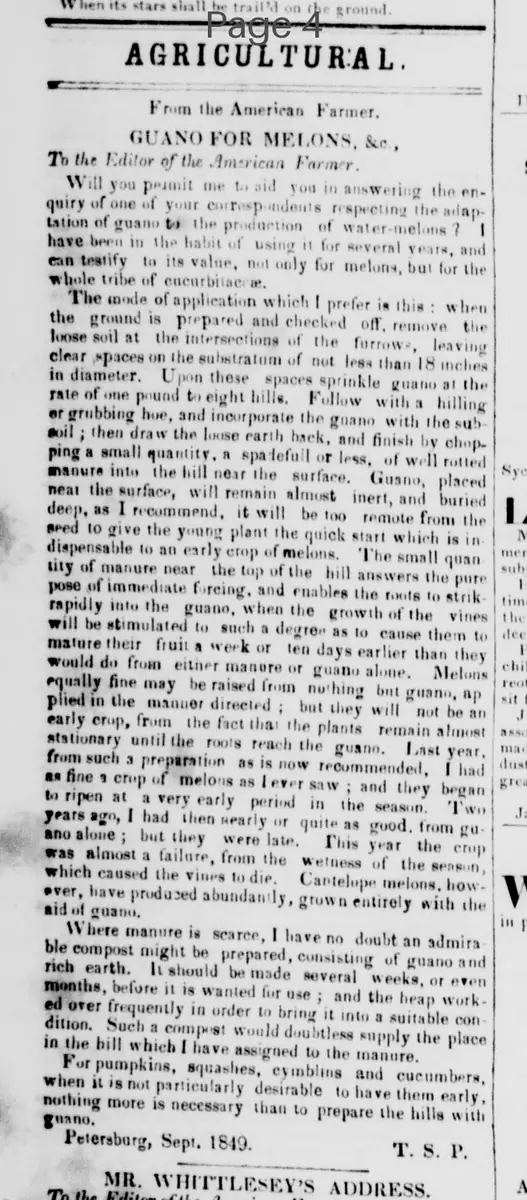
Will you permit me to aid you in answering the enquiry of one of your correspondents respecting the adaptation of guano to the production of water-melons? I have been in the habit of using it for several years, and can testify to its value, not only for melons, but for the whole tribe of cucurbitaceae.
The mode of application which I prefer is this: when the ground is prepared and checked off, remove the loose soil at the intersections of the furrows, leaving clear spaces on the substratum of not less than 18 inches in diameter. Upon these spaces sprinkle guano at the rate of one pound to eight hills. Follow with a hilling or grubbing hoe, and incorporate the guano with the sub soil; then draw the loose earth back, and finish by chopping a small quantity, a spadeful or less, of well rotted manure into the hill near the surface. Guano, placed near the surface, will remain almost inert, and buried deep, as I recommend, it will be too remote from the seed to give the young plant the quick start which is indispensable to an early crop of melons. The small quantity of manure near the top of the hill answers the purpose of immediate forcing, and enables the roots to strike rapidly into the guano, when the growth of the vines will be stimulated to such a degree as to cause them to mature their fruit a week or ten days earlier than they would do from either manure or guano alone. Melons equally fine may be raised from nothing but guano, applied in the manner directed; but they will not be an early crop, from the fact that the plants remain almost stationary until the roots reach the guano. Last year, from such a preparation as is now recommended, I had as fine a crop of melons as I ever saw; and they began to ripen at a very early period in the season. Two years ago, I had then nearly or quite as good, from guano alone; but they were late. This year the crop was almost a failure, from the wetness of the season, which caused the vines to die. Cantaloupe melons, however, have produced abundantly, grown entirely with the aid of guano.
Where manure is scarce, I have no doubt an admirable compost might be prepared, consisting of guano and rich earth. It should be made several weeks, or even months, before it is wanted for use; and the heap worked over frequently in order to bring it into a suitable condition. Such a compost would doubtless supply the place in the hill which I have assigned to the manure.
For pumpkins, squashes, cymlings and cucumbers, when it is not particularly desirable to have them early, nothing more is necessary than to prepare the hills with guano.
Petersburg, Sept. 1849.
T. S. P.
From the American Farmer.
GUANO FOR MELONS, &c.
To the Editor of the American Farmer.
Will you permit me to aid you in answering the enquiry of one of your correspondents respecting the adaptation of guano to the production of water-melons? I have been in the habit of using it for several years, and can testify to its value, not only for melons, but for the whole tribe of cucurbitaceae.
The mode of application which I prefer is this: when the ground is prepared and checked off, remove the loose soil at the intersections of the furrows, leaving clear spaces on the substratum of not less than 18 inches in diameter. Upon these spaces sprinkle guano at the rate of one pound to eight hills. Follow with a hilling or grubbing hoe, and incorporate the guano with the sub soil; then draw the loose earth back, and finish by chopping a small quantity, a spadeful or less, of well rotted manure into the hill near the surface. Guano, placed near the surface, will remain almost inert, and buried deep, as I recommend, it will be too remote from the seed to give the young plant the quick start which is indispensable to an early crop of melons. The small quantity of manure near the top of the hill answers the purpose of immediate forcing, and enables the roots to strike rapidly into the guano, when the growth of the vines will be stimulated to such a degree as to cause them to mature their fruit a week or ten days earlier than they would do from either manure or guano alone. Melons equally fine may be raised from nothing but guano, applied in the manner directed; but they will not be an early crop, from the fact that the plants remain almost stationary until the roots reach the guano. Last year, from such a preparation as is now recommended, I had as fine a crop of melons as I ever saw; and they began to ripen at a very early period in the season. Two years ago, I had then nearly or quite as good, from guano alone; but they were late. This year the crop was almost a failure, from the wetness of the season, which caused the vines to die. Cantaloupe melons, however, have produced abundantly, grown entirely with the aid of guano.
Where manure is scarce, I have no doubt an admirable compost might be prepared, consisting of guano and rich earth. It should be made several weeks, or even months, before it is wanted for use; and the heap worked over frequently in order to bring it into a suitable condition. Such a compost would doubtless supply the place in the hill which I have assigned to the manure.
For pumpkins, squashes, cymlings and cucumbers, when it is not particularly desirable to have them early, nothing more is necessary than to prepare the hills with guano.
Petersburg, Sept. 1849.
T. S. P.
What sub-type of article is it?
Curiosity
What themes does it cover?
Triumph
What keywords are associated?
Guano
Water Melons
Cucurbitaceae
Early Crop
Manure
Compost
Agriculture
What entities or persons were involved?
T. S. P.
Where did it happen?
Petersburg
Story Details
Key Persons
T. S. P.
Location
Petersburg
Event Date
Sept. 1849
Story Details
T. S. P. describes preferred method of applying guano buried in subsoil with surface manure for early melon crops, shares successful results from prior years, suggests compost alternative, and notes guano sufficiency for non-early cucurbitaceae like pumpkins and cucumbers.