Thank you for visiting SNEWPapers!
Sign up free
The Virginia Gazette
Richmond, Williamsburg, Richmond County, Virginia
What is this article about?
Letter from Bombay, March 14, 1779, by East India Company officer describes campaign starting Nov. 22, 1778: detachment secures Ghauts pass; army advances, loses Lt. Col. Cay and Capt. Stewart; forces enemy back but retreats Jan. 19 near Poonah amid superior numbers (3,000 vs. 60,000), losing baggage and howitzer.
Clipping
OCR Quality
Full Text
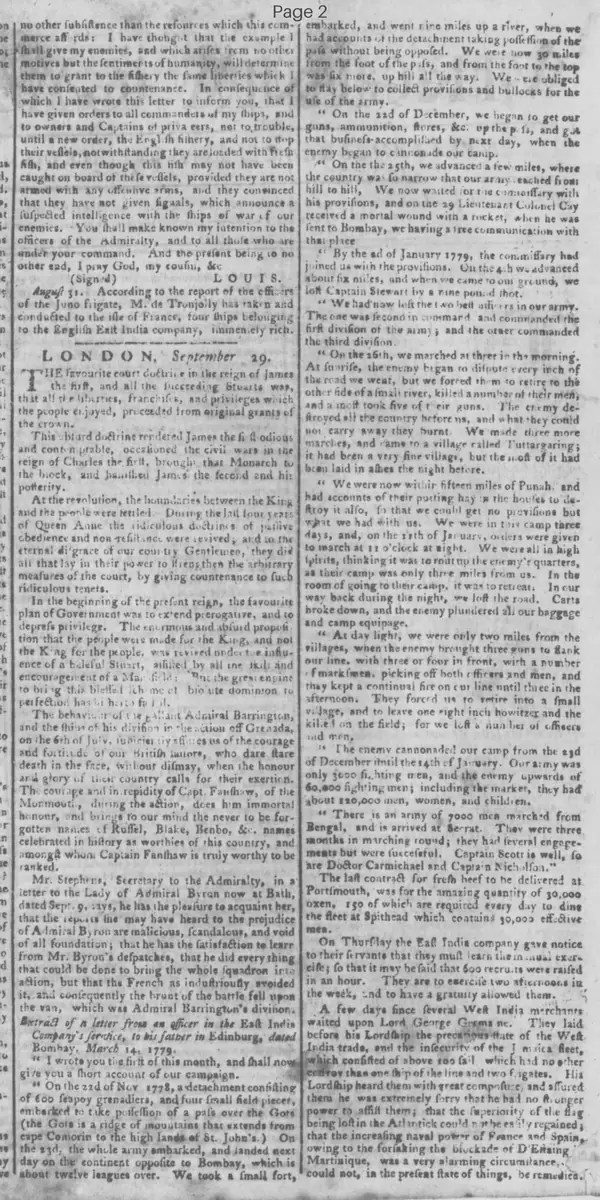
"I wrote you the first of this month, and shall now give you a short account of our campaign.
"On the 22d of Nov. 1778, a detachment consisting of 100 sepoy grenadiers, and four small field pieces, embarked to take possession of a pass over the Ghauts (the Ghauts is a ridge of mountains that extends from cape Comorin to the high lands of St. John's.) On the 2d, the whole army embarked, and landed next day on the continent opposite to Bombay, which is about twelve leagues over. We took a small fort, embarked, and went nine miles up a river, when we had accounts of the detachment taking possession of the pass without being opposed. We were now 30 miles from the foot of the pass, and from the foot to the top was six more, up hill all the way. We were obliged to stay below to collect provisions and bullocks for the use of the army.
"On the 22d of December, we began to get our guns, ammunition, stores, &c. up the pass, and got that business accomplished by next day, when the enemy began to cannonade our camp.
"On the 25th, we advanced a few miles, where the country was so narrow that our army reached from hill to hill. We now waited for the commissary with his provisions, and on the 28th Lieutenant Colonel Cay received a mortal wound with a rocket, when he was sent to Bombay, we having a free communication with that place.
"By the 2d of January 1779, the commissary had joined us with the provisions. On the 4th we advanced about six miles, and when we came to open ground, we lost Captain Stewart by a nine pound shot.
"We had now lost the two best officers in our army. The one was second in command and commanded the first division of the army; and the other commanded the third division.
"On the 16th, we marched at three in the morning. At sunrise, the enemy began to dispute every inch of the road we went, but we forced them to retire to the other side of a small river, killed a number of their men, and almost took five of their guns. The enemy destroyed all the country before us, and what they could not carry away they burnt. We made three more marches, and came to a village called Tuttargaring; it had been a very fine village, but the most of it had been laid in ashes the night before.
"We were now within fifteen miles of Poonah, and had accounts of their putting hay in the houses to destroy it also, so that we could get no provisions but what we had with us. We were in this camp three days, and, on the 19th of January, orders were given to march at 10 o'clock at night. We were all in high spirits, thinking it was to rout up the enemy's quarters, as their camp was only three miles from us. In the room of going to their camp, it was to retreat. In our way back during the night, we lost the road. Carts broke down, and the enemy plundered all our baggage and camp equipage.
"At day light, we were only two miles from the villages, when the enemy brought three guns to enfilade our line, with three or four in front, with a number of marksmen, picking off both officers and men, and they kept a continual fire on our line until three in the afternoon. They forced us to retire into a small village, and to leave one light 12 inch howitzer and the killed on the field; for we left a number of cheers and men.
"The enemy cannonaded our camp from the 22d of December until the 5th of January. Our army was only 3000 fighting men, and the enemy upwards of 60,000 fighting men; including the camp followers, they had about 20,000 men, women, and children.
"There is an army of 7000 men marched from Bengal, and is arrived at Surat. They were three months in marching round; they had several engagements but were successful. Captain Scott is well, as are Doctor Carmichael and Captain Nicholson."
What sub-type of article is it?
What keywords are associated?
What entities or persons were involved?
Where did it happen?
Foreign News Details
Primary Location
Bombay
Event Date
November 1778 January 1779
Key Persons
Outcome
british losses: lt. col. cay mortally wounded, capt. stewart killed, unspecified number of men killed, baggage and camp equipage plundered, one 12-inch howitzer abandoned; enemy: number of men killed, five guns nearly captured; british army of 3,000 fighting men retreated against 60,000 enemy fighters; separate bengal army of 7,000 successful at surat.
Event Details
East India Company army of 3,000 advanced from Bombay over Ghauts pass starting Nov. 22, 1778, securing pass unopposed, taking small fort, advancing towards Poonah despite enemy cannonade and destruction of provisions; lost key officers Cay and Stewart; on Jan. 16 forced enemy across river, killing many and nearly capturing guns; reached Tuttargaring 15 miles from Poonah; retreated Jan. 19 night, lost road, plundered by enemy who enfiladed line, forcing retirement to village with losses.