Thank you for visiting SNEWPapers!
Sign up free
Story
October 23, 1887
The Indianapolis Journal
Indianapolis, Marion County, Indiana
What is this article about?
Article details how three greedy Indiana men from Gentryville were duped in New York by 'boodlers' selling fake counterfeit money, receiving tissue paper after paying $250 via express. Includes scheme description and U.S. Secret Service explanation of why no aid is possible.
Clipping
OCR Quality
95%
Excellent
Full Text
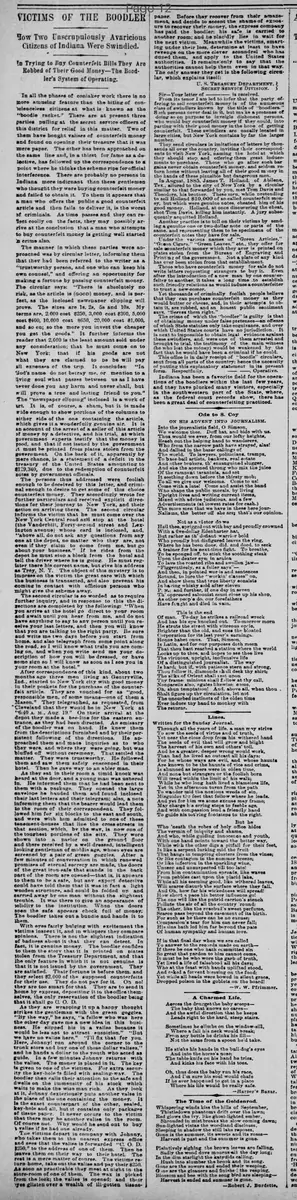
VICTIMS OF THE BOODLER
How Two Unscrupulously Avaricious
Citizens of Indiana Were Swindled.
In Trying to Buy Counterfeit Bills They Are
Robbed of Their Good Money—The Bood-
ler's System of Operating.
In all the phases of counterfeiter work there is no
more amusing feature than the biting of con-
denceless citizens at what is known as the
"boodle racket." There are at present three
parties pulling at the secret service officers of
this district for relief in this matter. Two of
them have bought valises of counterfeit money
and found on opening their treasure that it was
mere paper. The other has been approached on
the same line and, in a thirst for fame as a de-
toctive, has followed up the correspondence to a
point where he thinks the scheme ripe for official
interference. There are probably no persons in
Indiana more indignant than these gentlemen
who thought they were buying counterfeit money
and failed to obtain it. To them it appears that
a man who offers the public a good counterfeit
article and then fails to deliver it, is the worst
of criminals. As time passes and they can re-
Gect coolly on the facts, they may possibly ar-
rive at the conclusion that a man who attempts
to buy counterfeit money is getting well started
in crime also.
The manner in which these parties were ap-
proached was by circular letter, informing them
that they had been referred to the writer as a
"trustworthy person, and one who can keep his
own counsel," and offering an opportunity for
making a fortune by passing counterfeit money.
The circular says: "There is absolutely no
risk, as the article is good money, and is per-
fect, as the enclosed newspaper clipping will
prove. The sizes are 1s, 2s, 5s and 10s. My
terms are, 2,000 cost $250, 3,000 cost $300, 5,000
cost $400, 10,000 cost $650, 20,000 cost $1,000,
and so on; so the more you invest the cheaper
you get the goods." It further informs the
reader that 2,000 is the least amount sold under
any consideration; that he must come on to
New York; that if his goods are not
what they are claimed to be he will pay
all expenses of the trip. It concludes: "In
God's name do not betray me, or mention to a
living soul what passes between us as I have
never done you any harm and never shall, but
will prove a true and lasting friend to you."
The "newspaper clipping" enclosed is a work of
art. It is, of course, a sham, but it is made
wide enough to show portions of the columns to
either side of the one containing the article,
which gives it a wonderfully genuine air. It is
an account of the arrest of a seller of this article
of money by a detective, and his trial, at which
government experts testify that the money is
good, and that if not issued by the government
it must be printed from plates stolen from the
government. On the back of it, apparently by
mere chance, is a statement of a deficit in the
treasury of the United States amounting to
$129,340, due to the redemption of counterfeit
notes by government officials.
The persons thus addressed were foolish
enough to be deceived by this letter, and crimi-
nal enough to desire to get some of this choice
counterfeit money. They accordingly wrote for
further particulars and received explicit direc-
tions for their journey to New York, and their
action on arriving there. The second circular
informs the victim that he must come over the
New York Central road and stop at the hotel
(the Vanderbilt, Forty-second street and Lex-
ington avenue) whose card is enclosed, and,
"above all, do not ask any questions from any
one at the depot, no matter who they are, not
even if they claim to come from me, but go
about your business." If he rides from the
depot he must stop a block from the hotel and
tell the driver where he is going. He must reg-
ister there his correct name, but give his address
as Troy, N. Y. The object of this mystery is to
impress on the victim the great care with which
the business is transacted, and also prevent his
coming in contact with officious persons who
might give the scheme away.
The second circular is so worded as to require
further inquiry, and in response to this the di-
rections are completed by the following: "When
you arrive at the hotel go direct to your room
and await until you hear from me, and do not
have anything to say to any person until you re-
ceive your last letters, and then you will know
that you are talking to the right party. Be sure
and write me two days before you start from
home, and also telegraph from some point along
the road, so I will know what train you are com-
ing on, and when you write send me your de-
scription of how you will be dressed, or have
some sign so I will know as soon as I see you in
your room at the hotel."
After correspondence of this kind, about two
months ago three men living at Gentryville,
Ind., started to New York city with good money
in their pockets for the purchase of the counter-
feit article. They are vouched for as "good,
responsible men, of some means—one of them a
Mason." They telegraphed, as requested, from
Cleveland that they would be in New York at
6:40 A. M., Aug. 19.
On their arrival at the
depot they made a bee-line for the eastern en-
trance, as they had been directed. An emissary
of the boodler was on
hand. He knew them
from the descriptions furnished and by their per-
sistent following of the directions. He ap-
proached them and made inquiries as to who
they were, and where they were going, but was
bluffed off without ceremony. That settled the
matter. They were trustworthy. He followed
them and saw them safely ensconced in their
hotel. Then he gave way to an abler man.
As they sat in their room a timid knock was
heard at the door, and a young man was ushered
in. He informed them that he had been sent to
them with a package. They opened the large
envelope he handed them and found enclosed
their last letters and their telegram; also, a note
informing them that the bearer would lead them
to the room of their correspondent. They fol-
lowed him for six blocks to the east and south,
and were with him admitted to one of those
tenement-houses that line the cross-streets in
that section, which, by the way, is now one of
the toughest portions of the city. They were
shown into a parlor on the ground floor
and there received by a well-dressed, intelligent
looking gentleman of middle age, whose eyes are
screened by a pair of green goggles. After a
few minutes of conversation in which renewed
promises of eternal secrecy are made, the doors
of the great iron-safe that stands in the back
part of the room are opened—that is, it appears
to them to be a safe, but any expert detective
could have told them that it was in fact a light
wooden structure, and could be folded up and
carried away by one man without the slightest
trouble. It was there to give an appearance of
solidity to the institution. When the doors
open the safe appears chock full of money.
The boodler takes out a bundle and hands it to
them.
With eyes fairly bulging with excitement the
victims inspect it, and in whispers they compare
opinions. There is not the slightest indication
of badness about it that they can detect. In
fact, it is genuine money. The boodler confides
to them the story that it is printed on plates
stolen from the Treasury Department, and that
the only feature in which it is not genuine is
that it is not issued by the government. They
are satisfied. Their fortune is before them, and
they select $2,000 of the supposed counterfeits
for their use. They do not pay for it.
On no!
they are too smart for that. They are to send it
home by express, depositing it in the office them-
themselves, the only reservation of the boodler being
that it shall go C. O. D.
As they are wrapping it up a happy thought
strikes the gentleman with the green goggles.
"By the way," he says, "a fellow who was here
the other day gave me a new idea in this busi-
ness. He slipped his in a valise because it
would be less apt to attract suspicion."
"But
we have no valise here."
I'll fix that for you.
Here, Johnny! run around the corner to the
trunk store and buy one of those dollar valises,"
and he hands a dollar to the youth who acted as
guide. In a few minutes Johnny returns with
the valise. The money is placed in it. The key
is given to one of the victims. For extra secur-
ity the key-hole is filled with sealing-wax. The
boodler then calls their attention to the safe and
dwells on the immensity of his stock which
waits to make the wise man rich. As they look
at it, Johnny dexterously puts another valise in
the place of the one containing the money. It
is the exact counterpart of the other, sealed,
key-hole and all, but it contains only packages
of tissue paper. It never occurs to the victim
that there may be another valise in the room.
Of course not. Why would he send out to buy
a valise if he had one already.
The victims depart in company with Johnny,
who takes them to the nearest express office
and sees that the valise is forwarded "C. O. D.
$250," to the address of one of them. Then he
leaves them on their way to their hotel. The
rest is a mere matter of course. The victims re-
turn home, take out the valise and pay their $250.
As soon as practicable they meet at night in the
store-room of one of them. The wax is picked
from the lock; the valise is opened; and their
yes glisten over a wealth of ill-gotten tissue-
paper.
Before they recover from their amaze-
ment, and decide to accept the shame of expe-
sure to recover their money, the express company
has paid the boodler; his safe is carried to
another room; and he placidly lies in wait for
the next victim.
Meanwhile the victims, smart-
ing under their loss, determine at least to have
revenge on the more clever scoundrel who has
duped them, and apply to the United States
authorities. It remains only to say that the
authorities cannot help them even in that way.
The only answer they get is the following circu-
lar, which explains itself:
U. S. TREASURY DEPARTMENT.
Secret Service Division.
Sir—Your letter of
is received.
From its tenor I am led to infer that the party of-
fering to sell counterfeit money is of the numerous
class of swindlers known by the title of "boodlers."
Such persons never deal in it, but make a pretense of
doing so on purpose to inveigle dishonest persons,
who would buy counterfeit money if they could, into
parting with their good money in the hope of getting
counterfeit. These swindlers are usually located in
large cities, but New York contains by far the larger
number.
They send circulars in imitations of letters by thou-
sands all over the country, inviting their correspond-
ents to visit New York, naming the hotel at which
they should stop, and offering them great induce-
ments to purchase.
Those who go after such bar-
gains never obtain counterfeit money, and seldom re-
turn home without leaving all of their good money in
the hands of these plausible but dangerous men.
In August, 1885, James T. Holland, of Abilene,
Tex., allured to the city of New York by a circular
similar to that forwarded by you, met Tom Davis and
Theodore, his brother. These men, while pretending
to sell Holland $10,000 of so-called counterfeit mon-
ey, but which were genuine notes, cheated him of his
good money. Holland, at once discovering the cheat,
shot Tom Davis, killing him instantly. A jury subse-
quently acquitted Holland.
Another practice is to toll on their victims by send-
ing a genuine one or two-dollar note or parts of the
same, and representing them to be specimens of the
counterfeit notes they have for sale.
Under the various names of "Green Articles,"
"Green Cigars,"
"Green Leaves," etc., they offer for
sale counterfeit money which they aver is printed on
plates stolen from the Bureau of Engraving and
Printing of the government. Not a plate of any kind
has ever
been stolen from that establishment.
Those who have counterfeit money for sale do not
write letters requesting strangers to buy it. Even
after the introduction of a new man by one counter-
feiter to another, it takes a long time to establish
such friendly relations as would induce a counterfeiter
to trust a new-comer.
Yet thousands of criminally foolish people believe
that they can purchase counterfeit money as they
would butter or cheese, and, in their attempts to ob-
tain it, are robbed, and an honest public sentiment
says, "Serves them right."
The crime of which the "boodler" is guilty is that
of obtaining money under false pretenses—an offense
of which State statutes only take cognizance, and over
which United States courts have no jurisdiction. It
is next to impossible to obtain local evidence against
these swindlers, and, were one of them arrested and
brought to trial, the testimony of the main witness
(he who lost the money) would be weakened by the
fact that he would have been a criminal if he could.
This office is in daily receipt of "boodle" circulars.
sent from all parts of the country; hence the necessity
of putting this explanatory statement in its present
form.
Respectfully,
Operative.
Indiana has been a favorite field for the opera-
tions of the boodlers within the last few years,
and they have plucked many visitors, especially
in the southwestern part of the State, where,
as the federal court records show, there has
been a great deal of counterfeiting practiced.
How Two Unscrupulously Avaricious
Citizens of Indiana Were Swindled.
In Trying to Buy Counterfeit Bills They Are
Robbed of Their Good Money—The Bood-
ler's System of Operating.
In all the phases of counterfeiter work there is no
more amusing feature than the biting of con-
denceless citizens at what is known as the
"boodle racket." There are at present three
parties pulling at the secret service officers of
this district for relief in this matter. Two of
them have bought valises of counterfeit money
and found on opening their treasure that it was
mere paper. The other has been approached on
the same line and, in a thirst for fame as a de-
toctive, has followed up the correspondence to a
point where he thinks the scheme ripe for official
interference. There are probably no persons in
Indiana more indignant than these gentlemen
who thought they were buying counterfeit money
and failed to obtain it. To them it appears that
a man who offers the public a good counterfeit
article and then fails to deliver it, is the worst
of criminals. As time passes and they can re-
Gect coolly on the facts, they may possibly ar-
rive at the conclusion that a man who attempts
to buy counterfeit money is getting well started
in crime also.
The manner in which these parties were ap-
proached was by circular letter, informing them
that they had been referred to the writer as a
"trustworthy person, and one who can keep his
own counsel," and offering an opportunity for
making a fortune by passing counterfeit money.
The circular says: "There is absolutely no
risk, as the article is good money, and is per-
fect, as the enclosed newspaper clipping will
prove. The sizes are 1s, 2s, 5s and 10s. My
terms are, 2,000 cost $250, 3,000 cost $300, 5,000
cost $400, 10,000 cost $650, 20,000 cost $1,000,
and so on; so the more you invest the cheaper
you get the goods." It further informs the
reader that 2,000 is the least amount sold under
any consideration; that he must come on to
New York; that if his goods are not
what they are claimed to be he will pay
all expenses of the trip. It concludes: "In
God's name do not betray me, or mention to a
living soul what passes between us as I have
never done you any harm and never shall, but
will prove a true and lasting friend to you."
The "newspaper clipping" enclosed is a work of
art. It is, of course, a sham, but it is made
wide enough to show portions of the columns to
either side of the one containing the article,
which gives it a wonderfully genuine air. It is
an account of the arrest of a seller of this article
of money by a detective, and his trial, at which
government experts testify that the money is
good, and that if not issued by the government
it must be printed from plates stolen from the
government. On the back of it, apparently by
mere chance, is a statement of a deficit in the
treasury of the United States amounting to
$129,340, due to the redemption of counterfeit
notes by government officials.
The persons thus addressed were foolish
enough to be deceived by this letter, and crimi-
nal enough to desire to get some of this choice
counterfeit money. They accordingly wrote for
further particulars and received explicit direc-
tions for their journey to New York, and their
action on arriving there. The second circular
informs the victim that he must come over the
New York Central road and stop at the hotel
(the Vanderbilt, Forty-second street and Lex-
ington avenue) whose card is enclosed, and,
"above all, do not ask any questions from any
one at the depot, no matter who they are, not
even if they claim to come from me, but go
about your business." If he rides from the
depot he must stop a block from the hotel and
tell the driver where he is going. He must reg-
ister there his correct name, but give his address
as Troy, N. Y. The object of this mystery is to
impress on the victim the great care with which
the business is transacted, and also prevent his
coming in contact with officious persons who
might give the scheme away.
The second circular is so worded as to require
further inquiry, and in response to this the di-
rections are completed by the following: "When
you arrive at the hotel go direct to your room
and await until you hear from me, and do not
have anything to say to any person until you re-
ceive your last letters, and then you will know
that you are talking to the right party. Be sure
and write me two days before you start from
home, and also telegraph from some point along
the road, so I will know what train you are com-
ing on, and when you write send me your de-
scription of how you will be dressed, or have
some sign so I will know as soon as I see you in
your room at the hotel."
After correspondence of this kind, about two
months ago three men living at Gentryville,
Ind., started to New York city with good money
in their pockets for the purchase of the counter-
feit article. They are vouched for as "good,
responsible men, of some means—one of them a
Mason." They telegraphed, as requested, from
Cleveland that they would be in New York at
6:40 A. M., Aug. 19.
On their arrival at the
depot they made a bee-line for the eastern en-
trance, as they had been directed. An emissary
of the boodler was on
hand. He knew them
from the descriptions furnished and by their per-
sistent following of the directions. He ap-
proached them and made inquiries as to who
they were, and where they were going, but was
bluffed off without ceremony. That settled the
matter. They were trustworthy. He followed
them and saw them safely ensconced in their
hotel. Then he gave way to an abler man.
As they sat in their room a timid knock was
heard at the door, and a young man was ushered
in. He informed them that he had been sent to
them with a package. They opened the large
envelope he handed them and found enclosed
their last letters and their telegram; also, a note
informing them that the bearer would lead them
to the room of their correspondent. They fol-
lowed him for six blocks to the east and south,
and were with him admitted to one of those
tenement-houses that line the cross-streets in
that section, which, by the way, is now one of
the toughest portions of the city. They were
shown into a parlor on the ground floor
and there received by a well-dressed, intelligent
looking gentleman of middle age, whose eyes are
screened by a pair of green goggles. After a
few minutes of conversation in which renewed
promises of eternal secrecy are made, the doors
of the great iron-safe that stands in the back
part of the room are opened—that is, it appears
to them to be a safe, but any expert detective
could have told them that it was in fact a light
wooden structure, and could be folded up and
carried away by one man without the slightest
trouble. It was there to give an appearance of
solidity to the institution. When the doors
open the safe appears chock full of money.
The boodler takes out a bundle and hands it to
them.
With eyes fairly bulging with excitement the
victims inspect it, and in whispers they compare
opinions. There is not the slightest indication
of badness about it that they can detect. In
fact, it is genuine money. The boodler confides
to them the story that it is printed on plates
stolen from the Treasury Department, and that
the only feature in which it is not genuine is
that it is not issued by the government. They
are satisfied. Their fortune is before them, and
they select $2,000 of the supposed counterfeits
for their use. They do not pay for it.
On no!
they are too smart for that. They are to send it
home by express, depositing it in the office them-
themselves, the only reservation of the boodler being
that it shall go C. O. D.
As they are wrapping it up a happy thought
strikes the gentleman with the green goggles.
"By the way," he says, "a fellow who was here
the other day gave me a new idea in this busi-
ness. He slipped his in a valise because it
would be less apt to attract suspicion."
"But
we have no valise here."
I'll fix that for you.
Here, Johnny! run around the corner to the
trunk store and buy one of those dollar valises,"
and he hands a dollar to the youth who acted as
guide. In a few minutes Johnny returns with
the valise. The money is placed in it. The key
is given to one of the victims. For extra secur-
ity the key-hole is filled with sealing-wax. The
boodler then calls their attention to the safe and
dwells on the immensity of his stock which
waits to make the wise man rich. As they look
at it, Johnny dexterously puts another valise in
the place of the one containing the money. It
is the exact counterpart of the other, sealed,
key-hole and all, but it contains only packages
of tissue paper. It never occurs to the victim
that there may be another valise in the room.
Of course not. Why would he send out to buy
a valise if he had one already.
The victims depart in company with Johnny,
who takes them to the nearest express office
and sees that the valise is forwarded "C. O. D.
$250," to the address of one of them. Then he
leaves them on their way to their hotel. The
rest is a mere matter of course. The victims re-
turn home, take out the valise and pay their $250.
As soon as practicable they meet at night in the
store-room of one of them. The wax is picked
from the lock; the valise is opened; and their
yes glisten over a wealth of ill-gotten tissue-
paper.
Before they recover from their amaze-
ment, and decide to accept the shame of expe-
sure to recover their money, the express company
has paid the boodler; his safe is carried to
another room; and he placidly lies in wait for
the next victim.
Meanwhile the victims, smart-
ing under their loss, determine at least to have
revenge on the more clever scoundrel who has
duped them, and apply to the United States
authorities. It remains only to say that the
authorities cannot help them even in that way.
The only answer they get is the following circu-
lar, which explains itself:
U. S. TREASURY DEPARTMENT.
Secret Service Division.
Sir—Your letter of
is received.
From its tenor I am led to infer that the party of-
fering to sell counterfeit money is of the numerous
class of swindlers known by the title of "boodlers."
Such persons never deal in it, but make a pretense of
doing so on purpose to inveigle dishonest persons,
who would buy counterfeit money if they could, into
parting with their good money in the hope of getting
counterfeit. These swindlers are usually located in
large cities, but New York contains by far the larger
number.
They send circulars in imitations of letters by thou-
sands all over the country, inviting their correspond-
ents to visit New York, naming the hotel at which
they should stop, and offering them great induce-
ments to purchase.
Those who go after such bar-
gains never obtain counterfeit money, and seldom re-
turn home without leaving all of their good money in
the hands of these plausible but dangerous men.
In August, 1885, James T. Holland, of Abilene,
Tex., allured to the city of New York by a circular
similar to that forwarded by you, met Tom Davis and
Theodore, his brother. These men, while pretending
to sell Holland $10,000 of so-called counterfeit mon-
ey, but which were genuine notes, cheated him of his
good money. Holland, at once discovering the cheat,
shot Tom Davis, killing him instantly. A jury subse-
quently acquitted Holland.
Another practice is to toll on their victims by send-
ing a genuine one or two-dollar note or parts of the
same, and representing them to be specimens of the
counterfeit notes they have for sale.
Under the various names of "Green Articles,"
"Green Cigars,"
"Green Leaves," etc., they offer for
sale counterfeit money which they aver is printed on
plates stolen from the Bureau of Engraving and
Printing of the government. Not a plate of any kind
has ever
been stolen from that establishment.
Those who have counterfeit money for sale do not
write letters requesting strangers to buy it. Even
after the introduction of a new man by one counter-
feiter to another, it takes a long time to establish
such friendly relations as would induce a counterfeiter
to trust a new-comer.
Yet thousands of criminally foolish people believe
that they can purchase counterfeit money as they
would butter or cheese, and, in their attempts to ob-
tain it, are robbed, and an honest public sentiment
says, "Serves them right."
The crime of which the "boodler" is guilty is that
of obtaining money under false pretenses—an offense
of which State statutes only take cognizance, and over
which United States courts have no jurisdiction. It
is next to impossible to obtain local evidence against
these swindlers, and, were one of them arrested and
brought to trial, the testimony of the main witness
(he who lost the money) would be weakened by the
fact that he would have been a criminal if he could.
This office is in daily receipt of "boodle" circulars.
sent from all parts of the country; hence the necessity
of putting this explanatory statement in its present
form.
Respectfully,
Operative.
Indiana has been a favorite field for the opera-
tions of the boodlers within the last few years,
and they have plucked many visitors, especially
in the southwestern part of the State, where,
as the federal court records show, there has
been a great deal of counterfeiting practiced.
What sub-type of article is it?
Crime Story
Deception Fraud
What themes does it cover?
Deception
Crime Punishment
What keywords are associated?
Boodler Swindle
Counterfeit Money
New York Fraud
Indiana Victims
Tissue Paper Trick
Where did it happen?
Gentryville, Ind.; New York City
Story Details
Location
Gentryville, Ind.; New York City
Event Date
Aug. 19
Story Details
Three men from Gentryville, Ind., travel to New York to purchase counterfeit money but are swindled by boodlers who substitute a valise of tissue paper for genuine bills, taking their $250 payment.