Thank you for visiting SNEWPapers!
Sign up free
Trainman News
Indianapolis, Marion County, Indiana
What is this article about?
The 1953 Canadian general election campaign features pepped-up theme songs and familiar party strategies. Liberals emphasize their record, Progressive Conservatives push for change with tax cuts, CCF seeks better change via social services, and Social Credit targets disillusioned voters. Election set for Aug. 10 amid low turnout expectations.
Clipping
OCR Quality
Full Text
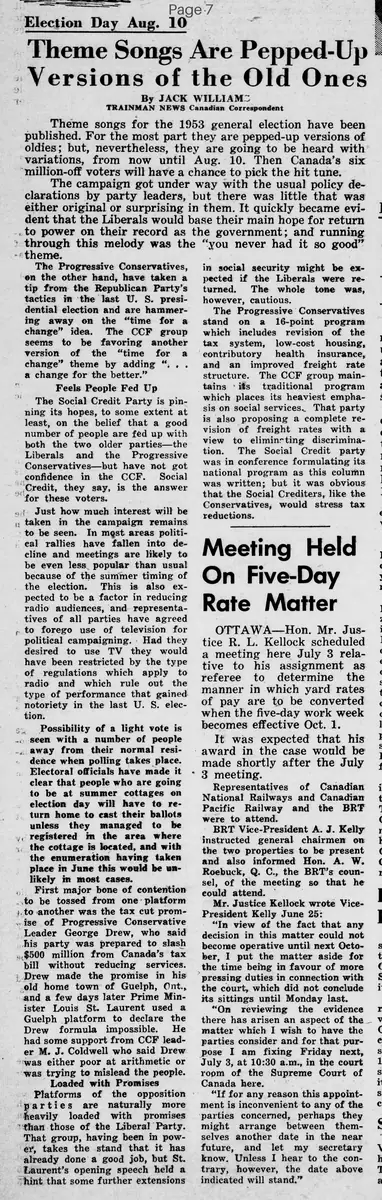
Theme Songs Are Pepped-Up Versions of the Old Ones
By JACK WILLIAMS
TRAINMAN NEWS Canadian Correspondent
Theme songs for the 1953 general election have been published. For the most part they are pepped-up versions of oldies; but, nevertheless, they are going to be heard with variations, from now until Aug. 10. Then Canada's six million voters will have a chance to pick the hit tune.
The campaign got under way with the usual policy declarations by party leaders, but there was little that was either original or surprising in them. It quickly became evident that the Liberals would base their main hope for return to power on their record as the government; and running through this melody was the "you never had it so good" theme.
The Progressive Conservatives, on the other hand, have taken a tip from the Republican Party's tactics in the last U. S. presidential election and are hammering away on the "time for a change" idea. The CCF group seems to be favoring another version of the "time for a change" theme by adding ". . . a change for the better."
Feels People Fed Up
The Social Credit Party is pinning its hopes, to some extent at least, on the belief that a good number of people are fed up with both the two older parties--the Liberals and the Progressive Conservatives--but have not got confidence in the CCF. Social Credit, they say, is the answer for these voters.
Just how much interest will be taken in the campaign remains to be seen. In most areas political rallies have fallen into decline and meetings are likely to be even less popular than usual because of the summer timing of the election. This is also expected to be a factor in reducing radio audiences, and representatives of all parties have agreed to forego use of television for political campaigning. Had they desired to use TV they would have been restricted by the type of regulations which apply to radio and which rule out the type of performance that gained notoriety in the last U. S. election.
Possibility of a light vote is seen with a number of people away from their normal residence when polling takes place. Electoral officials have made it clear that people who are going to be at summer cottages on election day will have to return home to cast their ballots unless they managed to be registered in the area where the cottage is located, and with the enumeration having taken place in June this would be unlikely in most cases.
First major bone of contention to be tossed from one platform to another was the tax cut promise of Progressive Conservative Leader George Drew, who said his party was prepared to slash $500 million from Canada's tax bill without reducing services.
Drew made the promise in his old home town of Guelph, Ont., and a few days later Prime Minister Louis St. Laurent used a Guelph platform to declare the Drew formula impossible. He had some support from CCF leader M. J. Coldwell who said Drew was either poor at arithmetic or was trying to mislead the people.
Loaded with Promises
Platforms of the opposition parties are naturally more heavily loaded with promises than those of the Liberal Party. That group, having been in power, takes the stand that it has already done a good job, but St. Laurent's opening speech held a hint that some further extensions in social security might be expected if the Liberals were returned.
The whole tone was, however, cautious.
The Progressive Conservatives stand on a 16-point program which includes revision of the tax system, low-cost housing, contributory health insurance, and an improved freight rate structure.
The CCF group maintains its traditional program which places its heaviest emphasis on social services. That party is also proposing a complete revision of freight rates with a view to eliminating discrimination.
The Social Credit party was in conference formulating its national program as this column was written; but it was obvious that the Social Crediters, like the Conservatives, would stress tax reductions.
What sub-type of article is it?
What keywords are associated?
What entities or persons were involved?
Where did it happen?
Foreign News Details
Primary Location
Canada
Event Date
Aug. 10
Key Persons
Outcome
progressive conservatives promise $500 million tax cut; liberals defend record; ccf emphasizes social services; social credit stresses tax reductions; low voter turnout expected due to summer timing.
Event Details
The 1953 Canadian general election campaign involves Liberals relying on their governance record with a 'you never had it so good' theme, Progressive Conservatives pushing 'time for a change' including tax cuts and a 16-point program, CCF advocating change for the better via social services and freight rate revisions, and Social Credit targeting voters disillusioned with major parties. Campaign features pepped-up theme songs, policy declarations, and debates over promises, with reduced interest due to summer scheduling and no TV use.