Thank you for visiting SNEWPapers!
Sign up free
Editorial
February 3, 1947
The Wilmington Morning Star
Wilmington, New Hanover County, North Carolina
What is this article about?
Editorial criticizes union abuses like forced membership and political levies, using C.B. DeMille's expulsion by AFRA for refusing a 1944 anti-proposition assessment as example. Urges Congress to eliminate these via labor legislation to prevent dictatorship.
Clipping
OCR Quality
95%
Excellent
Full Text
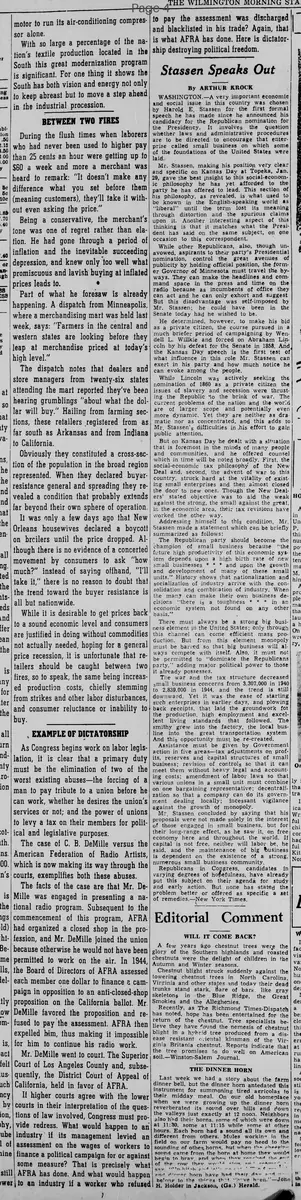
EXAMPLE OF DICTATORSHIP
As Congress begins work on labor legislation, it is clear that a primary duty must be the elimination of two of the worst existing abuses-the forcing of a man to pay tribute to a union before he can work, whether he desires the union's services or not; and the power of unions to levy a tax on their members for political and legislative purposes.
The case of C. B. DeMille versus the American Federation of Radio Artists which is now making its way through the courts, exemplifies both these abuses. The facts of the case are that Mr. DeMille was engaged in presenting a national radio program. Subsequent to the commencement of this program, AFRA had organized a closed shop in the profession, and Mr. DeMille joined the union because otherwise he would not have been permitted to work on the air. In 1944 the Board of Directors of AFRA assessed each member one dollar to finance a campaign in opposition to an anti-closed-shop proposition on the California ballot. Mr DeMille favored the proposition and refused to pay the assessment. AFRA then expelled him, thus making it impossible for him to continue his radio work.
Mr. DeMille went to court. The Superior Court of Los Angeles County and, subsequently, the District Court of Appeal of California, held in favor of AFRA. If higher courts agree with the lower courts in their interpretation of the questions of law involved, Congress must provide redress. What would happen to an industry if its management levied an assessment on the wages of workers to finance a political campaign for or against some measure? That is precisely what AFRA has done. And what would happen to an industry if a worker who refused to pay the assessment was discharged and blacklisted in his trade? Again, that is what AFRA has done. Here is dictatorship destroying political freedom.
As Congress begins work on labor legislation, it is clear that a primary duty must be the elimination of two of the worst existing abuses-the forcing of a man to pay tribute to a union before he can work, whether he desires the union's services or not; and the power of unions to levy a tax on their members for political and legislative purposes.
The case of C. B. DeMille versus the American Federation of Radio Artists which is now making its way through the courts, exemplifies both these abuses. The facts of the case are that Mr. DeMille was engaged in presenting a national radio program. Subsequent to the commencement of this program, AFRA had organized a closed shop in the profession, and Mr. DeMille joined the union because otherwise he would not have been permitted to work on the air. In 1944 the Board of Directors of AFRA assessed each member one dollar to finance a campaign in opposition to an anti-closed-shop proposition on the California ballot. Mr DeMille favored the proposition and refused to pay the assessment. AFRA then expelled him, thus making it impossible for him to continue his radio work.
Mr. DeMille went to court. The Superior Court of Los Angeles County and, subsequently, the District Court of Appeal of California, held in favor of AFRA. If higher courts agree with the lower courts in their interpretation of the questions of law involved, Congress must provide redress. What would happen to an industry if its management levied an assessment on the wages of workers to finance a political campaign for or against some measure? That is precisely what AFRA has done. And what would happen to an industry if a worker who refused to pay the assessment was discharged and blacklisted in his trade? Again, that is what AFRA has done. Here is dictatorship destroying political freedom.
What sub-type of article is it?
Labor
Partisan Politics
What keywords are associated?
Union Closed Shop
Political Assessments
Demille Case
Labor Legislation
Afra Expulsion
Radio Artists
What entities or persons were involved?
C. B. Demille
American Federation Of Radio Artists
Afra
Congress
Editorial Details
Primary Topic
Union Abuses In Closed Shops And Political Assessments Exemplified By Demille Case
Stance / Tone
Strongly Anti Union Dictatorship Destroying Political Freedom
Key Figures
C. B. Demille
American Federation Of Radio Artists
Afra
Congress
Key Arguments
Eliminate Forcing Workers To Pay Union Tribute To Work
Eliminate Unions' Power To Levy Political Taxes On Members
Demille Joined Afra Under Closed Shop But Refused 1944 Assessment Against Anti Closed Shop Proposition
Afra Expelled Demille, Preventing His Radio Work
Courts Favored Afra, But Congress Must Provide Redress
Union Actions Mirror Tyrannical Management Practices
Such Practices Constitute Dictatorship Destroying Political Freedom