Thank you for visiting SNEWPapers!
Sign up free
Literary
March 18, 1929
The Daily Worker
Chicago, Cook County, Illinois
What is this article about?
This essay excerpt explains Karl Marx's materialist conception of history, emphasizing how economic conditions and class struggles drive societal development and conflicts. It quotes the Communist Manifesto on class antagonisms between bourgeoisie and proletariat, and discusses its application in modern Europe.
Clipping
OCR Quality
98%
Excellent
Full Text
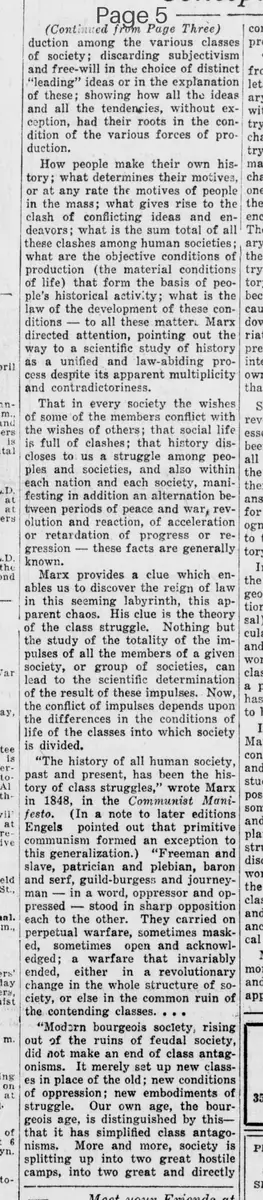
(Continued from Page Three)
duction among the various classes of society: discarding subjectivism and free-will in the choice of distinct "leading" ideas or in the explanation of these: showing how all the ideas and all the tendencies, without exception, had their roots in the condition of the various forces of production.
How people make their own history; what determines their motives, or at any rate the motives of people in the mass: what gives rise to the clash of conflicting ideas and endeavors; what is the sum total of all these clashes among human societies; what are the objective conditions of production (the material conditions of life) that form the basis of people's historical activity; what is the law of the development of these conditions -- to all these matters Marx directed attention, pointing out the way to a scientific study of history as a unified and law-abiding process despite its apparent multiplicity and contradictoriness.
That in every society the wishes of some of the members conflict with the wishes of others; that social life is full of clashes: that history discloses to us a struggle among peoples and societies, and also within each nation and each society, manifesting in addition an alternation between periods of peace and war, revolution and reaction, of acceleration or retardation of progress or regression -- these facts are generally known.
Marx provides a clue which enables us to discover the reign of law in this seeming labyrinth, this apparent chaos. His clue is the theory of the class struggle. Nothing but the study of the totality of the impulses of all the members of a given society, or group of societies, can lead to the scientific determination of the result of these impulses. Now, the conflict of impulses depends upon the differences in the conditions of life of the classes into which society is divided.
"The history of all human society past and present, has been the history of class struggles," wrote Marx in 1848, in the Communist Manifesto. (In a note to later editions Engels pointed out that primitive communism formed an exception to this generalization.) "Freeman and slave, patrician and plebian, lord and serf, guild-master and journeyman -- in a word, oppressor and oppressed -- stood in sharp opposition each to the other. They carried on perpetual warfare, sometimes masked, sometimes open and acknowledged; a warfare that invariably ended, either in a revolutionary change in the whole structure of society, or else in the common ruin of the contending classes. ...
"Modern bourgeois society, rising out of the ruins of feudal society, did not make an end of class antagonisms. It merely set up new classes in place of the old; new conditions of oppression; new embodiments of struggle. Our own epoch, the epoch of the bourgeoisie, is distinguished by this--that it has simplified class antagonisms. More and more, society is splitting up into two great hostile camps, into two great and directly contraposed classes: bourgeois and proletariat. ...
"Among all the classes that confront the bourgeoisie today, the proletariat alone is really revolutionary. Other classes decay and perish with the rise of large-scale industry, but the proletariat is the most characteristic product of that industry. The lower middle class--small manufacturers, small traders, handicraftsmen, peasant proprietors -- one and all fight the bourgeoisie in the hope of safeguarding their existence as sections of the middle class. They are, therefore, not revolutionary, but conservative. Nay more, they are reactionary, for they are trying to make the wheels of history turn backwards. If they ever become revolutionary, it is only because they are afraid of slipping down into the ranks of the proletariat: they are not defending their present interests, but their future interests; they are forsaking their own standpoint, in order to adopt that of the proletariat."
Since the time of the great French revolution, the class struggle as the essential motive force of history has been more than usually manifest in all the countries of Europe. During the Restoration period in France, there were already several historians (Thierry, Guizot, and Thiers, for instance) who could not but recognize in the class struggle the key to the understanding of all the history of France.
In the modern age -- the epoch of the complete victory of the bourgeoisie, of representative institutions, extended where not universal suffrage, cheap and widely circulated daily newspapers, powerful and ever-expanding organizations of workers and employers, etc. -- the class struggle, though sometimes in a peaceful and constitutional form, has shown itself still more obviously to be the mainspring of events.
In a number of historical works, Marx, on the basis of the materialist conception of history, gave brilliant and profound examples of historical studies containing an analysis of the position of each separate class, and sometimes of that of various groups and strata within a class, showing plainly why and how "every class struggle is a political struggle." He disclosed the structure of the network of social phenomena, showing the transitional stages between one class and another, between the past and the future, and drew up the balance sheet of the resulting historical evolution.
Marx's economic doctrines are a more profound, more many-sided and more detailed confirmation and application of the foregoing theory.
duction among the various classes of society: discarding subjectivism and free-will in the choice of distinct "leading" ideas or in the explanation of these: showing how all the ideas and all the tendencies, without exception, had their roots in the condition of the various forces of production.
How people make their own history; what determines their motives, or at any rate the motives of people in the mass: what gives rise to the clash of conflicting ideas and endeavors; what is the sum total of all these clashes among human societies; what are the objective conditions of production (the material conditions of life) that form the basis of people's historical activity; what is the law of the development of these conditions -- to all these matters Marx directed attention, pointing out the way to a scientific study of history as a unified and law-abiding process despite its apparent multiplicity and contradictoriness.
That in every society the wishes of some of the members conflict with the wishes of others; that social life is full of clashes: that history discloses to us a struggle among peoples and societies, and also within each nation and each society, manifesting in addition an alternation between periods of peace and war, revolution and reaction, of acceleration or retardation of progress or regression -- these facts are generally known.
Marx provides a clue which enables us to discover the reign of law in this seeming labyrinth, this apparent chaos. His clue is the theory of the class struggle. Nothing but the study of the totality of the impulses of all the members of a given society, or group of societies, can lead to the scientific determination of the result of these impulses. Now, the conflict of impulses depends upon the differences in the conditions of life of the classes into which society is divided.
"The history of all human society past and present, has been the history of class struggles," wrote Marx in 1848, in the Communist Manifesto. (In a note to later editions Engels pointed out that primitive communism formed an exception to this generalization.) "Freeman and slave, patrician and plebian, lord and serf, guild-master and journeyman -- in a word, oppressor and oppressed -- stood in sharp opposition each to the other. They carried on perpetual warfare, sometimes masked, sometimes open and acknowledged; a warfare that invariably ended, either in a revolutionary change in the whole structure of society, or else in the common ruin of the contending classes. ...
"Modern bourgeois society, rising out of the ruins of feudal society, did not make an end of class antagonisms. It merely set up new classes in place of the old; new conditions of oppression; new embodiments of struggle. Our own epoch, the epoch of the bourgeoisie, is distinguished by this--that it has simplified class antagonisms. More and more, society is splitting up into two great hostile camps, into two great and directly contraposed classes: bourgeois and proletariat. ...
"Among all the classes that confront the bourgeoisie today, the proletariat alone is really revolutionary. Other classes decay and perish with the rise of large-scale industry, but the proletariat is the most characteristic product of that industry. The lower middle class--small manufacturers, small traders, handicraftsmen, peasant proprietors -- one and all fight the bourgeoisie in the hope of safeguarding their existence as sections of the middle class. They are, therefore, not revolutionary, but conservative. Nay more, they are reactionary, for they are trying to make the wheels of history turn backwards. If they ever become revolutionary, it is only because they are afraid of slipping down into the ranks of the proletariat: they are not defending their present interests, but their future interests; they are forsaking their own standpoint, in order to adopt that of the proletariat."
Since the time of the great French revolution, the class struggle as the essential motive force of history has been more than usually manifest in all the countries of Europe. During the Restoration period in France, there were already several historians (Thierry, Guizot, and Thiers, for instance) who could not but recognize in the class struggle the key to the understanding of all the history of France.
In the modern age -- the epoch of the complete victory of the bourgeoisie, of representative institutions, extended where not universal suffrage, cheap and widely circulated daily newspapers, powerful and ever-expanding organizations of workers and employers, etc. -- the class struggle, though sometimes in a peaceful and constitutional form, has shown itself still more obviously to be the mainspring of events.
In a number of historical works, Marx, on the basis of the materialist conception of history, gave brilliant and profound examples of historical studies containing an analysis of the position of each separate class, and sometimes of that of various groups and strata within a class, showing plainly why and how "every class struggle is a political struggle." He disclosed the structure of the network of social phenomena, showing the transitional stages between one class and another, between the past and the future, and drew up the balance sheet of the resulting historical evolution.
Marx's economic doctrines are a more profound, more many-sided and more detailed confirmation and application of the foregoing theory.
What sub-type of article is it?
Essay
What themes does it cover?
Political
What keywords are associated?
Class Struggle
Historical Materialism
Marx
Bourgeoisie
Proletariat
Communist Manifesto
Revolution
Literary Details
Subject
Explanation Of Marx's Materialist Conception Of History And Class Struggle
Key Lines
"The History Of All Human Society Past And Present, Has Been The History Of Class Struggles," Wrote Marx In 1848, In The Communist Manifesto.
"Freeman And Slave, Patrician And Plebian, Lord And Serf, Guild Master And Journeyman In A Word, Oppressor And Oppressed Stood In Sharp Opposition Each To The Other."
"Modern Bourgeois Society, Rising Out Of The Ruins Of Feudal Society, Did Not Make An End Of Class Antagonisms."
"Among All The Classes That Confront The Bourgeoisie Today, The Proletariat Alone Is Really Revolutionary."
Every Class Struggle Is A Political Struggle.