Thank you for visiting SNEWPapers!
Sign up free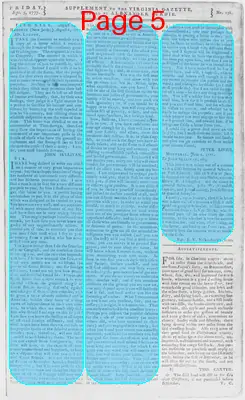
Domestic News
September 5, 1777
The Virginia Gazette
Williamsburg, Virginia
What is this article about?
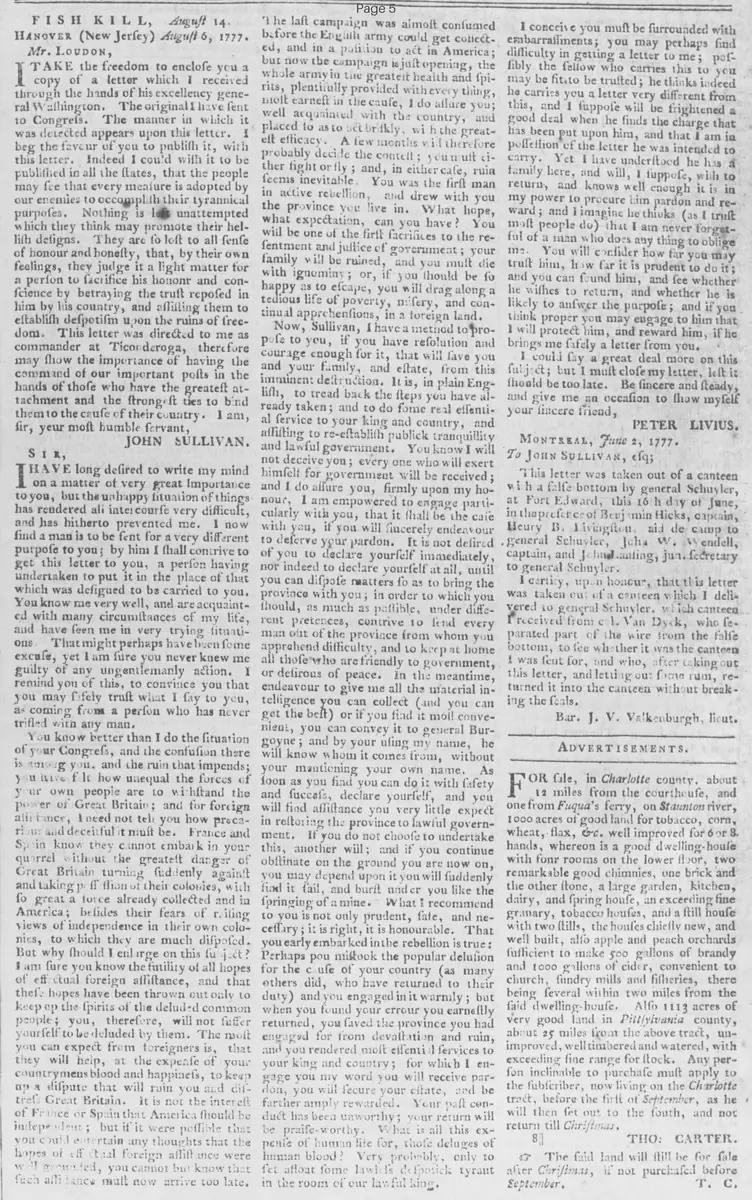
General John Sullivan publishes an intercepted British letter from Peter Livius urging him to defect and betray the American cause during the Revolutionary War, discovered in a false-bottomed canteen at Fort Edward.
Clipping
OCR Quality
98%
Excellent
Full Text
FISHKILL, August 14.
Hanover (New Jersey) August 6, 1777.
Mr. Loudon,
I take the freedom to enclose you a copy of a letter which I received through the hands of his excellency general Washington. The original I have sent to Congress. The manner in which it was detected appears upon this letter. I beg the favour of you to publish it, with this letter. Indeed I could wish it to be published in all the states, that the people may see that every measure is adopted by our enemies to accomplish their tyrannical purposes. Nothing is left unattempted which they think may promote their hellish designs. They are so lost to all sense of honour and honesty, that, by their own feelings, they judge it a light matter for a person to sacrifice his honour and conscience by betraying the trust reposed in him by his country, and assisting them to establish despotism upon the ruins of freedom. This letter was directed to me as commander at Ticonderoga, therefore may show the importance of having the command of our important posts in the hands of those who have the greatest attachment and the strong ties to bind them to the cause of their country. I am, sir, your most humble servant,
JOHN SULLIVAN.
SIR,
I have long desired to write my mind on a matter of very great importance to you, but the unhappy situation of things has rendered all intercourse very difficult, and has hitherto prevented me. I now find a man is sent for a very different purpose to you: by him I shall contrive to get this letter to you, a person having undertaken to put it in the place of that which was designed to be carried to you. You know me very well, and are acquainted with many circumstances of my life, and have seen me in very trying situations that might perhaps have been some excuse, yet I am sure you never knew me guilty of any ungentlemanly action. I remind you of this, to convince you that you may safely trust what I say to you, as coming from a person who has never trifled with any man. You know better than I do the situation of your Congress, and the confusion there is among you, and the ruin that impends; you have felt how unequal the forces of your own people are to withstand the power of Great Britain; and for foreign assistance, I need not tell you how precarious and deceitful it must be. France and Spain know they cannot embark in your quarrel without the greatest danger of Great Britain turning suddenly against and taking possession of their colonies, with so great a force already collected and in America: besides their fears of rising views of independence in their own colonies, to which they are much disposed. But why should I enlarge on this subject? I am sure you know the futility of all hopes of effectual foreign assistance, and that these hopes have been thrown out only to keep up the spirits of the deluded common people; you, therefore, will not suffer yourself to be deluded by them. The utmost you can expect from foreigners is, that they will help, at the expense of your countrymen's blood and happiness, to keep up a dispute that will ruin you and distress Great Britain. It is not the interest of France or Spain that America should be independent: but if it were possible that you could entertain any thoughts that the hopes of effectual foreign assistance were well grounded, you cannot but know that such alliances must now arrive too late.
The last campaign was almost consumed before the English army could get collected, and in a position to act in America; but now the campaign is just opening, the whole army in the greatest health and spirits, plentifully provided with every thing, most earnest in the cause, I do assure you; well acquainted with the country, and placed so as to act briskly, with the greatest efficacy. A few months will therefore probably decide the contest: you must either fight or fly; and, in either case, ruin seems inevitable. You was the first man in active rebellion, and drew with you the province you live in. What hope, what expectation, can you have? You will be one of the first sacrifices to the resentment and justice of government; your family will be ruined, and you must die with ignominy; or, if you should be so happy as to escape, you will drag along a tedious life of poverty, misery, and continual apprehensions, in a foreign land. Now, Sullivan, I have a method to propose to you, if you have resolution and courage enough for it, that will save you and your family, and estate, from this imminent destruction. It is, in plain English, to tread back the steps you have already taken; and to do some real essential service to your king and country, and assisting to re-establish public tranquillity and lawful government. You know I will not deceive you; every one who will exert himself for government will be received; and I do assure you, firmly upon my honour, I am empowered to engage particularly with you, that it shall be the case with you, if you will sincerely endeavour to deserve your pardon. It is not desired of you to declare yourself immediately, nor indeed to declare yourself at all, until you can dispose matters so as to bring the province with you; in order to which you should, as much as possible, under different pretences, contrive to send every man out of the province from whom you apprehend difficulty, and to keep at home all those who are friendly to government, or desirous of peace. In the meantime, endeavour to give me all the material intelligence you can collect (and you can get the best) or if you find it most convenient, you can convey it to general Burgoyne; and by your using my name, he will know from whom it comes, without your mentioning your own name. As soon as you find you can do it with safety and success, declare yourself, and you will find assistance you very little expect in restoring the province to lawful government. If you do not choose to undertake this, another will; and if you continue obstinate on the ground you are now on, you may depend upon it you will suddenly find it fail, and burst under you like the springing of a mine. What I recommend to you is not only prudent, safe, and necessary; it is right, it is honourable. That you early embarked in the rebellion is true: perhaps you mistook the popular delusion for the cause of your country (as many others did, who have returned to their duty) and you engaged in it warmly; but when you found your error you earnestly returned, you saved the province you had engaged for from devastation and ruin, and you rendered most essential services to your king and country; for which I engage you my word you will receive pardon, you will secure your estate, and be farther amply rewarded. Your past conduct has been unworthy; your return will be praise-worthy. What is all this expense of human life for, these deluges of human blood? Very probably, only to set afloat some lawless despotic tyrant in the room of our lawful king.
I conceive you must be surrounded with embarrassments; you may perhaps find difficulty in getting a letter to me; possibly the fellow who carries this to you may be fit to be trusted; he thinks indeed he carries you a letter very different from this, and I suppose will be frightened a good deal when he finds the charge that has been put upon him, and that I am in possession of the letter he was intended to carry. Yet I have understood he has a family here, and will, I suppose, wish to return, and knows well enough it is in my power to procure him pardon and reward; and I imagine he thinks (as I trust most people do) that I am never forgetful of a man who does any thing to oblige me. You will consider how far you may trust him, how far it is prudent to do it; and you can sound him, and see whether he wishes to return, and whether he is likely to answer the purpose; and if you think proper you may engage to him that I will protect him, and reward him, if he brings me safely a letter from you. I could say a great deal more on this subject; but I must close my letter, lest it should be too late. Be sincere and steady, and give me an occasion to show myself your sincere friend,
PETER LIVIUS.
MONTREAL, June 2, 1777.
To John Sullivan, esq;
This letter was taken out of a canteen with a false bottom by general Schuyler, at Fort Edward, this 16th day of June, in the presence of Benjamin Hicks, captain, Henry B. Livingston, aid de camp to general Schuyler, Isaac W. Wendell, captain, and Jelinda Staring, jun. secretary to general Schuyler. I certify, upon honour, that this letter was taken out of a canteen which I delivered to general Schuyler, which canteen I received from Cl. Van Dyck, who separated part of the wire from the false bottom, to see whether it was the canteen I was sent for, and who, after taking out this letter, and letting out some rum, returned it into the canteen without breaking the seals.
Bar. J. V. Varkenburgh, lieut.
Hanover (New Jersey) August 6, 1777.
Mr. Loudon,
I take the freedom to enclose you a copy of a letter which I received through the hands of his excellency general Washington. The original I have sent to Congress. The manner in which it was detected appears upon this letter. I beg the favour of you to publish it, with this letter. Indeed I could wish it to be published in all the states, that the people may see that every measure is adopted by our enemies to accomplish their tyrannical purposes. Nothing is left unattempted which they think may promote their hellish designs. They are so lost to all sense of honour and honesty, that, by their own feelings, they judge it a light matter for a person to sacrifice his honour and conscience by betraying the trust reposed in him by his country, and assisting them to establish despotism upon the ruins of freedom. This letter was directed to me as commander at Ticonderoga, therefore may show the importance of having the command of our important posts in the hands of those who have the greatest attachment and the strong ties to bind them to the cause of their country. I am, sir, your most humble servant,
JOHN SULLIVAN.
SIR,
I have long desired to write my mind on a matter of very great importance to you, but the unhappy situation of things has rendered all intercourse very difficult, and has hitherto prevented me. I now find a man is sent for a very different purpose to you: by him I shall contrive to get this letter to you, a person having undertaken to put it in the place of that which was designed to be carried to you. You know me very well, and are acquainted with many circumstances of my life, and have seen me in very trying situations that might perhaps have been some excuse, yet I am sure you never knew me guilty of any ungentlemanly action. I remind you of this, to convince you that you may safely trust what I say to you, as coming from a person who has never trifled with any man. You know better than I do the situation of your Congress, and the confusion there is among you, and the ruin that impends; you have felt how unequal the forces of your own people are to withstand the power of Great Britain; and for foreign assistance, I need not tell you how precarious and deceitful it must be. France and Spain know they cannot embark in your quarrel without the greatest danger of Great Britain turning suddenly against and taking possession of their colonies, with so great a force already collected and in America: besides their fears of rising views of independence in their own colonies, to which they are much disposed. But why should I enlarge on this subject? I am sure you know the futility of all hopes of effectual foreign assistance, and that these hopes have been thrown out only to keep up the spirits of the deluded common people; you, therefore, will not suffer yourself to be deluded by them. The utmost you can expect from foreigners is, that they will help, at the expense of your countrymen's blood and happiness, to keep up a dispute that will ruin you and distress Great Britain. It is not the interest of France or Spain that America should be independent: but if it were possible that you could entertain any thoughts that the hopes of effectual foreign assistance were well grounded, you cannot but know that such alliances must now arrive too late.
The last campaign was almost consumed before the English army could get collected, and in a position to act in America; but now the campaign is just opening, the whole army in the greatest health and spirits, plentifully provided with every thing, most earnest in the cause, I do assure you; well acquainted with the country, and placed so as to act briskly, with the greatest efficacy. A few months will therefore probably decide the contest: you must either fight or fly; and, in either case, ruin seems inevitable. You was the first man in active rebellion, and drew with you the province you live in. What hope, what expectation, can you have? You will be one of the first sacrifices to the resentment and justice of government; your family will be ruined, and you must die with ignominy; or, if you should be so happy as to escape, you will drag along a tedious life of poverty, misery, and continual apprehensions, in a foreign land. Now, Sullivan, I have a method to propose to you, if you have resolution and courage enough for it, that will save you and your family, and estate, from this imminent destruction. It is, in plain English, to tread back the steps you have already taken; and to do some real essential service to your king and country, and assisting to re-establish public tranquillity and lawful government. You know I will not deceive you; every one who will exert himself for government will be received; and I do assure you, firmly upon my honour, I am empowered to engage particularly with you, that it shall be the case with you, if you will sincerely endeavour to deserve your pardon. It is not desired of you to declare yourself immediately, nor indeed to declare yourself at all, until you can dispose matters so as to bring the province with you; in order to which you should, as much as possible, under different pretences, contrive to send every man out of the province from whom you apprehend difficulty, and to keep at home all those who are friendly to government, or desirous of peace. In the meantime, endeavour to give me all the material intelligence you can collect (and you can get the best) or if you find it most convenient, you can convey it to general Burgoyne; and by your using my name, he will know from whom it comes, without your mentioning your own name. As soon as you find you can do it with safety and success, declare yourself, and you will find assistance you very little expect in restoring the province to lawful government. If you do not choose to undertake this, another will; and if you continue obstinate on the ground you are now on, you may depend upon it you will suddenly find it fail, and burst under you like the springing of a mine. What I recommend to you is not only prudent, safe, and necessary; it is right, it is honourable. That you early embarked in the rebellion is true: perhaps you mistook the popular delusion for the cause of your country (as many others did, who have returned to their duty) and you engaged in it warmly; but when you found your error you earnestly returned, you saved the province you had engaged for from devastation and ruin, and you rendered most essential services to your king and country; for which I engage you my word you will receive pardon, you will secure your estate, and be farther amply rewarded. Your past conduct has been unworthy; your return will be praise-worthy. What is all this expense of human life for, these deluges of human blood? Very probably, only to set afloat some lawless despotic tyrant in the room of our lawful king.
I conceive you must be surrounded with embarrassments; you may perhaps find difficulty in getting a letter to me; possibly the fellow who carries this to you may be fit to be trusted; he thinks indeed he carries you a letter very different from this, and I suppose will be frightened a good deal when he finds the charge that has been put upon him, and that I am in possession of the letter he was intended to carry. Yet I have understood he has a family here, and will, I suppose, wish to return, and knows well enough it is in my power to procure him pardon and reward; and I imagine he thinks (as I trust most people do) that I am never forgetful of a man who does any thing to oblige me. You will consider how far you may trust him, how far it is prudent to do it; and you can sound him, and see whether he wishes to return, and whether he is likely to answer the purpose; and if you think proper you may engage to him that I will protect him, and reward him, if he brings me safely a letter from you. I could say a great deal more on this subject; but I must close my letter, lest it should be too late. Be sincere and steady, and give me an occasion to show myself your sincere friend,
PETER LIVIUS.
MONTREAL, June 2, 1777.
To John Sullivan, esq;
This letter was taken out of a canteen with a false bottom by general Schuyler, at Fort Edward, this 16th day of June, in the presence of Benjamin Hicks, captain, Henry B. Livingston, aid de camp to general Schuyler, Isaac W. Wendell, captain, and Jelinda Staring, jun. secretary to general Schuyler. I certify, upon honour, that this letter was taken out of a canteen which I delivered to general Schuyler, which canteen I received from Cl. Van Dyck, who separated part of the wire from the false bottom, to see whether it was the canteen I was sent for, and who, after taking out this letter, and letting out some rum, returned it into the canteen without breaking the seals.
Bar. J. V. Varkenburgh, lieut.
What sub-type of article is it?
Military
Politics
Crime
What keywords are associated?
Sullivan Defection
British Intrigue
Intercepted Letter
American Revolution
Treason Attempt
Fort Edward
Ticonderoga Commander
What entities or persons were involved?
John Sullivan
Peter Livius
General Washington
General Schuyler
General Burgoyne
Benjamin Hicks
Henry B. Livingston
Isaac W. Wendell
Jelinda Staring
Bar. J. V. Varkenburgh
Cl. Van Dyck
Where did it happen?
Fort Edward
Domestic News Details
Primary Location
Fort Edward
Event Date
June 16, 1777
Key Persons
John Sullivan
Peter Livius
General Washington
General Schuyler
General Burgoyne
Benjamin Hicks
Henry B. Livingston
Isaac W. Wendell
Jelinda Staring
Bar. J. V. Varkenburgh
Cl. Van Dyck
Outcome
letter intercepted and published to expose british attempts to induce defection; no casualties reported.
Event Details
A secret letter from Peter Livius in Montreal to John Sullivan, urging him to defect to the British and provide intelligence, was intercepted in a false-bottomed canteen at Fort Edward by General Schuyler. Sullivan forwards a copy for publication to warn against enemy tactics.