Thank you for visiting SNEWPapers!
Sign up free
The Mahnomen Pioneer
Mahnomen, Mahnomen County, Minnesota
What is this article about?
Article discusses the role of highway guard rails in preventing accidents in Mahnomen County, detailing construction stats since 1921, materials used, specifications, and broader safety efforts by the State Highway Department under C. M. Babcock.
Clipping
OCR Quality
Full Text
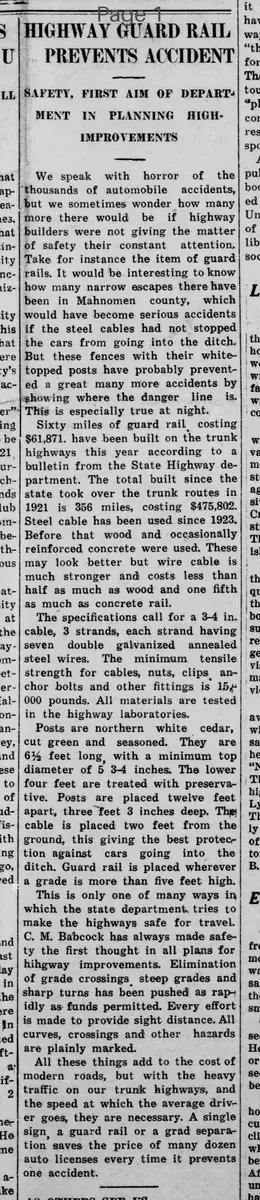
SAFETY, FIRST AIM OF DEPARTMENT IN PLANNING HIGHWAY IMPROVEMENTS
We speak with horror of the thousands of automobile accidents, but we sometimes wonder how many more there would be if highway builders were not giving the matter of safety their constant attention.
Take for instance the item of guard rails. It would be interesting to know how many narrow escapes there have been in Mahnomen county, which would have become serious accidents if the steel cables had not stopped the cars from going into the ditch. But these fences with their white-topped posts have probably prevented a great many more accidents by showing where the danger line is. This is especially true at night.
Sixty miles of guard rail costing $61,871. have been built on the trunk highways this year according to a bulletin from the State Highway department. The total built since the state took over the trunk routes in 1921 is 356 miles, costing $475,802.
Steel cable has been used since 1923. Before that wood and occasionally reinforced concrete were used. These may look better but wire cable is much stronger and costs less than half as much as wood and one fifth as much as concrete rail.
The specifications call for a 3/4 in. cable, 3 strands, each strand having seven double galvanized annealed steel wires. The minimum tensile strength for cables, nuts, clips anchor bolts and other fittings is 15,000 pounds. All materials are tested in the highway laboratories.
Posts are northern white cedar, cut green and seasoned. They are 6 1/2 feet long. with a minimum top diameter of 5 3/4 inches. The lower four feet are treated with preservative. Posts are placed twelve feet apart, three feet 3 inches deep. The cable is placed two feet from the ground, this giving the best protection against cars going into the ditch. Guard rail is placed wherever a grade is more than five feet high.
This is only one of many ways in which the state department tries to make the highways safe for travel. C. M. Babcock has always made safety the first thought in all plans for highway improvements. Elimination of grade crossings steep grades and sharp turns has been pushed as rapidly as funds permitted. Every effort is made to provide sight distance. All curves, crossings and other hazards are plainly marked.
All these things add to the cost of modern roads, but with the heavy traffic on our trunk highways. and the speed at which the average driver goes, they are necessary. A single sign a guard rail or a grade separation saves the price of many dozen auto licenses every time it prevents one accident.
What sub-type of article is it?
What themes does it cover?
What keywords are associated?
What entities or persons were involved?
Where did it happen?
Story Details
Key Persons
Location
Mahnomen County, Trunk Highways
Event Date
Since 1921, Steel Cable Since 1923
Story Details
Highway guard rails using steel cables prevent cars from ditches and mark dangers, especially at night. 60 miles built this year costing $61,871; total 356 miles since 1921 for $475,802. Specifications include 3/4 in. cable with 15,000 lbs strength, cedar posts. Broader safety includes eliminating hazards and marking roads under C. M. Babcock.