Thank you for visiting SNEWPapers!
Sign up free
Editorial
April 17, 1859
Daily National Democrat
Marysville, Yuba County, California
What is this article about?
The editorial argues that many former Democrats in the Republican Party will return to Democratic support for Popular Sovereignty in territories, following the Supreme Court's decision affirming Congress's lack of power to prohibit slavery there. It cites Silas Wright's support for the Wilmot Proviso as evidence of past shifts.
Clipping
OCR Quality
98%
Excellent
Full Text
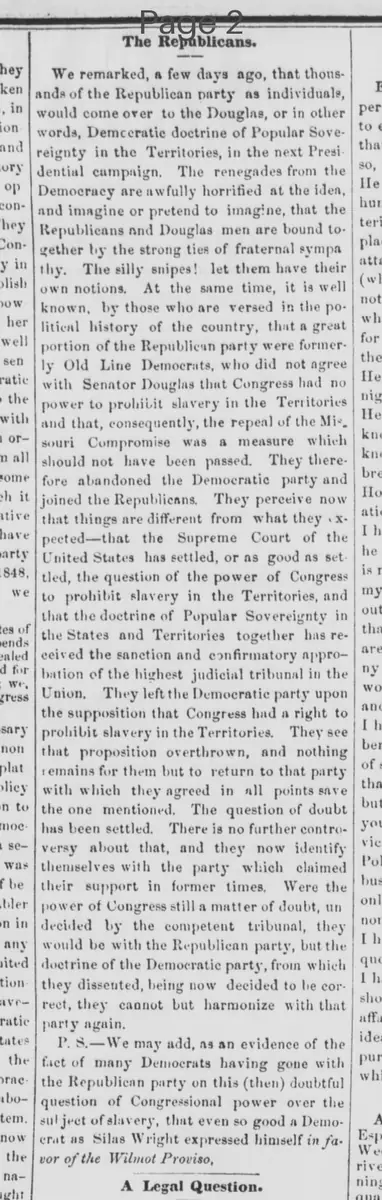
The Republicans,
We remarked, a few days ago, that thousands
of the Republican party as individuals
would come over to the Douglas, or in other
words, Democratic doctrine of Popular Sovereignty
in the Territories, in the next Presidential
campaign. The renegades from the
Democracy are awfully horrified at the idea,
and imagine or pretend to imagine, that the
Republicans and Douglas men are bound together
by the strong ties of fraternal sympathy.
The silly snipes! let them have their
own notions. At the same time, it is well
known, by those who are versed in the political
history of the country, that a great
portion of the Republican party were formerly
Old Line Democrats, who did not agree
with Senator Douglas that Congress had no
power to prohibit slavery in the Territories
and that, consequently, the repeal of the Missouri
Compromise was a measure which
should not have been passed. They therefore
abandoned the Democratic party and
joined the Republicans. They perceive now
that things are different from what they expected—
that the Supreme Court of the
United States has settled, or as good as settled,
the question of the power of Congress
to prohibit slavery in the Territories, and
that the doctrine of Popular Sovereignty in
the States and Territories together has received
the sanction and confirmatory approbation
of the highest judicial tribunal in the
Union. They left the Democratic party upon
the supposition that Congress had a right to
prohibit slavery in the Territories. They see
that proposition overthrown, and nothing
remains for them but to return to that party
with which they agreed in all points save
the one mentioned. The question of doubt
has been settled. There is no further controversy
about that, and they now identify
themselves with the party which claimed
their support in former times. Were the
power of Congress still a matter of doubt, undecided
by the competent tribunal, they
would be with the Republican party, but the
doctrine of the Democratic party, from which
they dissented, being now decided to be correct,
they cannot but harmonize with that
party again.
P. S.—We may add, as an evidence of the
fact of many Democrats having gone with
the Republican party on this (then) doubtful
question of Congressional power over the
subject of slavery, that even so good a Democrat
as Silas Wright expressed himself in favor
of the Wilmot Proviso.
We remarked, a few days ago, that thousands
of the Republican party as individuals
would come over to the Douglas, or in other
words, Democratic doctrine of Popular Sovereignty
in the Territories, in the next Presidential
campaign. The renegades from the
Democracy are awfully horrified at the idea,
and imagine or pretend to imagine, that the
Republicans and Douglas men are bound together
by the strong ties of fraternal sympathy.
The silly snipes! let them have their
own notions. At the same time, it is well
known, by those who are versed in the political
history of the country, that a great
portion of the Republican party were formerly
Old Line Democrats, who did not agree
with Senator Douglas that Congress had no
power to prohibit slavery in the Territories
and that, consequently, the repeal of the Missouri
Compromise was a measure which
should not have been passed. They therefore
abandoned the Democratic party and
joined the Republicans. They perceive now
that things are different from what they expected—
that the Supreme Court of the
United States has settled, or as good as settled,
the question of the power of Congress
to prohibit slavery in the Territories, and
that the doctrine of Popular Sovereignty in
the States and Territories together has received
the sanction and confirmatory approbation
of the highest judicial tribunal in the
Union. They left the Democratic party upon
the supposition that Congress had a right to
prohibit slavery in the Territories. They see
that proposition overthrown, and nothing
remains for them but to return to that party
with which they agreed in all points save
the one mentioned. The question of doubt
has been settled. There is no further controversy
about that, and they now identify
themselves with the party which claimed
their support in former times. Were the
power of Congress still a matter of doubt, undecided
by the competent tribunal, they
would be with the Republican party, but the
doctrine of the Democratic party, from which
they dissented, being now decided to be correct,
they cannot but harmonize with that
party again.
P. S.—We may add, as an evidence of the
fact of many Democrats having gone with
the Republican party on this (then) doubtful
question of Congressional power over the
subject of slavery, that even so good a Democrat
as Silas Wright expressed himself in favor
of the Wilmot Proviso.
What sub-type of article is it?
Partisan Politics
Slavery Abolition
Constitutional
What keywords are associated?
Popular Sovereignty
Republican Democrats
Supreme Court Slavery
Missouri Compromise Repeal
Congressional Power Territories
Wilmot Proviso
Political Realignment
What entities or persons were involved?
Republicans
Democrats
Senator Douglas
Supreme Court Of The United States
Silas Wright
Editorial Details
Primary Topic
Republican Shift To Democratic Popular Sovereignty Doctrine
Stance / Tone
Supportive Of Democratic Position And Mocking Of Republican Dissenters
Key Figures
Republicans
Democrats
Senator Douglas
Supreme Court Of The United States
Silas Wright
Key Arguments
Thousands Of Republicans Will Adopt Democratic Popular Sovereignty In Territories During Next Presidential Campaign
Many Republicans Were Former Old Line Democrats Who Left Over Disagreement On Congress's Power To Prohibit Slavery
Supreme Court Has Settled That Congress Lacks Power To Prohibit Slavery In Territories
Former Democrats Should Return To Democratic Party Now That Their Dissenting View Is Overthrown
Silas Wright, A Good Democrat, Supported Wilmot Proviso On The Doubtful Question