Thank you for visiting SNEWPapers!
Sign up free
Story
September 14, 1829
Phenix Gazette
Alexandria, Virginia
What is this article about?
Satirical essay on national prejudices, exemplified by boasts from Americans, French, Spaniards, Italians, and English. Includes excerpt from Madden's Travels in Turkey depicting Egyptians' naive, prejudiced discussion of the Battle of Navarino and European powers.
Merged-components note: Continuation of the story 'NATIONAL PREJUDICES', split across adjacent columns on the same page.
Clipping
OCR Quality
95%
Excellent
Full Text
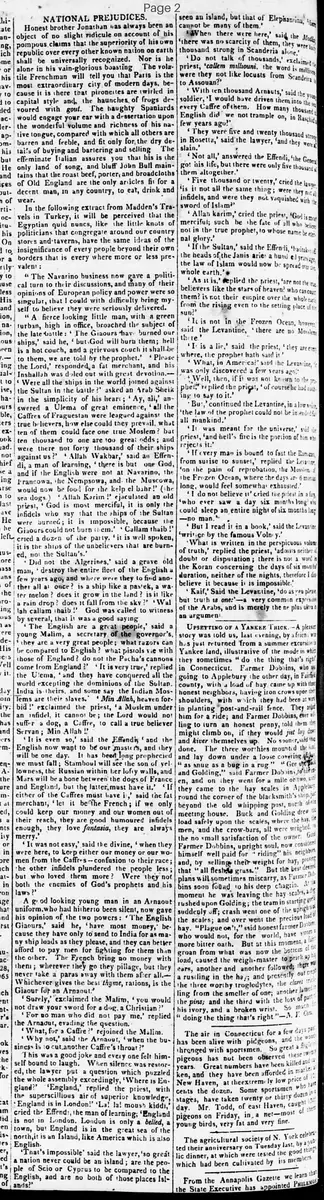
NATIONAL PREJUDICES.
Honest brother Jonathan has always been an object of no slight ridicule on account of his pompous claims that the superiority of his own republic over every other known nation on earth shall be universally recognized. Nor is he alone in his vain-glorious boasting. The volatile Frenchman will tell you that Paris is the most extraordinary city of modern days, because it is there that pirouettes are twirled in capital style and the haunches of frogs devoured with gout. The haughty Spaniards would engage your ear with a dissertation upon the wonderful volume and richness of his native tongue, compared with which all others are barren and feeble, and fit only for the dry details of buying and bartering and selling. The effeminate Italian assures you that his is the only land of song, and bluff John Bull maintains that the roast beef, porter, and broadcloths of Old England are the only articles fit for a decent man, in any country, to eat, drink and wear.
In the following extract from Madden's Travels in Turkey, it will be perceived that the Egyptian quid nuncs, like the little knots of politicians that congregate around our country stores and taverns, have the same ideas of the insignificance of every people beyond their own borders that is every where more or less prevalent:
"The Navarino business now gave a political turn to their discussions, and many of their opinions of European policy and power were so singular, that I could with difficulty bring myself to believe they were seriously delivered.
"A fierce looking little man, with a green turban, high in office, broached the subject of the late battle: 'The Giaours have burned our ships,' said he, 'but God will burn them: hell is a hot couch, and a grievous couch it shall be to them, we are told by the prophet.' 'Please the Lord,' responded a fat merchant, and his Inshallah was doled out with great devotion.—Were all the ships in the world joined against the Sultan in the battle?' asked an Arab Sheik in the simplicity of his heart; 'Ay, all,' answered a Ulema of great eminence, 'all the Caffres of Fraguestan were leagued against the true believers, how else could they prevail. what ten of them could face one true Moslem? but ten thousand to one are too great odds; and were there not forty thousand of their ships against us?' 'Allah Akbar,' said an Effendi, a man of learning, 'there is but one God, and if the English were not at Navarino, the Francowa, the Nempsowa, and the Muscowa, would now be food for the kelp el bahr!' (the sea dogs.) 'Allah Karim!' ejaculated an old priest, 'God is most merciful, it is only the infidels who say that the ships of the Sultan were burned; it is impossible, because the Giaours could not burn them.' Callam thaib! cried a dozen of the party. 'it is well spoken, it is the ships of the unbelievers that are burned, not the Sultan's.
'Did not the Algerines,' said a grave old man, 'destroy the entire fleet of the English a few years ago, and where were they to find another all at once? is a ship like a pastek, a water melon? does it grow in the land? is it like a rain drop? does it fall from the sky?' 'Wallah caliam thaib!' God was called to witness by several, that it was a good saying.
The English are a great people,' said a young Malim, a secretary of the governor's, 'they are a very great people; what razors can be compared to English? what pistols vie with those of England? do not the Pacha's cannons come from England?' 'It is very true,' replied the Ulema. 'and they have conquered all the world excepting the dominions of the Sultan. India is theirs, and some say the Indian Moslems are their slaves.' 'Min Allah, heaven forbid!' exclaimed the priest, 'a Moslem under an infidel, it cannot be; the Lord would not suffer a dog, a Caffre, to call a true believer Servant: Min Allah!'
'It is even so,' said the Effendi, 'and the English now want to be our masters, and they will be one day. It has been long prophesied we must fall; Stamboul will see the son of yellowness, the Russian within her lofty walls, and Mars will be a bone between the dogs of France and England, but the latter must have it.' 'If either of the Caffres must have it,' said the fat merchant, 'let it be the French; if we only could keep our money and our women out of their reach, they are good humoured infidels enough, they love fantasia, they are always merry.
'It was not easy,' said the divine, 'when they were here, to keep either our money or our women from the Caffres—confusion to their race; the other infidels plundered the people less; but who loved them more? Were they not both the enemies of God's prophets and his laws?'
A good looking young man in an Arnaout uniform, who had hitherto been silent, now gave his opinion of the two powers: 'The English Giaours,' said he, 'have most money, because they have only to send to India for as many ship loads as they please, and they can better afford to pay men for fighting for them than the other. The French bring no money with them; wherever they go they pillage, but they never take a paras away with them after all.—Whichever gives the best thyme, rations, is the Giaour or an Arnaout.
'Surely,' exclaimed the Malim, 'you would not draw your sword for a dog, a Christian?' 'For no man who did not pay me,' replied the Arnaout, evading the question.
What, for a Caffre?' rejoined the Malim.
Why not,' said the Arnaout, 'when the business is to cut another Caffre's throat?'
This was a good joke and every one felt himself bound to laugh. When silence was restored, the lawyer put a question which puzzled the whole assembly exceedingly, 'Where is England?' 'England,' replied the priest, with the supercilious air of superior knowledge. 'England is in London!' 'La! la! moush kiddi, cried the Effendi, the man of learning; 'England is not in London. London is only a belled, a town, but England is in the great sea of the north, it is an Island, like America which is also English.
'That's impossible' said the lawyer, 'so great a nation never could be an island; are the people of Scio or Cyprus to be compared to the English, and are not both of those places Islands?'
I've seen an island, but that of Elephantrina, cannot be many of them.'
"When they were here' said the Mass—' there was no scarcity of them, they were ten thousand strong in Scanderia alone.'
'Do not talk of thousands,' exclaimed the priest, 'call them millions, the word is millions were they not like locusts from Scanderia to Assouan?'
With ten thousand Arnaouts,' said the young soldier, I would have driven them into the sea, every Caffre of them.
How many thousands English did we not trample on, in Raschid a few years ago?'
"They were five and twenty thousand strong in Rosetta,' said the lawyer, 'and they were slain.'
: Not all,' answered the Effendi, 'the General got his life, but there were only five thousand of them altogether.'
Five thousand or twenty,' cried the lawyer 'is it not all the same thing; were they not all infidels, and were they not vanquished with the sword of Islam?'
Allah karim,' cried the priest, 'God is merciful; such be the fate of all who believe not in the true prophet, to whose name be eternal glory.'
"If the Sultan,' said the Effendi, 'had taken the heads of the Janissaries a hundred years ago the law of Islam would now be spread over the whole earth.'
'As it is,' replied the priest, 'are not the true believers like the stars of heaven? who can count them? is not their empire over the whole earth from the rising even to the setting place of the sun?'
It is not in the Frozen Ocean, however said the Levantine, there are no Musselmen there.
It is a lie.' said the priest, 'they are everywhere, the prophet hath said it'
What, in America?' said the Levantine, 'was only discovered a few years ago!'
'A Well, then, if it was not known to the prophet,' replied the priest, 'of course he had nothing to say to it.'
But,' continued the Levantine, in a low voice 'the law of the prophet could not be intended for all mankind.
'It was meant for the universe,' said the priest, 'and hell's fire is the portion of him who rejects it:'
If every man is bound to fast the Ramazan from sunrise to sunset,' replied the Levantine 'on the pain of reprobation, the Musselman of the Frozen Ocean, where the days are 6 months long, would feel somewhat exhausted.'
'I do not believe it' cried the priest in a fury 'who ever saw a day six months long when he could sleep an entire night of six months long—no man.'
'But I read it in a book.' said the Levantine 'written by the famous Volney.
'What is written in the perspicuous volume of truth,' replied the priest, 'admits neither doubt nor disputation: there is not a word in the Koran concerning the days of six months duration, neither of the nights, therefore I disbelieve it because it is impossible.'
Kaif,' said the Levantine, 'do as you please but truth is one:'—a very common expression of the Arabs, and is merely the ne plus ultra of an argument
Honest brother Jonathan has always been an object of no slight ridicule on account of his pompous claims that the superiority of his own republic over every other known nation on earth shall be universally recognized. Nor is he alone in his vain-glorious boasting. The volatile Frenchman will tell you that Paris is the most extraordinary city of modern days, because it is there that pirouettes are twirled in capital style and the haunches of frogs devoured with gout. The haughty Spaniards would engage your ear with a dissertation upon the wonderful volume and richness of his native tongue, compared with which all others are barren and feeble, and fit only for the dry details of buying and bartering and selling. The effeminate Italian assures you that his is the only land of song, and bluff John Bull maintains that the roast beef, porter, and broadcloths of Old England are the only articles fit for a decent man, in any country, to eat, drink and wear.
In the following extract from Madden's Travels in Turkey, it will be perceived that the Egyptian quid nuncs, like the little knots of politicians that congregate around our country stores and taverns, have the same ideas of the insignificance of every people beyond their own borders that is every where more or less prevalent:
"The Navarino business now gave a political turn to their discussions, and many of their opinions of European policy and power were so singular, that I could with difficulty bring myself to believe they were seriously delivered.
"A fierce looking little man, with a green turban, high in office, broached the subject of the late battle: 'The Giaours have burned our ships,' said he, 'but God will burn them: hell is a hot couch, and a grievous couch it shall be to them, we are told by the prophet.' 'Please the Lord,' responded a fat merchant, and his Inshallah was doled out with great devotion.—Were all the ships in the world joined against the Sultan in the battle?' asked an Arab Sheik in the simplicity of his heart; 'Ay, all,' answered a Ulema of great eminence, 'all the Caffres of Fraguestan were leagued against the true believers, how else could they prevail. what ten of them could face one true Moslem? but ten thousand to one are too great odds; and were there not forty thousand of their ships against us?' 'Allah Akbar,' said an Effendi, a man of learning, 'there is but one God, and if the English were not at Navarino, the Francowa, the Nempsowa, and the Muscowa, would now be food for the kelp el bahr!' (the sea dogs.) 'Allah Karim!' ejaculated an old priest, 'God is most merciful, it is only the infidels who say that the ships of the Sultan were burned; it is impossible, because the Giaours could not burn them.' Callam thaib! cried a dozen of the party. 'it is well spoken, it is the ships of the unbelievers that are burned, not the Sultan's.
'Did not the Algerines,' said a grave old man, 'destroy the entire fleet of the English a few years ago, and where were they to find another all at once? is a ship like a pastek, a water melon? does it grow in the land? is it like a rain drop? does it fall from the sky?' 'Wallah caliam thaib!' God was called to witness by several, that it was a good saying.
The English are a great people,' said a young Malim, a secretary of the governor's, 'they are a very great people; what razors can be compared to English? what pistols vie with those of England? do not the Pacha's cannons come from England?' 'It is very true,' replied the Ulema. 'and they have conquered all the world excepting the dominions of the Sultan. India is theirs, and some say the Indian Moslems are their slaves.' 'Min Allah, heaven forbid!' exclaimed the priest, 'a Moslem under an infidel, it cannot be; the Lord would not suffer a dog, a Caffre, to call a true believer Servant: Min Allah!'
'It is even so,' said the Effendi, 'and the English now want to be our masters, and they will be one day. It has been long prophesied we must fall; Stamboul will see the son of yellowness, the Russian within her lofty walls, and Mars will be a bone between the dogs of France and England, but the latter must have it.' 'If either of the Caffres must have it,' said the fat merchant, 'let it be the French; if we only could keep our money and our women out of their reach, they are good humoured infidels enough, they love fantasia, they are always merry.
'It was not easy,' said the divine, 'when they were here, to keep either our money or our women from the Caffres—confusion to their race; the other infidels plundered the people less; but who loved them more? Were they not both the enemies of God's prophets and his laws?'
A good looking young man in an Arnaout uniform, who had hitherto been silent, now gave his opinion of the two powers: 'The English Giaours,' said he, 'have most money, because they have only to send to India for as many ship loads as they please, and they can better afford to pay men for fighting for them than the other. The French bring no money with them; wherever they go they pillage, but they never take a paras away with them after all.—Whichever gives the best thyme, rations, is the Giaour or an Arnaout.
'Surely,' exclaimed the Malim, 'you would not draw your sword for a dog, a Christian?' 'For no man who did not pay me,' replied the Arnaout, evading the question.
What, for a Caffre?' rejoined the Malim.
Why not,' said the Arnaout, 'when the business is to cut another Caffre's throat?'
This was a good joke and every one felt himself bound to laugh. When silence was restored, the lawyer put a question which puzzled the whole assembly exceedingly, 'Where is England?' 'England,' replied the priest, with the supercilious air of superior knowledge. 'England is in London!' 'La! la! moush kiddi, cried the Effendi, the man of learning; 'England is not in London. London is only a belled, a town, but England is in the great sea of the north, it is an Island, like America which is also English.
'That's impossible' said the lawyer, 'so great a nation never could be an island; are the people of Scio or Cyprus to be compared to the English, and are not both of those places Islands?'
I've seen an island, but that of Elephantrina, cannot be many of them.'
"When they were here' said the Mass—' there was no scarcity of them, they were ten thousand strong in Scanderia alone.'
'Do not talk of thousands,' exclaimed the priest, 'call them millions, the word is millions were they not like locusts from Scanderia to Assouan?'
With ten thousand Arnaouts,' said the young soldier, I would have driven them into the sea, every Caffre of them.
How many thousands English did we not trample on, in Raschid a few years ago?'
"They were five and twenty thousand strong in Rosetta,' said the lawyer, 'and they were slain.'
: Not all,' answered the Effendi, 'the General got his life, but there were only five thousand of them altogether.'
Five thousand or twenty,' cried the lawyer 'is it not all the same thing; were they not all infidels, and were they not vanquished with the sword of Islam?'
Allah karim,' cried the priest, 'God is merciful; such be the fate of all who believe not in the true prophet, to whose name be eternal glory.'
"If the Sultan,' said the Effendi, 'had taken the heads of the Janissaries a hundred years ago the law of Islam would now be spread over the whole earth.'
'As it is,' replied the priest, 'are not the true believers like the stars of heaven? who can count them? is not their empire over the whole earth from the rising even to the setting place of the sun?'
It is not in the Frozen Ocean, however said the Levantine, there are no Musselmen there.
It is a lie.' said the priest, 'they are everywhere, the prophet hath said it'
What, in America?' said the Levantine, 'was only discovered a few years ago!'
'A Well, then, if it was not known to the prophet,' replied the priest, 'of course he had nothing to say to it.'
But,' continued the Levantine, in a low voice 'the law of the prophet could not be intended for all mankind.
'It was meant for the universe,' said the priest, 'and hell's fire is the portion of him who rejects it:'
If every man is bound to fast the Ramazan from sunrise to sunset,' replied the Levantine 'on the pain of reprobation, the Musselman of the Frozen Ocean, where the days are 6 months long, would feel somewhat exhausted.'
'I do not believe it' cried the priest in a fury 'who ever saw a day six months long when he could sleep an entire night of six months long—no man.'
'But I read it in a book.' said the Levantine 'written by the famous Volney.
'What is written in the perspicuous volume of truth,' replied the priest, 'admits neither doubt nor disputation: there is not a word in the Koran concerning the days of six months duration, neither of the nights, therefore I disbelieve it because it is impossible.'
Kaif,' said the Levantine, 'do as you please but truth is one:'—a very common expression of the Arabs, and is merely the ne plus ultra of an argument
What sub-type of article is it?
Curiosity
Historical Event
What themes does it cover?
Social Manners
Moral Virtue
What keywords are associated?
National Prejudices
Cultural Bias
Battle Of Navarino
Egyptian Discussion
European Powers
Islamic Views
Where did it happen?
Egypt
Story Details
Location
Egypt
Story Details
Essay satirizes national prejudices with examples from various cultures, followed by an extract depicting Egyptians' ignorant and biased conversation about the Battle of Navarino, European powers, and Islamic superiority.