Thank you for visiting SNEWPapers!
Sign up free
Letter to Editor
February 25, 1841
Edgefield Advertiser
Edgefield, Edgefield County, South Carolina
What is this article about?
A young planter advises farmers to burn cotton stalks after harvest to destroy caterpillars hiding in them, preventing crop damage and potential ruin from failed yields during hard times. He shares his discovery from examining fields and urges immediate action post-rain.
Clipping
OCR Quality
95%
Excellent
Full Text
Communication.
BURN YOUR COTTON STALKS.
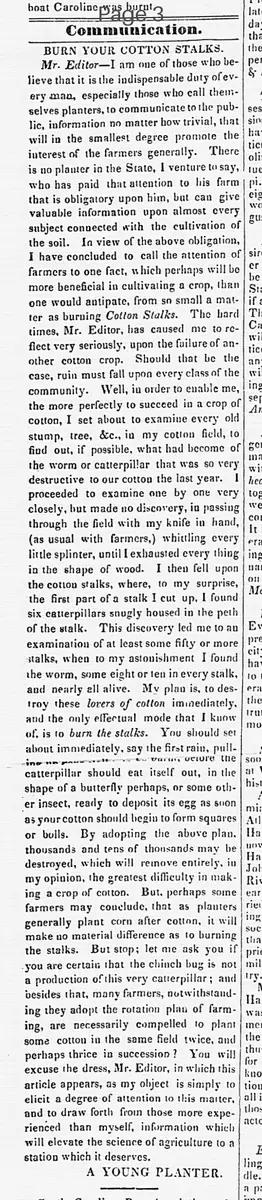
Mr. Editor—I am one of those who believe that it is the indispensable duty of every man, especially those who call themselves planters, to communicate to the public, information no matter how trivial, that will in the smallest degree promote the interest of the farmers generally. There is no planter in the State, I venture to say, who has paid that attention to his farm that is obligatory upon him, but can give valuable information upon almost every subject connected with the cultivation of the soil. In view of the above obligation, I have concluded to call the attention of farmers to one fact, which perhaps will be more beneficial in cultivating a crop, than one would anticipate, from so small a matter as burning Cotton Stalks. The hard times, Mr. Editor, has caused me to reflect very seriously, upon the failure of another cotton crop. Should that be the case, ruin must fall upon every class of the community. Well, in order to enable me, the more perfectly to succeed in a crop of cotton, I set about to examine every old stump, tree, &c., in my cotton field, to find out, if possible, what had become of the worm or caterpillar that was so very destructive to our cotton the last year. I proceeded to examine one by one very closely, but made no discovery, in passing through the field with my knife in hand, (as usual with farmers,) whittling every little splinter, until I exhausted every thing in the shape of wood. I then fell upon the cotton stalks, where, to my surprise, the first part of a stalk I cut up, I found six caterpillars snugly housed in the pith of the stalk. This discovery led me to an examination of at least some fifty or more stalks, when to my astonishment I found the worm, some eight or ten in every stalk, and nearly all alive. My plan is, to destroy these lovers of cotton immediately and the only effectual mode that I know of, is to burn the stalks. You should set about immediately, say the first rain, pull up, before the caterpillar should eat itself out, in the shape of a butterfly perhaps, or some other insect, ready to deposit its egg as soon as your cotton should begin to form squares or boils. By adopting the above plan, thousands and tens of thousands may be destroyed, which will remove entirely, in my opinion, the greatest difficulty in making a crop of cotton. But, perhaps some farmers may conclude, that as planters generally plant corn after cotton, it will make no material difference as to burning the stalks. But stop; let me ask you if you are certain that the chinch bug is not a production of this very caterpillar; and besides that, many farmers, notwithstanding they adopt the rotation plan of farming, are necessarily compelled to plant some cotton in the same field twice, and perhaps thrice in succession? You will excuse the dress, Mr. Editor, in which this article appears, as my object is simply to elicit a degree of attention to this matter, and to draw forth from those more experienced than myself, information which will elevate the science of agriculture to a station which it deserves.
A YOUNG PLANTER.
BURN YOUR COTTON STALKS.
Mr. Editor—I am one of those who believe that it is the indispensable duty of every man, especially those who call themselves planters, to communicate to the public, information no matter how trivial, that will in the smallest degree promote the interest of the farmers generally. There is no planter in the State, I venture to say, who has paid that attention to his farm that is obligatory upon him, but can give valuable information upon almost every subject connected with the cultivation of the soil. In view of the above obligation, I have concluded to call the attention of farmers to one fact, which perhaps will be more beneficial in cultivating a crop, than one would anticipate, from so small a matter as burning Cotton Stalks. The hard times, Mr. Editor, has caused me to reflect very seriously, upon the failure of another cotton crop. Should that be the case, ruin must fall upon every class of the community. Well, in order to enable me, the more perfectly to succeed in a crop of cotton, I set about to examine every old stump, tree, &c., in my cotton field, to find out, if possible, what had become of the worm or caterpillar that was so very destructive to our cotton the last year. I proceeded to examine one by one very closely, but made no discovery, in passing through the field with my knife in hand, (as usual with farmers,) whittling every little splinter, until I exhausted every thing in the shape of wood. I then fell upon the cotton stalks, where, to my surprise, the first part of a stalk I cut up, I found six caterpillars snugly housed in the pith of the stalk. This discovery led me to an examination of at least some fifty or more stalks, when to my astonishment I found the worm, some eight or ten in every stalk, and nearly all alive. My plan is, to destroy these lovers of cotton immediately and the only effectual mode that I know of, is to burn the stalks. You should set about immediately, say the first rain, pull up, before the caterpillar should eat itself out, in the shape of a butterfly perhaps, or some other insect, ready to deposit its egg as soon as your cotton should begin to form squares or boils. By adopting the above plan, thousands and tens of thousands may be destroyed, which will remove entirely, in my opinion, the greatest difficulty in making a crop of cotton. But, perhaps some farmers may conclude, that as planters generally plant corn after cotton, it will make no material difference as to burning the stalks. But stop; let me ask you if you are certain that the chinch bug is not a production of this very caterpillar; and besides that, many farmers, notwithstanding they adopt the rotation plan of farming, are necessarily compelled to plant some cotton in the same field twice, and perhaps thrice in succession? You will excuse the dress, Mr. Editor, in which this article appears, as my object is simply to elicit a degree of attention to this matter, and to draw forth from those more experienced than myself, information which will elevate the science of agriculture to a station which it deserves.
A YOUNG PLANTER.
What sub-type of article is it?
Informative
Persuasive
What themes does it cover?
Agriculture
What keywords are associated?
Cotton Stalks
Caterpillars
Burning
Agriculture
Pests
Cotton Crop
Planters
Chinch Bug
What entities or persons were involved?
A Young Planter
Mr. Editor
Letter to Editor Details
Author
A Young Planter
Recipient
Mr. Editor
Main Argument
farmers should burn cotton stalks immediately after the first rain to destroy caterpillars hiding in the pith, preventing damage to future cotton crops and possibly related pests like chinch bugs, especially amid hard times that could lead to community ruin if yields fail.
Notable Details
Discovery Of 6 10 Caterpillars Per Stalk In Pith After Examining Stumps And Trees
Urges Action Before Caterpillars Emerge As Insects To Lay Eggs On Forming Cotton Squares Or Boils
Questions If Chinch Bug Derives From This Caterpillar
Addresses Rotation Planting But Notes Repeated Cotton In Same Fields