Thank you for visiting SNEWPapers!
Sign up free
Story
August 31, 1956
St. Paul Recorder
Saint Paul, Ramsey County, Minnesota
What is this article about?
Historical anecdotes on Democratic civil rights claims during New Deal, including vote-bidding exclusions, FDR's 1935 purge orders, and a 1948 Washington segregation survey released only to Democrats, highlighting political hypocrisies.
Clipping
OCR Quality
98%
Excellent
Full Text
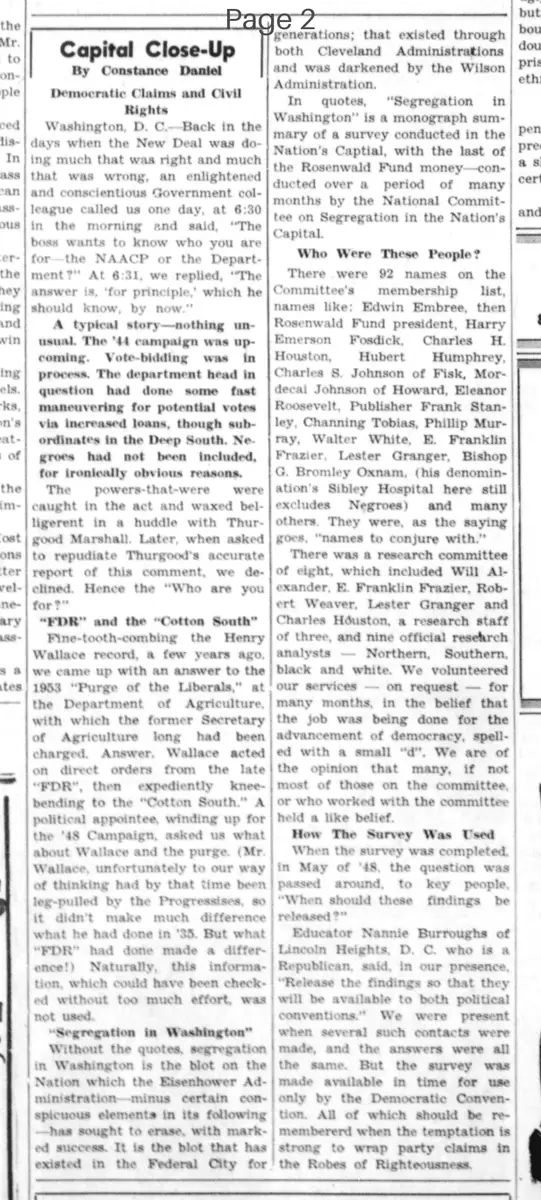
Capital Close-Up
By Constance Daniel
Democratic Claims and Civil Rights
Washington, D. C.—Back in the days when the New Deal was doing much that was right and much that was wrong, an enlightened and conscientious Government colleague called us one day, at 6:30 in the morning and said, "The boss wants to know who you are for—the NAACP or the Department?" At 6:31, we replied, "The answer is, 'for principle,' which he should know, by now."
A typical story—nothing unusual. The '44 campaign was up-coming. Vote-bidding was in process. The department head in question had done some fast maneuvering for potential votes via increased loans, though subordinates in the Deep South, Negroes had not been included, for ironically obvious reasons.
The powers-that-were were caught in the act and waxed belligerent in a huddle with Thurgood Marshall. Later, when asked to repudiate Thurgood's accurate report of this comment, we declined. Hence the "Who are you for?"
"FDR" and the "Cotton South"
Fine-tooth-combing the Henry Wallace record, a few years ago, we came up with an answer to the 1953 "Purge of the Liberals," at the Department of Agriculture, with which the former Secretary of Agriculture long had been charged. Answer: Wallace acted on direct orders from the late "FDR", then expediently knee-bending to the "Cotton South." A political appointee, winding up for the '44 Campaign, asked us what about Wallace and the purge. (Mr. Wallace, unfortunately to our way of thinking had by that time been leg-pulled by the Progressives, so it didn't make much difference what he had done in '35. But what "FDR" had done made a difference!) Naturally, this information, which could have been checked without too much effort, was not used.
"Segregation in Washington"
Without the quotes, segregation in Washington is the blot on the Nation which the Eisenhower Administration—minus certain conspicuous elements in its following—has sought to erase, with marked success. It is the blot that has existed in the Federal City for generations; that existed through both Cleveland Administrations and was darkened by the Wilson Administration.
In quotes, "Segregation in Washington" is a monograph summary of a survey conducted in the Nation's Capital, with the last of the Rosenwald Fund money—conducted over a period of many months by the National Committee on Segregation in the Nation's Capital.
Who Were These People?
There were 92 names on the Committee's membership list, names like: Edwin Embree, then Rosenwald Fund president, Harry Emerson Fosdick, Charles H. Houston, Hubert Humphrey, Charles S. Johnson of Fisk, Mordecai Johnson of Howard, Eleanor Roosevelt, Publisher Frank Stanley, Channing Tobias, Phillip Murray, Walter White, E. Franklin Frazier, Lester Granger, Bishop G. Bromley Oxnam. (his denomination's Sibley Hospital here still excludes Negroes) and many others. They were, as the saying goes, "names to conjure with."
There was a research committee of eight, which included Will Alexander, E. Franklin Frazier, Robert Weaver, Lester Granger and Charles Houston, a research staff of three, and nine official research analysts—Northern, Southern, black and white. We volunteered our services—on request—for many months, in the belief that the job was being done for the advancement of democracy, spelled with a small "d". We are of the opinion that many, if not most of those on the committee, or who worked with the committee held a like belief.
How The Survey Was Used
When the survey was completed, in May of '48, the question was passed around, to key people, "When should these findings be released?"
Educator Nannie Burroughs of Lincoln Heights, D. C. who is a Republican, said, in our presence, "Release the findings so that they will be available to both political conventions."
We were present when several such contacts were made, and the answers were all the same. But the survey was made available in time for use only by the Democratic Convention. All of which should be remembered when the temptation is strong to wrap party claims in the Robes of Righteousness.
By Constance Daniel
Democratic Claims and Civil Rights
Washington, D. C.—Back in the days when the New Deal was doing much that was right and much that was wrong, an enlightened and conscientious Government colleague called us one day, at 6:30 in the morning and said, "The boss wants to know who you are for—the NAACP or the Department?" At 6:31, we replied, "The answer is, 'for principle,' which he should know, by now."
A typical story—nothing unusual. The '44 campaign was up-coming. Vote-bidding was in process. The department head in question had done some fast maneuvering for potential votes via increased loans, though subordinates in the Deep South, Negroes had not been included, for ironically obvious reasons.
The powers-that-were were caught in the act and waxed belligerent in a huddle with Thurgood Marshall. Later, when asked to repudiate Thurgood's accurate report of this comment, we declined. Hence the "Who are you for?"
"FDR" and the "Cotton South"
Fine-tooth-combing the Henry Wallace record, a few years ago, we came up with an answer to the 1953 "Purge of the Liberals," at the Department of Agriculture, with which the former Secretary of Agriculture long had been charged. Answer: Wallace acted on direct orders from the late "FDR", then expediently knee-bending to the "Cotton South." A political appointee, winding up for the '44 Campaign, asked us what about Wallace and the purge. (Mr. Wallace, unfortunately to our way of thinking had by that time been leg-pulled by the Progressives, so it didn't make much difference what he had done in '35. But what "FDR" had done made a difference!) Naturally, this information, which could have been checked without too much effort, was not used.
"Segregation in Washington"
Without the quotes, segregation in Washington is the blot on the Nation which the Eisenhower Administration—minus certain conspicuous elements in its following—has sought to erase, with marked success. It is the blot that has existed in the Federal City for generations; that existed through both Cleveland Administrations and was darkened by the Wilson Administration.
In quotes, "Segregation in Washington" is a monograph summary of a survey conducted in the Nation's Capital, with the last of the Rosenwald Fund money—conducted over a period of many months by the National Committee on Segregation in the Nation's Capital.
Who Were These People?
There were 92 names on the Committee's membership list, names like: Edwin Embree, then Rosenwald Fund president, Harry Emerson Fosdick, Charles H. Houston, Hubert Humphrey, Charles S. Johnson of Fisk, Mordecai Johnson of Howard, Eleanor Roosevelt, Publisher Frank Stanley, Channing Tobias, Phillip Murray, Walter White, E. Franklin Frazier, Lester Granger, Bishop G. Bromley Oxnam. (his denomination's Sibley Hospital here still excludes Negroes) and many others. They were, as the saying goes, "names to conjure with."
There was a research committee of eight, which included Will Alexander, E. Franklin Frazier, Robert Weaver, Lester Granger and Charles Houston, a research staff of three, and nine official research analysts—Northern, Southern, black and white. We volunteered our services—on request—for many months, in the belief that the job was being done for the advancement of democracy, spelled with a small "d". We are of the opinion that many, if not most of those on the committee, or who worked with the committee held a like belief.
How The Survey Was Used
When the survey was completed, in May of '48, the question was passed around, to key people, "When should these findings be released?"
Educator Nannie Burroughs of Lincoln Heights, D. C. who is a Republican, said, in our presence, "Release the findings so that they will be available to both political conventions."
We were present when several such contacts were made, and the answers were all the same. But the survey was made available in time for use only by the Democratic Convention. All of which should be remembered when the temptation is strong to wrap party claims in the Robes of Righteousness.
What sub-type of article is it?
Historical Event
Biography
What themes does it cover?
Justice
Social Manners
Moral Virtue
What keywords are associated?
Civil Rights
Segregation
New Deal
Fdr
Washington Dc
Thurgood Marshall
Henry Wallace
Political Maneuvering
Rosenwald Fund
Democratic Convention
What entities or persons were involved?
Constance Daniel
Thurgood Marshall
Fdr
Henry Wallace
Eisenhower
Edwin Embree
Harry Emerson Fosdick
Charles H. Houston
Hubert Humphrey
Charles S. Johnson
Mordecai Johnson
Eleanor Roosevelt
Frank Stanley
Channing Tobias
Phillip Murray
Walter White
E. Franklin Frazier
Lester Granger
Bishop G. Bromley Oxnam
Will Alexander
Robert Weaver
Charles Houston
Nannie Burroughs
Where did it happen?
Washington, D.C.
Story Details
Key Persons
Constance Daniel
Thurgood Marshall
Fdr
Henry Wallace
Eisenhower
Edwin Embree
Harry Emerson Fosdick
Charles H. Houston
Hubert Humphrey
Charles S. Johnson
Mordecai Johnson
Eleanor Roosevelt
Frank Stanley
Channing Tobias
Phillip Murray
Walter White
E. Franklin Frazier
Lester Granger
Bishop G. Bromley Oxnam
Will Alexander
Robert Weaver
Charles Houston
Nannie Burroughs
Location
Washington, D.C.
Event Date
1930s 1948
Story Details
Anecdotes from New Deal era involving civil rights pressures, vote-bidding excluding Negroes, confrontation with Thurgood Marshall; FDR's orders for 1935 purge at Agriculture Department to appease Cotton South; 1948 segregation survey in Washington by National Committee, released only to Democratic Convention despite broader intentions.